Saturday, March 20, 2010

Periya Vachan Pillai: The Lord is accessible and friendly to His creatures (Saulabhyam, Saushilyam)

In the last several posts, we have seen about the immense potency and glory of the Supreme God, Narayana. His greatness is clearly evident from the fact that He is (1) The Supreme Cause and Creator who dwells both within and beyond the realm of the created universes. (2) The ultimate controller who has at His mercy every being from Lord Brahma to a blade of grass. This can make one wonder: can we, the powerless beings inhabiting a tiny planet in this universe ever approach Him with love, knowing His greatness? If the Lord be compared to the sun, are we not like fireflies? What would happen to a firefly if it approaches the sun? Won't it get burned to ashes?

In response to the above, our timeless Vedic Sanatana Dharma and our Acharyas say the following: The truth is that Lord Vasudeva is very merciful, compassionate, and gentle to His creatures, if we approach Him with true devotional reverence and love. He cares for each one of us like a mother is concerned with the well-being of every child of hers. In order that He is approachable to us, He takes various pleasing forms that facilitate reverential worship and adoration on our part. He is not like the blazing sun to His devotees, though He is omnipotent. He appears in this world in the form of adorable avatAr-s like Rama and Krishna, to bless His devotees. Even for those like us, who did not have the good fortune to live in those ancient times when we could see the Lord in the form of Rama and Krishna directly, He takes various forms as arcA-mUrtis (temple deities) -- forms such as Lord Ranganatha of Srirangam, Lord Venkateswara of Tirupati, Lord Jagannath of Puri, Lord of Udupi, Lord of Dwaraka etc. His quality of being easily accessible in those forms to His creatures is known as saulabhyam, and His willingness to manifest Himself "as one among us" is known as saushIlyam.

In a previous post, we discussed about Azhwars and their works -- the ancient Tamil poet-saints who rendered the hard-to-understand Sanskrit Vedas in simple Tamil as the Divya Prabandha. Sri Periya Vachan Pillai (periya-vAccAn-piLLai) is a great Acharya who belonged to the Ramanuja school. His greatest gift to humanity are his commentaries on the Divya Prabandha, the Tamil Veda. Since we are going to begin this new chapter on the Lord's saulabhyam and saushIlyam, we begin with the following invocation to Acharya Periya Vachan Pillai:
shriimatkRSNasamAhvAya namo yAmunasUnave
yatkaTAkSaikalakSyANAM sUlpaH shriidharaH sadA
Translation:

"Salutations to Sri Periya Vachan Pillai, the son of yAmuna, and to whose followers (those who are the target of his grace), Lord Sridhara is easily obtained."

Swami Nammazhwar is one of the greatest among Azhwars. He is counted as the fifth of the twelve Azhwars. Another appellation of him in Tamil goes as "vEdam tamizh seyda mARan" (the one who translated the Vedas in Tamil). This is because Nammazhwar's four works, tiruviruttam, tiruvAsiriyam, periya-tiruvandAdi, and tiruvAimozhi are compared to the four Vedas -- Rig, Yajur, Atharva, and
Sama. All these four works are hymnal in nature, and have the nature of overwhelming the sincere reader with emotional outpourings of bhakti (devotion) and love for the Lord, while at the same time explaining complex philosophical concepts.

Nammazhwar was also a great devotee of the Lord, and showed particular involvement in the Lord's avatAr as Krishna. He has said in his works: "for me, Lord Krishna alone is food, water, and everything" ("uNNum sORu, parugum nIr, tinnum veRRilai ellAm kaNNan"). Swami Ramanujacharya's Srivaishnava tradition, to this day, revere Swami Nammazhwar as "kRSNa-tRSNA-tattvam", which means one who always had "tRSNA" (thirst) for "kRSNa" (Lord Krishna). Sri U. Ve. Velukkudi Krishnan Swami, a great modern-day orator who gives discourses on Vedic Sanatana Dharma says thus in his Tamil discourse on "Eight and Nine types of Devotion" [1] --

"If one were asked to draw a picture of Lord Krishna, one knows how to do it. However, if one were asked to draw a picture of Krishna Bhakti (Devotion to Lord Krishna) how would one do it? The answer is very simple -- draw a picture of Nammazhwar, for he is not just a person with devotion, he is devotion personified."

A portrait of Krishna Bhakti


The Lord's avatar as Krishna is best-known for His approachability and gentleness, as He sported with the common village folk during His time as a child growing up in Gokul and Nandagram. It is therefore appropriate that our first look at the Lord's saulabhyam and saushIlyam should be from the words of none other than Nammazhwar. After contemplating on the lotus feet of the Azhwar, let us have a look at the following Thiruvaimozhi verse:

"pattuDai aDiyavarkku eLiyavan piRargaLukku ariya
vittagan malarmagan virumbum nam arumperal aDigaL
mattaRu kaDaiveNNey kaLavinil uraliDai AppuNDu
ettiRam uralinODu iNaindirundu Engiya eLivE."
       
"பத்துடை யடியவர்க் கெளியவன் பிரர்களுக் கரிய
வித்தகன் மலர்மகள் விரும்பும்நம் அரும்பெற லடிகள் 
மத்தறுகடைவெண்ணெய் களவினி லுரலிடை யாப்புண்டு
எத்திற முரலினோ டிணைந்திருந் தேங்கிய எளிவே."
(Thiruvaimozhi 1.3.1)

Translation:

"He (the Lord) is easily accessible to those who are devoted to Him, (but) is virtually inaccessible to others who are not devoted. He is truly amazing. He is liked by Mother Lakshmi who has the lotus as her birth-place, and is very hard to reach. Yet it is the same Lord who let himself be punished for stealing butter, by letting Himself be tied to a mortar. Moreover, He stayed tied to the mortar as if helpless. He is indeed easy to approach and attainable for His servants!"

We have to understand the above verse from Acharya Periya Vachan Pillai's own words. The Acharya has written a very elaborate commentary on Nammazhwar's Thiruvaimozhi, known as irupattinAlAyirap-paDi in the maNipravALa style of Tamil. Going through Periya Vachan Pillai's commentary to the verse quoted above (Thiruvaimozhi 1.3.1) is a great pleasure for the devotee. Let us simply follow and analyze the following extracts from the same: [2]
"முதற்பாட்டில் சௌலப்யத்தை உபதேசிக்கைக்காக அவதாரங்களை அனுசந்தித்தவர், தொடங்கின உபதேசத்தை மறந்து கிருஷ்ணாவதாரத்தில் நவநீதசௌர்யத்ரத்திலே தாமகப்பட்டு அழுந்துகிறார்."
Gist:

"Having forgotten that he took up the subject of the Lord's avatars to illustrate his gentle and approachable nature, Swami Nammazhwar immerses himself in the Lord's divine sportive act involving the stealing of butter, during his avatar as Krishna."

Lord Krishna's avatar is well-known to the world. The Lord blessed Devaki and Vasudeva by being born as their son inside the prison of the city of Mathura. He was the darling of His foster parents Yashodha and Nandagopa. He spent His childhood as a mischievous lad and mingled with common village folk. Lord Krishna used to steal butter and curd stored in the houses of cowherd folk, and the womenfolk used to complain to Yashodha about His mischief. Once Yashodha was extremely fed-up with all the complaints and decided to tie up Lord Krishna to a mortar (grinding stone) as a punishment for His mischief.

The Lord has performed many miraculous deeds as a child, but also let Himself be chastised by His foster parents for His mischief. However, there is no doubt that the village folk, in their hearts, used to love every part of their experience with little Krishna. Though He is the omnipotent creator and Lord of the entire Cosmos, He disguised Himself to bless the village folk in whose eyes He was just an adorable child.

Let us continue further with what Nammazhwar is saying in the Thiruvaimozhi verse: "The Lord is easily accessible to those who are devoted to Him." Does that mean only to those who worship Him by meditation, chanting, etc? Nay, says Periya Vachan Pillai:
"பக்தி சப்தத்தால் இங்கு பரபக்த்யாதிகளைச் சொல்லுகிரதன்று; பக்தியுபக்ரமமான அத்வேஷமாத்ரத்தைச் சொல்கிறது. தாழ்ந்தாரக்கு முகங்கோடுக்குமென்கிற குணப்ரகரமாகையாலே (உடை) இம்மாத்ரத்தைக்  கனக்க உடைமையாகச் சொல்லுகிறது. 'விண்ணுளாரிலுஞ் சீரியர்' என்று இங்கே பகவதனுபவம் பண்ணுவாரை அவ்வருகாக நினைத்திருக்கும் பகவதபிப்ராயத்தாலே. (அடியவர்) - இதுவும் பகவதபிப்ராயத்தாலே. ஆனுகூல்ய லேசம் குவாலாயிருக்கை."
Gist:

"Nammazhwar is not using the term 'devotion' in the sense of ritual worship and deep heartfelt reverence/adoration. In this context, the simple act of resolving to not be antagonistic to the Lord is being meant. That simple resolution alone is the first step towards reaching sublime devotion. This is said in order to highlight that the Lord graces with compassion even people who are in the lowest strata. Thus, 'devotion' here means being full of non-animosity to the Lord."

Sri Periya Vachan Pillai then goes on: "The Lord offers Himself and nothing else, as a gift to those who are thus friendly to Him. Did He not speak to the monkey-king Sugriva, thus: 'Oh Sugriva! Of what use is rescuing Sita, if you suffer the slightest harm because of this quest of mine?' and showed His willingness to even abandon His beloved consort Lakshmi, who is ever at His service, for that monkey-king who was His acquaintance only for a few days? Did He not serve as a lowly messenger to the five Pandavas? Did He not serve as a lowly charioteer to Arjuna?"

Does this mean that the Lord offers Himself as a servant to even those who are antagonistic to Him such as Ravana, Kamsa, etc? Not at all, says the Acharya: "In dealing with Ravana etc., He does not let Himself be humbled." The Acharya then proceeds to say:

"(வித்தகன்) விஸ்மயநீயன். யசோதைக்கு பவ்யனாயிருக்கிற இருக்கிற இருப்பிலே யமளார்ஜுனர்க்கு அனபிபவனீயனாயிருக்கை."
Gist:

"He is astonishing. Even as he was bound by Yashodha, He showed to Yamala and Arjuna that He cannot be overpowered."

The Acharya, Sri Periya Vachan Pillai, recalls here an amazing incident involving little Lord Krishna. We saw above that Lord Krishna let Himself be punished by mother Yashodha for mischief. He was thus tied to a kind of grinding stone. Lord Krishna then slowly dragged the mortar along and went out of the residence of Nandagopa. He went in between two trees (named "Yamala" and "Arjuna") and the mortar got stuck in the gap. With great force, He continued to drag the mortar snapping up and uprooting the two trees. The Lord did this willingly, in order to redeem Nalakuvara and Manigriva who were cursed into taking the two trees as their bodily forms. Nalakuvara and Manigriva were the sons of Kubera who were cursed into this pitiable state by none other than sage Narada. The sage had also promised that the Supreme Lord alone will be able to relieve them from this plight. Fully aware of this, Lord Krishna uprooted the two trees with the mortar tied to His waist. Having thus been liberated by the Lord Himself, and fully aware that He alone was that little Krishna, they offered their obeisances to Him and returned to their abode. Thus the little Krishna showed that He was both (1) accessible and gentle to those like Yashodha who love Him, as well as (2) He has supreme transcendental miraculous powers that is capable of redeeming anyone from any sin. It is none other than Him who can display these two apparently contradictory facets in one go! Thus He is truly amazing and astonishing, says Sri Periya Vachan Pillai.

The Acharya then says: "The Azhwar is saying that the Lord is none other than the beloved of Mother Lakshmi who is praised in the Vedas as 'the Queen to all beings'. This shows His unparalleled greatness, and He shines with lordliness and compassion. Having thus described His glory, Sri Nammazhwar then tries to explain His gentleness and approachability by starting with His Krishna avatar, but ends up recollecting, enjoying, and swooning in the Lord's divine playful act of stealing butter." He details this further:

"அவாப்தஸமஸ்தகாமன் தனக்கு ஒரு குறையுண்டாய், அது நேர்கொடு நேர் கிடவாமையாலே களவிலேயிழிந்து, அது தலைக்கட்டப்பெறாதே, வாயது கையதாக அகப்பட்டு, கட்டுண்டு, அடியுண்டு நிற்கும் நிலையைச் சொல்லுகிறது"
Gist:

"This Lord, who does not have anything unfulfilled, who is complete and content by His divine nature as the Lord of all, the owner of the entire universe, does something diametrically opposite to it in this divine pastime. He gets into the business of stealing freshly-churned butter. Not only that, He (deliberately) pathetically fails in this act and gets caught red-handed. He then lets himself be tied with a rope and beaten up by Yashodha. This state of the Lord is described (by the Azhwar)."

The revered Acharya Sri Periya Vachan Pillai explains further. The gist I provide in English should be self-explanatory:

"(உரலினோடிணைந்திருந்து) உரல் மூச்சுவிடிலும் தான் மூச்சுவிடாதே அசிதவ்யாவ்ருத்தனாயிருந்தபடி (எங்கியவெளிவு) இந்த சுத்தனைக் கள்ளனென்று கட்டினால் பொறுக்கமாட்டாதே அழத்தொடங்குமே! அவள் "வாய்வாய்" என்றால் ஏறிட்ட த்வனி இழியவிடமாட்டாதே பயப்பட்டு நிற்கும். (எளிவு) சௌலப்யம். (எத்திறம்) இதென்னபடி! "यतो वाचो निवर्तन्ते" என்று வேதம் மீண்ட பரத்வத்தை எல்லைக்காணலாம்; இந்த சௌலப்யம் தரை காணவொண்ணாதாயிருந்ததீ! என்கிறார்."
Gist:

"Nammazhwar says that the Lord remained tied to the mortar in such a manner that, if the mortar had a life of its own, it would weep being unable to see the Purest One letting Himself be called a 'thief' and be punished like this! He was obedient to Yashodha, and (act as if He) was trembled by her command. What to say of this great act that shows His approachable nature! The Vedic scriptures say thus about His lordly potency: 'Failing to reach Him, speech and thought turn back'[3]. It may even be possible to find a limit to His omnipotence, but it is certainly impossible to find a limit to His approachability and friendliness!"

Let us again offer our obeisances to the lotus feet of Nammazhwar, Sri Periya Vachan Pillai, and Supreme Lord Krishna.
(to be continued)

Tailpiece:

In addition to providing immense pleasure and awe to devotees, the sportive pastimes of Lord Krishna - His residence in the community of cowherds and His butter-stealing act, also convey a deep philosophical meaning. This is confirmed by the Vedas themselves. The Brahmabindu Upanishad (a.k.a. Amritabindu Upanishad) has been quoted by Sri Adi Shankara and other great Acharyas of the past. At the end of this Upanishad, we find the following statement [4]:
19. Of the cows of different colors, milk is of one color only. The wise man regards essential nature of the individual soul unto the milk, and the different beings as the cows.
20. Quite concealed in all beings dwells the Supreme Lord in His essential nature, as butter in milk; ever churn, O aspirant, with the mind as the churning rod!
21. With the churning rope of knowledge, one should see the Supreme Lord, just like fire is churned with a wooden rod. 'My Supersoul is that indivisible, immutable, and tranquil Brahman', so it is said.
22. In Whom reside all beings, and Who resides in all beings by virtue of His being the giver of grace to all – My Supersoul is that vAsudeva, the Supreme Being.
It may be recalled that "Vasudeva (vAsudeva)" is one of the names of Lord Krishna. It is then clear that "stealing the butter" conveys the idea that we, the individual souls, belong to the Lord and are His property. The Lord Himself will come and rescue our souls from the mire of materialistic life, like He stole the butter from the pots.

Acknowledgements:
  • http://acharya.org/ for providing the invocatory verse on Sri Periya Vachan Pillai.
  • http://www.maransdog.com/ and Sri Vaishnava Sri for the free download of Thiruvaimozhi and its various commentaries.
  • Humanity is permanently indebted to two great Vedic Srivaishnava scholars of the twentieth century: Puttur Sri U. Ve. Krishnaswamy Iyengar, and Kanchi Sri P. B. Annangaracharya Swamy. I used only their Tamil commentaries, available for free download here.
  • We are also indebted to Sri U. Ve. Velukkudi Krishnan Swami for his wonderful discourses on Bhakti and Sanatana Dharma that he has been giving in various branches of the media (TV, Internet, the Music Store, etc.). This article is greatly inspired by Swami's discourse on Bhakti.
Notes:

[1] This quote is from Sri U. Ve. Velukkudi Krishnan Swami's Tamil discourse titled "Ashta Vidha Bhakti - Nava Vidha Bhakti" series in his "Bhakti" audio CD. The mp3 audio CD can be purchased from here or here.

[2] The transcription given here is different from that of the original document downloadable for free here, as the latter uses Tamil Grantha characters not available in universal fonts.

[3] Taittiriya Upanishad, II.iv.1

[4] Translation courtesy: Sri Vishnu Chitta Vijayam, Sri U. Ve. Krishnaswamy Iyengar, Vol. 1 Part 2. The verses quoted from the Brahmabindu (Amritabindu) Upanishad can be found here.


Read more >>

Tuesday, March 9, 2010

The Lord of Guruvayur, Narayaneeyam, and Cosmic Manifestation

Guruvayur is a sacred pilgrimage center in the state of Kerala in South India. There is a very famous temple dedicated to Lord Krishna here. According to the traditional history of this temple, this is the spot where Lord Siva is said to have instructed the Rudra Gita, a song that glorifies Sriman Narayana -- the Lord of even great Lords like Brahma, Siva, and Indra. The deity of this temple is said to have been in possession of Lord Krishna during His stay in Dwaraka, which he then gave to a disciple named Uddhava before voluntarily disappearing from this world after fulfilling the mission of His avatar. But since a deluge followed the ascent of Lord Krishna back to His spiritual realm, the idol had to be eventually salvaged by Brihaspati (bRhaspati, also known as guru),  the devata in charge of the planet Jupiter, with the help of his disciple Vayu (vAyu) who is in charge of the one of the elements of nature- the wind. Ultimately, they were guided by Lord Siva, and hence it was installed at the present location - Guruvayur. The name Guruvayur comes from the combination guru + vAyu (the devatas who installed the deity of Lord Krishna) and the word oor which means "place" in the South Indian languages Malayalam and Tamil. Here, the deity form of Lord Krishna is known affectionately as guruvAyUrappan - the Lord of Guruvayur.


Little Lord Krishna, the deity of Guruvayur

Bhagavata  Purana (srImad bhAgavata purANa, srImad bhAgavatam, or simply bhAgavatam) is a divine revelation compiled by Sri Veda Vyasa Maharishi, consisting of 18,000 verses. The book extols devotion to Supreme Lord Hari, and is praised by both scholars and the lay as "the essence of all Vedic literature". Sri Narayana Bhattathiri (nArAyaNa bhaTTatiri) was a great devotee of Lord Krishna who belonged to the 16th Century. He identified with the Advaita school of Vedanta. When he was once inflicted with a severe illness Sri Bhattathiri prayed to the Lord of Guruvayur. The devotional outpourings came in the form of a 1000-verse summary of the contents of the Bhagavata Purana, known as "Narayaneeyam" (nArAyaNIyam).


Lord Krishna's abode at Guruvayur, Kerala

In the last several posts, we have been dealing with the subject of the threefold acts of creation, sustenance, and destruction by Lord Narayana. We shall now wind up this discussion with relevant verses from Narayaneeyam which summarize the Lord's threefold activity. Let us now look at the following slokas-

vyakta-avyaktam-idaM na ki~ncit-abhavat prAk prAkRta-prakSaye
        mAyAyAM guNa-sAmya-ruddha-vikRtau tvayi-AgatAyAM layam     |
no mRtyuH-ca tat-AmRtaM ca sama-bhUnnohno na rAtreH sthitiH
        tatra-ekaH-tvam-ashiSyathAH kila para-Ananda-prakAsha-AtmanA    ||
(Narayaneeyam, 5:1)

Translation:

"When the earlier great deluge occurred, the world was nonexistent and mAyA (the primordial seed of material existence) was merged in Thy (Lord Krishna's) Supreme Form indiscernible in any way. There was no life or death and no day or night. Only Thy brilliant form of Supreme Bliss existed."

In a previous post, we saw that, according to Vedic Sanatana Dharma, the universe is created, sustained, and re-absorbed by Lord Hari. This entire process is repeated in a cyclical manner. At the end of each cycle, there is a period known as mahApraLaya ("great deluge") when the entire material universe exists without name and form in a subtle, indescribable manner. In another post, we saw that this indescribable matter is described as "avyakta" in the Vedic scriptures. The Narayaneeyam verse that we just saw above confirms these scriptural statements. It describes the dissolved state of the material universe during this great deluge, before the universe was created by Lord Hari as it exists today.

Lord Manu, the author of Manu-Smriti also confirms that the material universe existed in a very subtle, indiscernible form during the cosmic night:
This (universe) existed in the shape of Darkness, unperceived, destitute of distinctive marks, unattainable by reasoning, unknowable, wholly immersed, as it were, in deep sleep.
(Manu Smriti, I.5)

Manu Bhagavan then proceeds to describe the brilliance of the Lord as He shone during the great deluge, in the manner agreed by the above Narayaneeyam verse:
He who can be perceived by the internal organ (alone), who is subtle, indiscernible, and eternal, who contains all created beings and is inconceivable, shone forth of his own (will).
(Manu Smriti, I.7)

One may ask thus-- "When it is said in scripture that 'the universe did not exist', does it mean that the Lord created everything out of nothing"? Not at all, says Sri Narayana Bhattathiri in the next verse:

kAlaH karma guNAH-ca jIvanivahA vishvaM ca  kArye vibho!
         cilliilAratimeyuSi tvayi tadA nirliinatAmAyayuH                                    |
teSAM na-eva vadanti-asatvamayi bhOH-shakti-AtmanA 
         no cet kiM gagana-prasUna-sadRshAM bhUyo bhavet-sambhavaH        ||
(Narayaneeyam, 5:2)
Translation:

"Oh Lord ! At that point of time everything in the Universe viz. Kala (time), Karma (action), Guna (mood), the Jivathmas (individual souls ) all lay merged in Thy supreme form. But they were never nonexistent or imaginary like flowers of the sky. They were ensconced in Thee and re-emerged after the deluge."

For how long did this state last, and how did creation begin? Narayana Bhattathiri answers this for us thus:

evam-ca dvi-parArdha-kAla-vigatAvIkSAM sisRkSAtmikAM
        bibhrANe tvayi cukSubhe tribhuvanIbhAvAya mAyA svayam            |
mAyAtaH khalu kAla-shaktiH-akhila-adRSTaM svabhAvo-api ca
        prAdurbhUya guNAn vikAsya vidadhuH-tasyAH sahAya-kriyAm     ||
(Narayaneeyam, 5:3)
Translation:

This state lasted for one hundred Brahma-years. Then with the desire for creation Thou activated the mAyA (primordial matter) with a single glance and the evolution of the three worlds began. From the mAyA came "kAla-shakti", the hidden resultant karmA (the balance of good and bad deeds committed in the past) of individual souls and their svabhAvas (inborn dispositions). From these evolved the guNas (qualities/natures) and helped mAyA to manifest as the universe.

Hence, Sri Bhattathiri says that all the cosmic forces that maintain orderliness and justice in the universe were activated by Lord Vishnu by a single glance of his eyes. One hundred Brahma-years is the lifetime of one Brahma (four-faced deva), and is approximately equal to 310 Trillion human years. In the past, innumerable Brahmas have lived through their full tenures, and more will continue to do so. Fifty Brahma-years is known as a parArdha in Vedic cosmology. In other words, after the lifetime of every Brahma, the universe enters into another cosmic deluge lasting for 100 Brahma-years, but actually there is no Brahma during this time.

The next verse (5:4) of the Narayaneeyam describes Supreme Lord Narayana as the witness to the entire process of creation, and that he is not enveloped by mAyA, the cause of delusion and suffering in the material universe. Everything in this universe is ordained by the Lord, according to the principles of dharma (justice) and karma (past good/bad deeds).

Under the Lord's ordinance, primordial matter then evolved into the principle known as mahAn, then into aha"nkAra (ego-principle). The ego-principle further got divided into the three modes: sAttvika (goodness), rAjasa (passion), and tAmasa (ignorance). From the tAmasa ego-principle, the principles behind the five modes of perception (tanmAtra-s) -- sabda, sparsha, rUpa, rasa, and gandha (sound, touch, sight, taste, and smell), as well as the five material elements -- space, wind, fire, water, and earth, came into existance one after the other in an interleaved manner. This creation is described in the following Narayaneeyam verse:

shabdAd vyoma tataH sasarjitha vibho! sparshaM tato mArutam
        tasmAd rUpamato maho-athaH-ca rasaM toyaM ca gandhaM mahIm        |
evam mAdhava! pUrva-pUrva-kalanAd-AdyAdadharmAnvitaM
        bhUtagrAmamimaM tvayeva bhagavan! prAkAshayaH-tAmasAt               ||
(Narayaneeyam, 5:8)
Translation:

"From sound (sabda) Thou created the space (AkAsha). From that came touch (sparsha); from which air (vAyu) was born; from that came the visual form (rUpa); from visual form came fire (agni); from fire came taste (rasa); then came water (Apa) from taste; from water came smell (gandha) and from smell earth (prithvI) was formed. Thus Oh Lord Madhava ! Thou caused the group of elements to manifest from tamasa egoism with each one of them having the qualities of those created prior to them and hence all of them being interconnected."


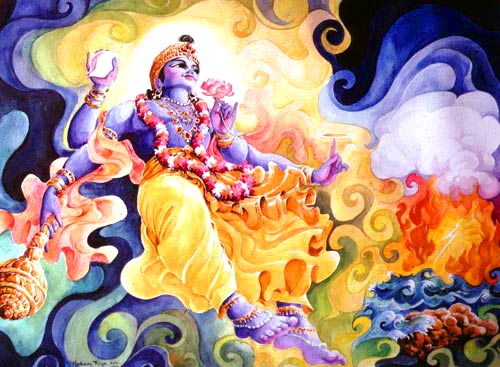
In the Causal Ocean, the Supreme Lord first separates the qualities of the material elements (ether, air, fire, water, and earth) by His glance. 
 Thanks: www.glimpseofkrishna.com.  Copyrighted image and caption reproduced with permission of the artist Smt. Madhavapriya Devi

The above creation process by Lord Vishnu is known as samaSTi sRSTi or "aggregate creation" in English. The samaSTi sRSTi process continues further until four-faced Brahma deva is created by the Supreme Lord Narayana from the Divine Lotus springing from His navel. After that, the Lord ordains Brahma to be the agent for the next stage in creation known as vyaSTi sRSTi or "individual creation". It is then that Lord Brahma, under the instructions of the Lord, proceeds to create other beings -- from devas, gandharvas, angels, elves, demons, men, animals, down to plants, and further down to simplest single-cell organisms.

We close the discussion of Lord Hari's relation to the cosmos and His creation, which we have been running for weeks, with the following excellent summary given by Sri Adi Shankaracharya in his introductory chapter to his commentary on the Bhagavad Gita:

"sa Adi-kartA nArAyaNAkhyo viSNUH... sa ca bhagavAn jnAna-aishvarya-shakti-bala-vIrya-tejobhiH sadA sampannas triguNAtmikAm vaiSNavIm svAm mAyAm mUla-prakRtim vashIkrtya, ajo-avyayo bhUtAnAm Ishvaro nitya-shuddha-buddha-mukta svabhAvaH"
 (Adi Sankara's Introduction 
to Bhagavad Gita)
Translation:

"Lord Vishnu (all-pervading), known as Narayana, is the primordial creator... The Lord, possessed of infinite knowledge, supremacy, power, strength, might, and vigor, controls the mAyA -- belonging to Him as Vishnu -- the primordial matter that is the first cause composed of the three natures (goodness, passion, and ignorance). The Lord is unborn and indestructible, and is by nature Eternal, Pure, Intelligent, and Free."

So far, we have explored the greatness and supremacy (paratva) of the Lord. Starting with the next post, we will start exploring his other great aspect, namely His compassion and accessibility (saulabhya) to all of His creatures.


Read more >>

Saturday, February 27, 2010

Shri Ramanujacharya: The marvelous miracles of Lord Madhava

Bhagavad Ramanujacharya (rAmAnuja-AcArya, 1017 A.D.-1137 A.D.) was the great proponent of Vishishtadvaita philosophy in the eleventh century. His service to the cause of Vedic sanAtana dharma (eternal religion of the Vedic scriptures) is one of the most unparalleled. He was also a great proponent of the Bhakti movement, and a social reformer par excellence. The tradition propounded by this great Acharya continues to live on today as the Srivaishnava (shrIvaiSNava) tradition, many of whose followers have their roots in South India. Let us prostrate and salute this great savior of the eternal Vedic religion with the following sloka (verse) composed by his direct disciple shrIvatsA"nka (in Tamil: kUrattAlvAn):
yo nityaM acyuta-padAmbuja-yugma-rukma
vyAmohatas tad itarANi tRNAya mene |
asmad guror bhagavato 'sya dayaika-sindhoH
rAmAnujasya caraNau sharaNam prapadye ||
English translation (thanks- http://sriramanujar.tripod.com/):  "I take refuge at the feet of our guru Bhagavaan Ramanuja, that ocean of mercy who, infatuated with the gold-like, lotus feet of the Lord, considered all else as mere blades of grass."

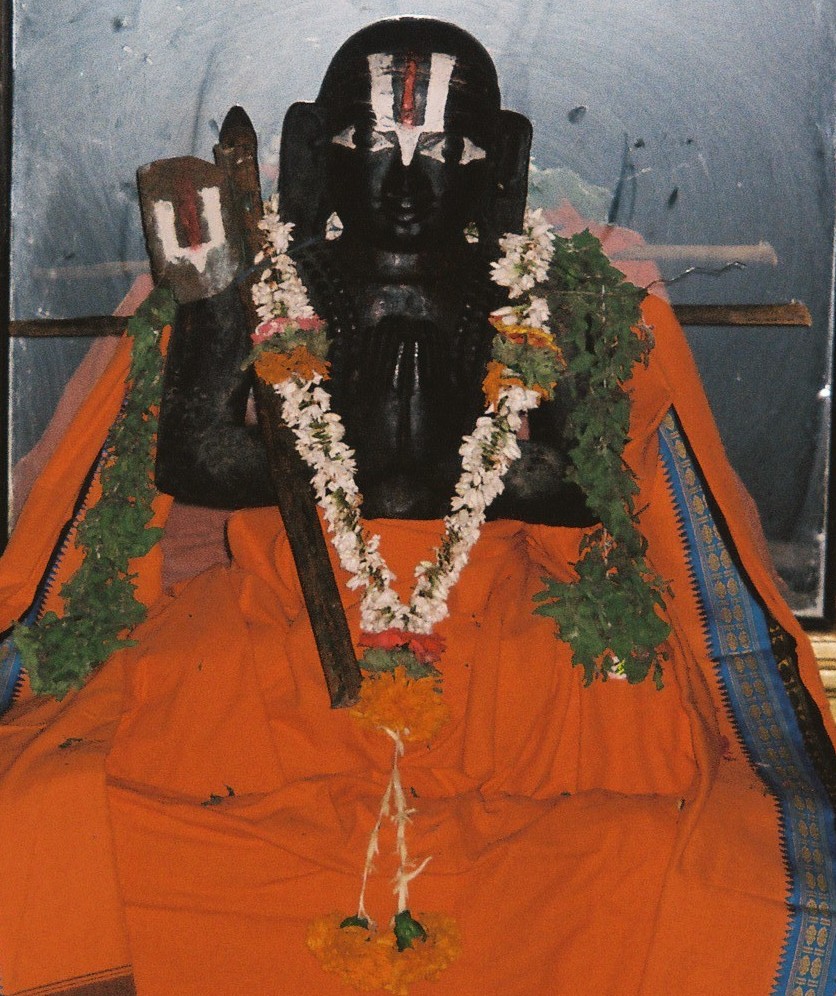
 Ramanujacharya's image in a Temple

Srimad Ramanujacharya has produced a remarkable commentary on the Bhagavad Gita for the benefit of this world. Before him, his grand-guru Yamunacharya (Sanskrit: yAmunAcArya, Tamil: ALavandAr) produced a terse metrical exposition on the essence of the Bhagavad Gita, dedicating one verse to each chapter of the Gita, known as gItArtha sa"ngraH. Sri Vedanta Desika Acharya (a.k.a ve"nkaTanAtha), who lived a little more than a century after Sri Ramanuja, has produced an elaborate sub-commentary known as tAtparya candrika, upholding the spiritual lineage.


We will now look at how the great acharya of the Srivaishnava tradition, Sri Ramanuja, has attested to the Lord's attributes of Transcendence (paratvam), Immanence (antaryAmitvam), and Creator-hood (jagatkAraNatvam) that we saw in the second and the third posts using Sri Ramanujacharya's commentary to the Bhagavad Gita. Thankfully, there is a good English translation of the same available on the web, and I am depending on the same [1]. Elaborating on verse 5 of Chapter 9 in the Gita, Sri Ramanujacharya writes:
"Lord Hari says: 'I do not support the beings as a jug or any kind of vessel supports the water contained in them. How then are the beings contained in Me? By My will. Behold My divine Yoga power, namely, My wonderful divine modes, unique to Me alone and having no comparison elsewhere'. What are these modes? 'I am the upholder of all beings and yet I am not in them --- My will sustains all beings.' The meaning is, 'I am the supporter of all beings, and yet I derive no help for Myself whatever from them. My will alone projects, sustains and controls all beings.' "
(Ramanuja's bhagavad-gItA-bhASya, 9.5)

The Acharya then says that the Lord is now going to give an illustration to show how all beings depend on His will for their being and acts. To the next verse in the Gita, Sri Ramanuja writes:
"The knowers of the Veda declare thus: 'The origin of clouds, the waters of the ocean remaining within bounds, the phases of the moon, the strong movements of the gale, the flash of lightning and the movements of the sun --- all these are marvelous manifestations of the power of Vishnu.' The meaning is that they are all the marvelous miracles which are unique to Vishnu."
(Ramanuja's bhagavad-gItA-bhASya, 9.6)

He proceeds thus in his commentary to the next verse:
"All the mobile and immobile entities enter into the primordial matter owned by Lord Krishna at the end of a cycle, namely at the end of Brahma's life in accordance with the Lord's will." 
(Ramanuja's bhagavad-gItA-bhASya, 9.7)

and then,

"Lord Hari, operating His Prakrti (primordial matter), with its wonderfully variegated potency, develops it eightfold and send forth this fourfold aggregate of beings: the devas, animals, men and inanimate things, time after time." 
(Ramanuja's bhagavad-gItA-bhASya, 9.8)

We turn to the natural question - How does our dear Lord Hari work these great miracles without physical effort? Before we investigate, let us learn a little bit more about Sri Ramanujacharya's glorious school.

The Divya Prabandha (divya prabandha) is an anthology of 4000 devotional hymns on Lord Hari in Tamil, written by South Indian saints known as Azhwars (pronounced as AlvArs in our transliteration scheme). Traditionally, the lifetimes of these saints are said to have spanned several thousand years BC till somewhere around the 7th/8th Centuries AD. The works of these twelve poets, rich in devotion, philosophical depth, and universal brotherhood concepts, are celebrated as "Dravida Vedam (drAviDa vedam)" by great scholars of Sri Ramanujacharya's tradition. This is indeed no exaggeration and hence is not to be taken lightly, as the Divya Prabandha works do indeed get into the depths of the philosophy and theology of the Vedas, albeit in poetic Tamil. However, unlike the Sanskrit Vedas, the Divya Prabandhas do not require very strict regulations on chanting, and in fact, can be learned by anyone irrespective of caste, creed, gender, etc.

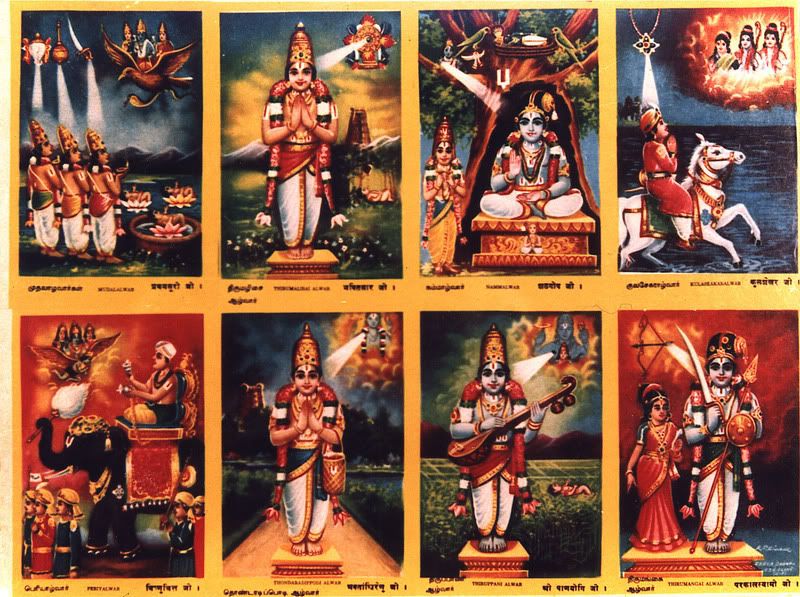
 An illustration of the lives of ten of the twelve Azhwars
The very first successors and disciples of Sri Ramanujacharya include the following Acharyas in the following order: (1) Sri Embar (a.k.a. Govinda Bhattar), the cousin of Sri Ramanujacharya; (2) Sri Parasara Bhattar, the disciple of Sri Embar and the son of Sri Kurattalvan; (3) Sri Nanjeeyar, disciple of Sri Bhattar, and (4) Sri Nampillai, disciple of Sri Nanjeeyar. Sri Nampillai wrote a commentary (known as nampiLLai iiDu in Tamil) on "Thiruvaimozhi (tiru-vAy-moli)", a work of Saint Nammalwar that belongs to the Divya Prabandha.

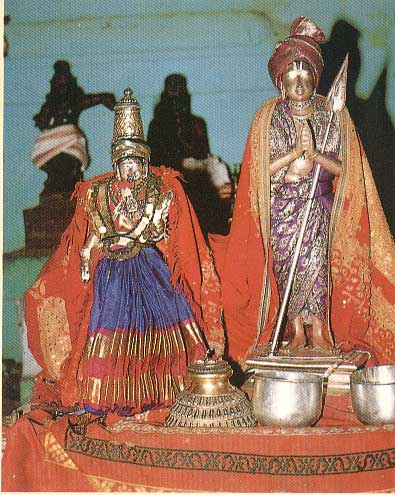
Acharya Nanjeeyar

Sri Nampillai's guru and Sri Parasara Bhattar's disciple, Sri Nanjeeyar, is initially said to have been an advaitin known as mAdhavAcArya, and eventually became the disciple of Sri Parasara Bhattar owing to the latter's brilliant exposition of "Thirunedum-Thandakam" (tiru-neDum-tANDakam) which also belongs to the 4000 Divya Prabandha and is composed by one of the AlvAr saints known as "Thirumangai Azhwar" (tiruma"ngai AlvAr). Thirunedum-Thandakam is a very beautiful composition that combines both "masculine" philosophical exposition and "feminine" devotional adoration in a balanced manner, in one single work. It combines both Vedantic descriptions of Lord Hari as well as the adoration of His form, as he resides in sacred shrines located all over India. In one verse, Saint Tirumangai Azhwar says:
indirarkkum piramaRkkum mudalvan-tannai
irunilamkAl tInIrviN pUtam aintAy,
cen-tiRatta tamizhOsai vaDa-soll-Agit
ticai nAnkumAyt ti"nkaL ~nAyiRAgi,
antarattil-tEvarkkum aRiyal AgA-
andaNanai, andaNar mATTu andi-vaitta-
mandirattai, mandirattAl maRavAdu enRum
vAzhutiyEl vAzhalAm maDa ne~njE!
(Thirunedum-Thandakam 4, Divya Prabandha 2055)

The above verse means: "Hey you foolish mind! If you want to live, live chanting the name of the Lord using the sacred eight-lettered mantra ending with 'namo nArAyaNAya' - the name of the Lord who is (1) The Lord to even great devatas such as the four-faced Brahma and Indra, (2) Who is the inner controller and inner-dweller (antaryAmin) for everything made of the five elements - earth, water, fire, wind, and space, (3) Who pervades all directions, the sun and the moon, (4) Who is very hard to comprehend even for the great devas from Brahma, Indra, etc. (5) Who is praised by the Sanskrit Upanishads and the Tamil Divya Prabandha, (5) Who is the Lord known through the wealth of the learned scholars - the Vedas." Thus, Thirumangai Azhwar is confirming the doctrine of the Lord Narayana being the antaryAmi or the inner-soul and inner-controller of everything in the universe, the Lord of all, and is known through the Vedas and Tamil Divya Prabandha texts.

Since the last post, we have discussed about the marvelous miracles of Lord Madhava (another name of the Supreme Lord Hari).With His unlimited unfathomable power, He creates, sustains, and dissolves the entire universe consisting of all beings. This shows that we are entirely dependent on Him and should thank Him for our existence, prosperity, and enjoyment in this life and the next.

(to be continued)

Bibliography

[1] English Translation of Ramanuja's Gita Bhashya, Dr. S. Sankaranarayanan. (Thanks: Gita Supersite 2.0)
[2] Sudarshanam Editor Sri Puttur Krishnaswami Iyengar's book, "Thirunedum-Thandaka Vivaranam" (திருநெடுந்தாண்டக விவரணம்), Thanks: http://www.maransdog.org

Read more >>

Friday, February 12, 2010

Lord Hari - the Creator, Sustainer, and Dissolver of the universe (Jagatkaranatvam)

In the last post, we started exploring how the great Acharyas of the Vedantic traditions have described the glory of the Supreme Lord Narayana. We saw that Adi Sankara and other Acharyas have described Him as both

  1. Transcendental i.e., beyond the realm of the material universe comprising the five elements.
  2. Immanent i.e., pervades in and controls all of His creation, as the inner-soul (antaryAmi), and hence is praised by the Vedas as the one who has all the three worlds as His body.
Let us now proceed to explain further the relationship between Lord Hari and his creation, the material universe. The Vedantic Bhakti traditions praise Him as the creator, sustainer, and dissolver of the entire universe. Let us examine this aspect, like we did last time, from the works and quotations of Acharyas.

The great philosopher of the dvaita tradition (dualistic school of Vedanta), Srimad Madhvacharya
(madhvAcArya, also known as Anandatiirtha or pUrNapraj~na AcArya) writes in his commentary to the Brahma Sutra (I-i-2) that Hari, described in the Veda as Brahman, is the first great cause of the world. Adi Sankara Bhagavatpada Acharya also says in the introductory chapter of the Gita Bhashya: "AdikartA nArAyaNAkhyo vishNuH", meaning "the first creator, Vishnu who is known as Narayana". For now, let us return to the nectar, in the form of the following scriptural quotations, offered by Srimad Madhvacharya in I-i-2 of Brahma Sutra Bhashya:
"The person - from whom the origin, subsistence, and dissolution, order, enlightenment, the cover of gloom, bondage, and liberation proceed - that Primordial Lord is none other than Lord Hari."
 (Skanda Purana)

"To Him is (our) obeisance made, in whose abdomen has grown up the lotus, the prop of the worlds, as referred to in the Sruti (Vedas): 'In the navel, of the Unborn' - unto Him the glorious Vishnu who is the cause of all the states of the world and the sole author of the universe"
(Skanda Purana)

"In the navel of the Unborn, that thing is set on which all the worlds stand."
(Rig Veda X-lxxxii-6)

"He who is our immediate progenitor and father, who is the maker and who is cognizant of all the worlds and the things abiding therein."
(Rig Veda X-lxxxii-3)


We next take a look at Shankara Bhagavatpada Acharya's elaborate commentary on the Brahma Sutras, where he quotes the following passages in his explanation to the sUtra II-i-1:

"Hear thence this short statement: The ancient Narayana is all this; he produces the creation at the due time, and at the time of re-absorption he consumes it again."
(Brahmanda Purana I.174)


"I am the origin and the place of reabsorption of the whole world."
(says Lord Narayana as Krishna in the Bhagavad Gita, VII.6)


"From Him spring all bodies; He is the primary cause, He is eternal, He is unchangeable"
 (Apastamba Dharma Sutra, I.8.23.2)


Kambar, respectfully and quite aptly known in Tamil Vaishnavite circles as "kambanATTAzhvAr", starts his bhakti-laden poetic work rAmAvatAram (now popularly known as Kamba Ramayanam), the medieval Tamil version of the original Ramayana written down by Valmiki, with the following prayer:


ulagam yAvaiyum tAm uLa Akkalum

nilai peRuttalum niikkalum nI"ngalA

alagu ilA viLaiyATTu uDaiyAr avar

talaivar annavarkkE caraN nA"ngaLE.
               
உலகம் யாவையும் தாம் உள ஆக்கலும்

நிலை பெறுத்தலும் நீக்கலும் நீங்கலா

அலகு இலா விளையாட்டு உடையார் அவர்

தலைவர் அன்னவர்க்கே சரண் நாங்களே.

The above prayer translates into English as: "We only surrender to that One who is the Lord (of all), and whose timeless, unlimited divine play involves the creation, sustenance, and dissolution of the entire universe."


For the pleasure of the readers, I have attempted to translate the following two similar invocatory verses found in the major works of two Acharyas of the Advaitic tradition:

(1)

Srimad Rama Tirtha, a medieval advaitic scholar, also began one of his philosophical works with a similar tribute to the Lord's avatAra as Rama:

praNamya rAmAbhidaM AtmadhIpadaM jagat prasUti-sthiti-samyamAyanam
 (Invocatory verse of upadesasAhasri padayojanikA)
My translation: "Salutations to the One known as Rama, who is the object of cognition for the soul, the abode of creation, sustenance, and dissolution of the universe."

(2)

Nyaya Makaranda, a work by a 11th/12th-century scholar named Anandabodha, commences with a similar prayer to the Lord:
yadbhAsA nikhilaM vibhAti  viSayo yo na svayaM jyotiSAM    |
yasya AhuH bhuvanodbhavasthitilayAn liilAmayAn sUrayaH     || 
yaM cAgocaramAmananti manasAM vAcAM ca vishvAtmane  |
tasmai shuddhasukhAdvitIyavapushe shashvannamo viSNave     ||
My translation: "That splendor by which the entire material universe, which by itself is devoid of any luminosity, shines - to the one whose oblations - who creates, sustains, and dissolves the universe sportingly - who is beyond the imagination of (even) the greatest of sages and devas - to that Vishnu who is the Supersoul for the entire universe - to that immaculate Vishnu who is without an equal to Him, we offer our salutations."

All of the above hymns have their basis in the vedic mantras such  as Taittiriya Upanishad, which says that Brahman creates, sustains, and dissolves this entire universe:
"Try to know that Brahman, from whom all beings are born ; in whom, they are sustained ; into whom they enter after dissolution."
(Taittiriya Upanishad III-i-1)

Thus, we should meditate on Lord Narayana, the Supreme Parabrahman as the one who creates, sustains, and dissolves the entire universe. Being totally self-contented and having no craving for any achievement, He performs this threefold action as a mere play of His (liilA in Sanskrit). Such is His might and power!

(to be continued)
Read more >>

Monday, February 1, 2010

Lord Narayana - The Supreme Transcendental and Immanent Lord (Paratvam, Antaryamitvam)

May we contemplate on the Supreme Lord Vasudeva so that we may begin this journey without hurdles.


As we promised in the last post, we are now ready to embark on a journey filled with enjoyment of the Lord's Glories. What I am going to write in this series is from whatever sense I have made, with my tiny brain, of this great tradition of Sanatana Dharma. I am just a novice in these matters. All the faults belong to me, and whatever little good comes out of my writing belongs to the great teachers and preachers who I have been fortunate enough to listen to.

Contemplation on the Lord's Divine Attributes and enjoying the same with fellow devotees is one of the best ways of serving Him, and gives immense bliss to the everyone. Two of His primary attributes are: His Lordliness and His Accesibility. Everyone is familiar with the Divine Names of the Supreme Lord of the Universe - the Vedas describe Him as Narayana, Vishnu, Vasudeva, and Hari. We all are familiar with His Divine Incarnations, Divine Form, and His Divine Sportive Acts. All these prove that He is quite accessible to His devotees. In order to understand and appreciate this fully, one first needs to understand His Lordliness in a proper manner.

Let us then investigate: How then, is He intimately related to His creation? How is He to be contemplated as the Supreme Lord? We shall now see how one of the great Acharyas of the sanatana dharma, Shri Adi Shankara Bhagavatpada answers this questions for us.

Bhagavatpada Acharya says in his benedictory verse for the introductory chapter to the Bhagavad Gita:


nArAyaNaH paro'vyaktAd aNDam avyakta-sambhavam |
aNDasyAntas tv ime lokAH sapta-dvIpA ca medinI ||

Narayana is beyond the seed of material existance. From this seed, the cosmos comes to exist.
Within the bounds of this cosmic egg are the seven worlds and this earth.

[nArAyaNaH - The Supreme Lord, paraH - is beyond, avyaktAd - the primordial matter known as avyakta or mUlaprakRti (avyakta literally means "the undeveloped"). aNDam - the cosmic egg from which the entire material creation emanates, avyakta-sambhavam - is born from this primordial nature, andasya - of this cosmic egg, antaH - within the bounds, tu - verily, ime lokAH - these worlds, sapta-dvIpA - the seven islands (according to puranic literature of Hinduism, the earthly regions in the universe are classified into seven islands), ca - and, medinI - the earth in which we live (belonging to the solar system of the Milky Way, according to modern science).]

In this introductory verse, the AcArya says that the Supreme Lord Narayana is beyond the material universe consisting of the primordial matter known as avyakta or mUla-prakRti, and that it is the mUla prakRti that gives rise to the Cosmic Egg, within the bounds of which material existence belonging to the category of effects is confined to. I will try to explain the concepts and terminology in creation are further in next paragraph, which may be skipped for those who are not curious about the same.

From puranic literature, it is well-known that the first thing in the realm of effects to be created by Lord Narayana is the avyakta principle. Subject to the Lord's control and as per His volition (sa"nkalpa), the avyakta principle then evolves into mahAn, then to aha"nkAra, followed by the five subtle elements or tanmAtras (sabda, sparsha, rUpa, rasa, and gandha - sound, touch, sight, taste, and smell respectively) and the five gross elements or pancabhUtas (akAsha, vAyu, agni, Apa, and pRthvI - ether, wind, fire, water, and earth). The Lord then performs pancIkaraNa, the process of intermixing the five gross elements for creation to proceed. From this, the principles of five sensory organs and five motor organs arise. The Lord then forms a body known as Hiranyagarbha, which is then taken up by one of the several baddha jIvas or souls that are to be born in the world of samsAra (existence in the realm of effects) selected by the Lord based on their karma or actions. This jIva taking up the name and form known as Hiranyagarbha is none but Lord Brahma, who then proceeds to create further bodies based on the Lord's instructions. The jIvas are then assigned to different bodies by the Supreme Lord Narayana himself, again based on their past karma.

From the above, it is clear that Supreme Lord Narayana is different from creation, which is in the category of effects (known in Sanskrit as kArya vastu). In other words, the Lord is the kAraNa (cause) and the entire universe is His kArya (effect). Shankaracharya has also explained elsewhere (BSBh. IV.iv.19-20) in his commentary to the Brahma Sutras, that the Highest Lord is not confined in any way to this mundane universe:

"Moreover, according to scripture, there is also an eternal form of the highest Lord which does not abide in effects", and

"Scripture and Smriti both declare that the highest light does not abide within effected things".

In the previous section in the Brahma Sutra Bhashya, he says that the liberated soul is reabsorbed into the world of Parabrahman Narayana, and also that it is the purest, Highest Place of Vishnu (paramapada, vaikuNTha, or brahmaloka), which is beyond the realm of effects.

Another aspect of His lordliness is that though He exists beyond the material universe, He simultaneously exists as the manifest universe in two ways: (1) with the entire cosmos is His body, and (2) as the inner-controller of every particle and every being/creature. This is part of his divine pastime, and in no way compromises his Lordliness.

Mundaka Upanishad 2-1-4 says:

The indwelling Self (Atman) of all is surely He of whom the heaven is the head, the moon and sun are the two eyes, the directions are the two ears, the revealed Vedas are the speech, air is the vital force, the whole Universe is the heart, and (It is He) from whose two feet emerged the earth.

In the penultimate sentence of the commentary to the same verse, Bhagavatpada Acharya says:

"this dEva, (known as) Vishnu or Ananta, is the first to have a body in this universe, and has all the three worlds as his body. He is the inner-dweller of all elements."


We will explore the concept of inner-dweller (antaryAmi/antarAtmA) in a little while. It is worth comparing the statement made by Bhagavatpada Acharya to that of his immediate disciple Totakacharya, who further adds the following lines in the last verse of his work shrutisArasamuddharaNa. This famous verse is now recited by everyone who chants Vishnu Sahasranama, in the dhyAnam section just before "shAntAkAram bhujaga shayanam", even though it does not belong to the original Sahasranama text in the Mahabharata:
bhUH pAdau yasya khaM codaramasuranilaH candra sUryau ca netre
karNAvAshAH shiro dyaurmukhamapi dahano yasya vAstavyamabdhiH |
antaHstaM yasya vishvam suranarakhagagobhogigandharvadaityaiH citraM
raMramyate tam tribhuvanavapuSaM viSNumIsham namAmi ||

(shrutisArasamuddharaNa, 179)
"I bow down to Lord Visnu (Vishnu), whose body comprises the three worlds. His feet are the earth, the cavity of His belly is space, his vital breath is the wind, and His eyes are the sun and the moon. His ears are the directions, His head is the heaven, His face is the fire, and His bladder is the ocean. Within Him this universe delights with its variety of gods (divinities created by Supreme Lord), human beings, birds, cows, snakes, celestial beings, and demons. To that Visnu I offer my salutations."


The above principle that the Lord has the material universe as (one of) His body (ies), or in other words, that He is the supersoul of all of His creation, is known as sharIra-sharIri bhAva in vishiSTAdvaita vedanta school of Bhagavad Ramanujacharya. In this school, the Lord is aptly called "ubhaya-vibhUti nAtha", meaning both the material universe (liilA vibhUti) and His own transcendental realm (nitya vibhUti a.k.a. vaikunTam or paramapadam) are His bodies.

The Vedas further affirm that the Lord entered into his creation as the inner-controller of all as he created. The name Vishnu is significant here since it means "all-pervading". Hence, Lord Narayana, having created the material universe, entered into each and every particle of creation as the antaryAmin, which menas inner-controller. This is confirmed by Shankaracharya in his commentary to the antaryAmi brAhmaNa section (Chapter 3, Section 7) of the Brihadaranyaka Upanishad, where he says:

"Such is the Lord, who controls from within, known as Narayana, who dwells from within the earth and controlls it, whom the earth-deity (prithvI) does not know. He is also the inner-controller of everyone, including you, myself, and all beings." (Brihadaranyaka Upanishad Bhashya 3.7.3)


Sureshvaracharya, another disciple of Adi Shankaracharya (as attested by himself in his works), confirms this further in the antaryAmi brAhmaNa section of his vArtika (metrical exposition) on Bhagavatpadacharya's commentary on the Brihadaranyaka Upanishad:

"Krishna Dwaipayana (Veda Vyasa), desiring welfare for all creatures, has repeated this time and again: Lord Narayana is beyond the avyakta, the cosmic egg is born from it. Salutations to Lord Narayana, the inner-dweller of all the dEvatas (divinities created by the Lord). It is to Him that the Narayana chants in the Vedas are addressed to." (Brihadaranyaka Bhashyavartika, Verses 39-42 expounding Section 3.7)

Anandagiri or Anandaj~nAna, a medieval advaitic scholar and a disciple of shuddhAnanda, wrote a Tiika (gloss) on the vArttika. To the above, he says: "The author of the vArtika says that the glory of the Supreme Lord Narayana is evident not only from the purANic and Agamic texts, but also in the Vedas." Anandagiri then quotes the first verse in the Narayana Sukta of Taittiriya Aranyaka (Section 10.11) to his support.

The Acharyas of yore have thus praised the Lord as the Supreme Transcendental (beyond material existence) as well as Immanent (who pervades and controls everything) God. Such is his greatness, as understood in the Vedantic texts.
 (to be continued)


Read more >>

Monday, January 25, 2010

Hello World...

Prostrations to Vashishta, Shakti, Parashara, Vyasa, and Shuka, and to Valmiki, Narada, and so many other great sages who, with their yogic effort, saw the Divine Light in All His Glory and gave Him to the  world out of pure compassion for all beings.

Glory be to all the Alvars who explained to us hidden meanings in the Divine Scriptures. Glory be to Kamban who gave the Nectar from Ayodhya in the banks of Cauvery. Glory be to the Haridasas, Tyagaraja, Annamacharya, Purandaradasa, Jayadeva, Mirabai, Tukaram, Namdev, Tulasidas, Kabir, and others who excelled in His Devotion.

I salute the parama bhAgavatas Paramashiva and Parvati, who constantly take delight in the Nectar of chanting the Glories of Lord Ramachandra.

Humble prostrations to the great Shankara Bhagavatpada, Bhagavad Ramanujacharya, Shri Madhvacharya, Shri Lokacharya and Shri Venkatanatharya, Vadirajatirtha, Sri Vallabha, Sri Nimbarka, and all the other Acharyas who dedicated themselves to the cause of the path of Vedic Dharma in the world.

I bow to Garuda, Shesha, and Vishvaksena who delight in attending to the Supreme Lord for ever.

Glory be to the Son of the Wind who likes being seated next to whoever reads as much as a line from the Magnificent Epic about the Scion of the Raghu dynasty.

I take refuge in the ocean of compassion, the Queen of the Waters, Lakshmi who dwells in the Srivatsa mark of the Divine Lord, so that I may deserve His Grace.

Let us adore Highest Light dwelling beyond the material universe - who is known in the Timeless Scriptures as Shriman Narayana and Vasudeva, who is the first to enter into the cosmos as the Lord of the Milky Ocean, dividing Himself into the First Four and many more, who sports with His creation as the son of Nanda, who dwells in the middle of the Solar Orb, golden-hued, with eyes like just-bloomed lotuses, residing in the cavity of the heart with a form as brilliant as a streak of lightning in amid dark-blue clouds, possessed of a thousand heads, hands, and feet, projecting Himself in every direction, who is reclining in the Islet surrounded by the Two Rivers and standing on top of the Hill of the Great Earth-bearing Serpant, who delights His devotees with His Magnificent Form, bearing the Divine Conch, Discus, Mace, and Lotus, wearing the Vaijayanti garland, the Kaustubha jewel, the Kasturi Tilaka mark on His forehead, bedecked in Yellow Garbs, with a Lotus springing from His navel that bears the grandsire of all beings. Wisdom, Strength, Lordship, Valor, Power, and Splendor belong to Him! Let us adore Him again, again, and again!!!


Dear Bhagavatas from all over the world,

Humble prostrations to all of you. This is my modest attempt at taking baby steps towards getting a glimpse of the glories of the Lord, as told in the writings of great compassionate Acharyas across all sampradayas.

I want to make this effort quite different. There are many blogs that discuss poetry-style verses (prabhanda) written by the Acharyas of yore. Online resources explaining word-to-word and inner meanings of the devotional outpourings of Tyagaraja, Dikshitar, Purandaradasa, Bhadrachala Ramdas, Annamacharya, Mirabhai, Tukaram, and others great composers are aplenty. What I would like to do here is to explore how various great commentators, starting from Adi Sankaracharya, have explained the glories of Hari in their elaborate commentaries otherwise dealing with serious polemical discussions.


Since I am familiar more with Advaitic writings due to my background, I will start with the great works of Adi Shankaracharya and his early and contemporary followers, sticking to bhakti-related discussions. Discussions will only be on Bhakti and Saguna Upasana alone. No way does this imply that I will not quote from other Dvaita/Vishishtadvaita schools of thought in future. From time to time, I may also post my own independent thoughts.

I want to keep this blog free of controversy, discussions on current affairs, sarcasm, politics, and bickering (ABSOLUTELY NO inter-sampradAya/inter-religious debates and controversies), and will myself try to stay away from writing anything insulting to any individual/group of people even though it might be the truth.


This is just a place for sharing the nectar of pure Haribhakti - appealing to both the heart and the intellect. Your inputs and suggestions will be greatly appreciated.

Humbly yours,

Prahladadasa

Read more >>
 
Web Analytics