Showing posts with label Bhattathiri. Show all posts

Wednesday, June 16, 2010

The Unassailable Glory of Lord Narayana: Part 4 -- More from the Narayaneeyam


Little Krishna of Guruvayur
The Keralite scholar Sri Narayana Bhatta of the 16th/17th Century, in his devotion-laden work Narayaneeyam, conveys more about the nature of the highest Paramatma, Sriman Narayana, in the last two verses of the first decad. I will try to summarize the meanings and provide English translations of key portions from the old commentary by Desa Mangala Variar.

Verse 1-9: 
kAruNyAt-kAmam-anyaM dadati khalu pare svaatmadastvaM visheSAd-
aishvaryAdi-Ishate(a)nye jagati parajane svAtmano(a)pi-Ishvarastvam |
tvaiyyuccairAramanti pratipadamadhure chetanAH sphItabhAgyAstvaM
chAtmArAma evetyatulaguNagaNa-AdhAra shaure namaste ||
[Oh Shauri! Thou art omnipotent and the embodiment of all virtue and hence Thou hath the unique power to grant supreme bliss to Thy devotees instead of only desired objects, in contrast to other deva-s. Those who realize this truth are blessed at every step they take towards Thee. Oh Lord Krishna! I pray to Thee for such a blessing.]

Commentary:
kAruNyAditi | pare brahmAdayaH | kAruNyAd bhaktavatsalatayA | anyaM mokSavyatiriktaM kAmaM varaM dadAti | tvaM visheSAd vishiSTAd brahmAdyatishayitAt kAruNyAt svAtmadaH svAtmAnaM svarUpaM mokSamapi dadAsItyarthaH | ki~nca, anye brahmAdayaH aishvaryAd jagati asmin prapa~nce parajane svavyatirikteSu sthiracareSvena Ishate nigrahItumanugrahItuM vA shaktA bhavanti | tvaM tu svAtmanaH svarUpasya brahmaNo(a)pIshvaraH ... he shaure! shrI-kRSNa ! te tubhyaM namaH namaskaromi-ityarthaH ||
[O Shauri! O Krishna! I offer my salutations to Thee! Brahma and others, out of compassion for their devotees, grant to them all sorts of blessings that they wish for, other than final liberation. Since you are special -- being superior to deva-s such as Brahma, being extremely merciful -- being such, you grant Yourself -- Your own Supreme Station that is free from the cycle of births and deaths -- to Thy devotees. Moreover, Brahma and others are only lords of this visible universe consisting of plants, animals, and human beings. You however, by nature, are the Lord of even Brahma and others. It is only Thyself that is equal to Thee.]

This is another reason why the greatness of Lord Hari surpasses other devas, as He alone is the one who grants liberation, while the other deva-s are only able to grant material benefits. The ancient Tamil work paripADal says thus about Vishnu:
"Unless the One who wears a garland of fragrant Tulsi leaves (Vishnu) grants libeation, it is extremely hard to reach the same" (நாறு இணர்த் துழாயோன் நல்கின் அல்லதை ஏறுதல் எளிதோ வீறு பெறு துறக்கம்).

Lord Vishnu is ever consorted by Lakshmi
Verse 1-10:
aishvaryaM sha^nkarAdi-IshvaraviniyamanaM vishvatejoharANAM
tejassanhAri vIryaM vimalamapi yasho nispRhaish copagItam |
angAsa^ngA sadA shrIrakhilavidasi na kvApi te sa^ngavArtA
tadvAtAgAravAsin murahara bhagavacchabda-mukhya-Ashrayo(a)si ||
[Oh Lord Murari ! Ordainer of even great lords such as Shiva and others! Who excels all in splendor! Your famous pastimes are sought after and sung about even by great yogis. Lakshmi, who is the goddess of all riches, likes to reside in your chest always. Thou art the embodiment of all the six divine qualities of greatness viz., Sri (prosperity), Jnana (knowledge), Vairagya (detachment), Aishwarya (sovereignty), Veerya (valour) and Yashas (fame) and hence the word Bhagavath is the most befitting attribution to Thee, who art the resident of the Guruvayur temple.]

Commentary:
aishvaryamiti | he vAtAgAravAsin! murahara! te tvaishvaryaM sha^nkarAdInAmIshvarANAM viniyamanaM tattadadhikArapravartakam | ki^nca, tava vIryaM vishveSAM sarveSAM tejaH parAkramaM harantIti vishvatejoharAH shrIsha^nkarAdayaH, teSAM tejaH prabhAvaM saMhartuM shIlamasyeti tathA | vakSyati ca 'muhustAvacchakraM' (10.82. 9) ityAdi | tava yasho(a)pi vimalaM pApashodhakam | nispRhair-muktair-apyupagItaM, tvaccaritAkRSTacetastayA taishvarNitamityarthaH | shrIshca sadA a^ngAsa^ngA tava vakSaHsthalamAshrityaivAste | akhilavidasIti | akhilaM svAtmAnaM svamAyAM tatkAryaM ca vittItyakhilavidasi tvaM | anye tvAM tattvato na jAnantIti bhAvaH | kvApi viSaye | te sa^ngasya vArtApi kathApi na shrUyata ityarthaH | tat tasmAt, yasmAdaishvaryayashaH shrIvIryaj~nAnasa^ngatAnAM bhagavacchabdavAcyAnAM tvayyatishayena vRttistasmAdityarthaH | bhagavacchabdasya mukhyAshrayo vAcyArtho bhavasi, anyeSu bhagavacchabdasya lAkSaNikI vRttirityarthaH ||
[O Divine Resident of Guruvayur! Slayer of the demon Mura! Thy sovereignty includes being the Lord of, the controller of, the one who gives orders to -- even Shankara (Shiva) and others! Moreover, Thy prowess is better than those of Shiva who is of very great potence himself. It is also said by Sri Narayana Bhattathiri elsewhere that the Lord's prowess is better than those of Brahma, Siva, Indra, Varuna, and Yama (82-9).

Your glory is also blemishless -- listening to the same removes the listener's sins. Even those who have conquered their senses, and those who have attained liberation sing Thy glory, having all their senses irresistably drawn towards hearing Thy Divine Pastimes.

Even Lakshmi (Shri), who is the Goddess of all riches likes to reside in your chest for ever, not wanting to be separate from Thou even for a moment. You are the one who is possessed of all knowledge of the entire cosmos and its beings. Others do not know these fully.

From this, it is clear that since Thou alone art the One possessed of unlimited Sovereignty, Glory, Wealth, Prowess, and Wisdom, the term 'Bhagavan' denotes Thee primarily. Thou alone naturally possess the title of 'Bhagavan' by Thy own nature. With regard to the others, it is only an acquired title.]

REFERENCES:

[1] Complete Narayaneeyam online
[2] Narayaneeyam of Narayana Bhatta, with the commentary, Bhaktapriya, of Desamangala Varya. Edited by T. Ganapati Sastri, Travancore Government Press, 1912


Read more >>

Monday, June 7, 2010

The Unassailable Glory of Lord Narayana: Part 3 -- From the Narayaneeyam


In a previous post, we have learned a little bit about the Narayaneeyam, a devotional work by Sri Narayana Bhattathiri, a 16th Century Keralite scholar. The following verses firmly establish Sri Bhattathiri's conviction that Lord Narayana is the Supreme One:

Narayaneeyam, 82-9:
muhustAvacchakraM varuNamajayo nandaharaNe
yamaM bAlAnItau davadahana pAne(a)nila sakham |
vidhiM vatsasteye girishamiha bANasya samare
vibho vishvotkarSI tadayamavatAro jayati te ||
[Thy repeated victories over Indra, over Varuna (when Nandagopa was kidnapped by him while bathing), over Yama (by reclaiming from him the son of Thy preceptor, Sandeepani), over Agni (by Thy devouring the wild forest fire), over Brahma (when he stole the calves) and over Siva here in the battle with Bana, O Lord, amply prove that this avatAra of Thine as Krishna surpasses all other avatAra-s and is most superior.]

Narayaneeyam, 90-1:
vRka bhRgu muni mohinyambarIShaadi vRtteSu
ayi tava hi mahattvaM sarvasharvAdi jaitram |
sthitamiha paramAtman niSkalArvAgabhinnaM
kimapi tadavabhAtaM taddhi rUpaM tavaiva ||
[O Supreme Being ! From the episodes of Vrikasura, Sage Bhrigu, the Mohini incarnation, King Ambarisha and others, it is here firmly established that Thy glory is superior to, and transcends, that of Siva and all other deva-s. Thou art none other than the Nishkala Supreme Brahman, as also all the Sakala forms, and art that Indefinable One who doth shine as the essence of all.]

Sri Madhusudana Saraswati expounds on this further in his Gudhartha Dipika, in his commentary to verse 7-24 of the Bhagavad Gita:
"nanu janma-kAle(a)pi sarva-yogi-dhyeyaM shrIvaikuṇṭhasthaM-aishvarameva rUpaM-AvirbhAvitavati saMprati ca shrIvatsa-kaustubha-vanamAlA-kirITa-kuNDalAdi-divya-upakaraNashAlini kambu-kamala-kaumodakI-cakra-varadhAri-caturbhuje shrImad-vainateyavAhane nikhila-sura-loka-saMpAdita-rAjarAjeshvara-abhiSekAdi-mahAvaibhave sarva-surAsura-jetari vividha-divyaliilA-vilAsashIle sarva-avatArashiromaNau sAkSAd-vaikuNTha-nAyake nikhilaloka-duHkha-nistArAya bhuvamavatIrNe viri~nci-prapa~nca-asaMbhavi-niratishaya-saundaryasAra-sarvasvamUrtau bAlaliilA-vimohita-vidhAtari taraNi-kiraNojjvalavyapItAmbare nirupamashyAmasundare karadIkRta-pArijAtArtha-parAjita-purandare bANayuddha-vijita-shashA^nkashekhare samasta-surAsura-vijayi-naraka-prabhRti-mahAdaiteya-prakara-prANa-paryanta-sarva-svahAriNi shrIdAmAdi-parama-ra^nka-mahAvaibhava-kAriNi SoDasha-sahasra-divya-rUpadhAriNya-parimeya-guNagarimaNi mahAmahimani nArada-mArkraNDeyAdi-mahAmunigaNastute tvayi katham-avivekino(a)pi manuSya-buddhir-jIvabuddhir-veti?"

[Well, with regard to you who even at the time of Your birth had manifested that Divine Form itself which exists in the holy Vaikuntha, and which is an object of meditation for the yogis, and who at present possesses charming adorations such as the Srivatsa, the Kaustubha, a garland of flowers etc. reaching up to the feet, a crown, earrings, etc., who have four hands holding a conch, a lotus, the (mace called) Kaumodaki and an excellent discus, who have the graceful Vainateya (Garuda) as your carrier, who are possessed of the great glory of having been coronated as the Supreme King of kings by the entire heavenly world, who have conquered all the devas (celestial beings) and asuras (demons), who like to remain engaged in various divine sports, who are the crest-jewel of all avatAra-s, who are none other than the Lord of Vaikuntha, who have descended on the earth to help all people get rid of their sorrows, who are the embodiment of all that constitutes the essence of the unsurpassable beauty that is not to be found in the creation of Brahma, who outwitted Brahma by the divine sport of your childhood, who wear a dazzling yellow garment as bright as the rays of the sun, who are incomparably dark and charming, who defeated Indra to make him offer the Parijata tree as a tribute, who defeated Siva while fighting Bana, who took away everything including the lives of mighty demons such as Naraka and others who had defeated all the devas and asuras, who made an extremely poor person like Sudama greatly opulent, who had assumed sixteen thousand divine forms, who are endowed with virtues the excellence of which is immeasurable, who are possessed of great fame, and who are prayed to by the great sages such as Narada, Markandeya and others, how can even the non-discriminating persons have the idea that You are a human being or a jiva?]


In another place, Sri Narayana Bhattathiri cites the incident where the devas and asuras were churning the ocean seeking the amRta (elixir), with the aid of none other than Lord Vishnu. Lakshmi, the eternal companion of the Lord in His Vaikuntha abode, manifested herself as one of the by-products during the course of churning. She examined all the onlookers one by one, and finally chose our Lord Sri Hari as her husband. Sri Bhattathiri says thus:

Narayaneeyam, 28-7:
girishadruhiNAdi sarvadevAn guNabhAjo(a)pyavimukta doSaleshAn |
avamRshya sadaiva sarvaramye nihitaa tvayyanayA(a)pi divyamAlA ||
[Knowing that all the others such as Brahma and Siva, though virtuous were still not blemishless, she offered the divine garland to Thee, who art the eternal embodiment of perfection and charm.]

It is worth noting here that in Sri Vishnu Sahasranama Bhashya, Sri Sankara explains the name "shrIpatiH" as follows: "amRtamathane sarvAn sura-asurAdIn vihAya shrIrenaM patitvena varayAmAseti shrIpatiH" [He who was chosen by Laksmi after she rejected all the other devas and asuras during the churning of the cosmic ocean for nectar].

Sri Bhattathiri further confirms this doctrine in the following verse belonging to the section describing the deliverence of the elephant Gajendra:

Narayaneeyam, 26-8:
shrRtvaa stotraM nirguNasthaM samastaM brahmeshAdyairnAhamityaprayAte |
sarvAtmA tvaM bhUri kAruNya vegAt tArkshyArUDhaH prekSitobhUH purastAt ||
[On hearing the entire hymn, describing the impersonal nature of the Universal Being, Brahma, Siva and others, knowing that it did not refer to them, did not come there. But Thou, who art all knowing, manifested before him, seated on Garuda, impelled by Thy flow of mercy.]

Hence, our Acharyas have repeatedly emphasized the point that the glory of Lord Narayana surpasses that of the other devas such as Brahma, Siva, Indra, and others.


Read more >>

Tuesday, March 9, 2010

The Lord of Guruvayur, Narayaneeyam, and Cosmic Manifestation

Guruvayur is a sacred pilgrimage center in the state of Kerala in South India. There is a very famous temple dedicated to Lord Krishna here. According to the traditional history of this temple, this is the spot where Lord Siva is said to have instructed the Rudra Gita, a song that glorifies Sriman Narayana -- the Lord of even great Lords like Brahma, Siva, and Indra. The deity of this temple is said to have been in possession of Lord Krishna during His stay in Dwaraka, which he then gave to a disciple named Uddhava before voluntarily disappearing from this world after fulfilling the mission of His avatar. But since a deluge followed the ascent of Lord Krishna back to His spiritual realm, the idol had to be eventually salvaged by Brihaspati (bRhaspati, also known as guru),  the devata in charge of the planet Jupiter, with the help of his disciple Vayu (vAyu) who is in charge of the one of the elements of nature- the wind. Ultimately, they were guided by Lord Siva, and hence it was installed at the present location - Guruvayur. The name Guruvayur comes from the combination guru + vAyu (the devatas who installed the deity of Lord Krishna) and the word oor which means "place" in the South Indian languages Malayalam and Tamil. Here, the deity form of Lord Krishna is known affectionately as guruvAyUrappan - the Lord of Guruvayur.


Little Lord Krishna, the deity of Guruvayur

Bhagavata  Purana (srImad bhAgavata purANa, srImad bhAgavatam, or simply bhAgavatam) is a divine revelation compiled by Sri Veda Vyasa Maharishi, consisting of 18,000 verses. The book extols devotion to Supreme Lord Hari, and is praised by both scholars and the lay as "the essence of all Vedic literature". Sri Narayana Bhattathiri (nArAyaNa bhaTTatiri) was a great devotee of Lord Krishna who belonged to the 16th Century. He identified with the Advaita school of Vedanta. When he was once inflicted with a severe illness Sri Bhattathiri prayed to the Lord of Guruvayur. The devotional outpourings came in the form of a 1000-verse summary of the contents of the Bhagavata Purana, known as "Narayaneeyam" (nArAyaNIyam).


Lord Krishna's abode at Guruvayur, Kerala

In the last several posts, we have been dealing with the subject of the threefold acts of creation, sustenance, and destruction by Lord Narayana. We shall now wind up this discussion with relevant verses from Narayaneeyam which summarize the Lord's threefold activity. Let us now look at the following slokas-

vyakta-avyaktam-idaM na ki~ncit-abhavat prAk prAkRta-prakSaye
        mAyAyAM guNa-sAmya-ruddha-vikRtau tvayi-AgatAyAM layam     |
no mRtyuH-ca tat-AmRtaM ca sama-bhUnnohno na rAtreH sthitiH
        tatra-ekaH-tvam-ashiSyathAH kila para-Ananda-prakAsha-AtmanA    ||
(Narayaneeyam, 5:1)

Translation:

"When the earlier great deluge occurred, the world was nonexistent and mAyA (the primordial seed of material existence) was merged in Thy (Lord Krishna's) Supreme Form indiscernible in any way. There was no life or death and no day or night. Only Thy brilliant form of Supreme Bliss existed."

In a previous post, we saw that, according to Vedic Sanatana Dharma, the universe is created, sustained, and re-absorbed by Lord Hari. This entire process is repeated in a cyclical manner. At the end of each cycle, there is a period known as mahApraLaya ("great deluge") when the entire material universe exists without name and form in a subtle, indescribable manner. In another post, we saw that this indescribable matter is described as "avyakta" in the Vedic scriptures. The Narayaneeyam verse that we just saw above confirms these scriptural statements. It describes the dissolved state of the material universe during this great deluge, before the universe was created by Lord Hari as it exists today.

Lord Manu, the author of Manu-Smriti also confirms that the material universe existed in a very subtle, indiscernible form during the cosmic night:
This (universe) existed in the shape of Darkness, unperceived, destitute of distinctive marks, unattainable by reasoning, unknowable, wholly immersed, as it were, in deep sleep.
(Manu Smriti, I.5)

Manu Bhagavan then proceeds to describe the brilliance of the Lord as He shone during the great deluge, in the manner agreed by the above Narayaneeyam verse:
He who can be perceived by the internal organ (alone), who is subtle, indiscernible, and eternal, who contains all created beings and is inconceivable, shone forth of his own (will).
(Manu Smriti, I.7)

One may ask thus-- "When it is said in scripture that 'the universe did not exist', does it mean that the Lord created everything out of nothing"? Not at all, says Sri Narayana Bhattathiri in the next verse:

kAlaH karma guNAH-ca jIvanivahA vishvaM ca  kArye vibho!
         cilliilAratimeyuSi tvayi tadA nirliinatAmAyayuH                                    |
teSAM na-eva vadanti-asatvamayi bhOH-shakti-AtmanA 
         no cet kiM gagana-prasUna-sadRshAM bhUyo bhavet-sambhavaH        ||
(Narayaneeyam, 5:2)
Translation:

"Oh Lord ! At that point of time everything in the Universe viz. Kala (time), Karma (action), Guna (mood), the Jivathmas (individual souls ) all lay merged in Thy supreme form. But they were never nonexistent or imaginary like flowers of the sky. They were ensconced in Thee and re-emerged after the deluge."

For how long did this state last, and how did creation begin? Narayana Bhattathiri answers this for us thus:

evam-ca dvi-parArdha-kAla-vigatAvIkSAM sisRkSAtmikAM
        bibhrANe tvayi cukSubhe tribhuvanIbhAvAya mAyA svayam            |
mAyAtaH khalu kAla-shaktiH-akhila-adRSTaM svabhAvo-api ca
        prAdurbhUya guNAn vikAsya vidadhuH-tasyAH sahAya-kriyAm     ||
(Narayaneeyam, 5:3)
Translation:

This state lasted for one hundred Brahma-years. Then with the desire for creation Thou activated the mAyA (primordial matter) with a single glance and the evolution of the three worlds began. From the mAyA came "kAla-shakti", the hidden resultant karmA (the balance of good and bad deeds committed in the past) of individual souls and their svabhAvas (inborn dispositions). From these evolved the guNas (qualities/natures) and helped mAyA to manifest as the universe.

Hence, Sri Bhattathiri says that all the cosmic forces that maintain orderliness and justice in the universe were activated by Lord Vishnu by a single glance of his eyes. One hundred Brahma-years is the lifetime of one Brahma (four-faced deva), and is approximately equal to 310 Trillion human years. In the past, innumerable Brahmas have lived through their full tenures, and more will continue to do so. Fifty Brahma-years is known as a parArdha in Vedic cosmology. In other words, after the lifetime of every Brahma, the universe enters into another cosmic deluge lasting for 100 Brahma-years, but actually there is no Brahma during this time.

The next verse (5:4) of the Narayaneeyam describes Supreme Lord Narayana as the witness to the entire process of creation, and that he is not enveloped by mAyA, the cause of delusion and suffering in the material universe. Everything in this universe is ordained by the Lord, according to the principles of dharma (justice) and karma (past good/bad deeds).

Under the Lord's ordinance, primordial matter then evolved into the principle known as mahAn, then into aha"nkAra (ego-principle). The ego-principle further got divided into the three modes: sAttvika (goodness), rAjasa (passion), and tAmasa (ignorance). From the tAmasa ego-principle, the principles behind the five modes of perception (tanmAtra-s) -- sabda, sparsha, rUpa, rasa, and gandha (sound, touch, sight, taste, and smell), as well as the five material elements -- space, wind, fire, water, and earth, came into existance one after the other in an interleaved manner. This creation is described in the following Narayaneeyam verse:

shabdAd vyoma tataH sasarjitha vibho! sparshaM tato mArutam
        tasmAd rUpamato maho-athaH-ca rasaM toyaM ca gandhaM mahIm        |
evam mAdhava! pUrva-pUrva-kalanAd-AdyAdadharmAnvitaM
        bhUtagrAmamimaM tvayeva bhagavan! prAkAshayaH-tAmasAt               ||
(Narayaneeyam, 5:8)
Translation:

"From sound (sabda) Thou created the space (AkAsha). From that came touch (sparsha); from which air (vAyu) was born; from that came the visual form (rUpa); from visual form came fire (agni); from fire came taste (rasa); then came water (Apa) from taste; from water came smell (gandha) and from smell earth (prithvI) was formed. Thus Oh Lord Madhava ! Thou caused the group of elements to manifest from tamasa egoism with each one of them having the qualities of those created prior to them and hence all of them being interconnected."


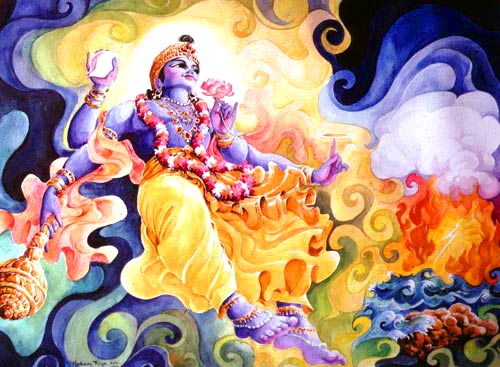
In the Causal Ocean, the Supreme Lord first separates the qualities of the material elements (ether, air, fire, water, and earth) by His glance. 
 Thanks: www.glimpseofkrishna.com.  Copyrighted image and caption reproduced with permission of the artist Smt. Madhavapriya Devi

The above creation process by Lord Vishnu is known as samaSTi sRSTi or "aggregate creation" in English. The samaSTi sRSTi process continues further until four-faced Brahma deva is created by the Supreme Lord Narayana from the Divine Lotus springing from His navel. After that, the Lord ordains Brahma to be the agent for the next stage in creation known as vyaSTi sRSTi or "individual creation". It is then that Lord Brahma, under the instructions of the Lord, proceeds to create other beings -- from devas, gandharvas, angels, elves, demons, men, animals, down to plants, and further down to simplest single-cell organisms.

We close the discussion of Lord Hari's relation to the cosmos and His creation, which we have been running for weeks, with the following excellent summary given by Sri Adi Shankaracharya in his introductory chapter to his commentary on the Bhagavad Gita:

"sa Adi-kartA nArAyaNAkhyo viSNUH... sa ca bhagavAn jnAna-aishvarya-shakti-bala-vIrya-tejobhiH sadA sampannas triguNAtmikAm vaiSNavIm svAm mAyAm mUla-prakRtim vashIkrtya, ajo-avyayo bhUtAnAm Ishvaro nitya-shuddha-buddha-mukta svabhAvaH"
 (Adi Sankara's Introduction 
to Bhagavad Gita)
Translation:

"Lord Vishnu (all-pervading), known as Narayana, is the primordial creator... The Lord, possessed of infinite knowledge, supremacy, power, strength, might, and vigor, controls the mAyA -- belonging to Him as Vishnu -- the primordial matter that is the first cause composed of the three natures (goodness, passion, and ignorance). The Lord is unborn and indestructible, and is by nature Eternal, Pure, Intelligent, and Free."

So far, we have explored the greatness and supremacy (paratva) of the Lord. Starting with the next post, we will start exploring his other great aspect, namely His compassion and accessibility (saulabhya) to all of His creatures.


Read more >>
 
Web Analytics