Showing posts with label Bhagavad Gita. Show all posts

Sunday, June 6, 2010

The Unassailable Glory of Lord Narayana -- Part 2: Unequalled and Unsurpassed Supremacy

Long before the advent of great Acharyas, ancient India had a glorious time during which Vedic knowledge had spread far and wide, owing to the unparalleled efforts of great sages such as Valmiki, Vasishta, Shakti, Parashara, Vyasa, and Shuka who propounded that knowledge among the masses through the Smritis, Itihasas, and Puranas. Their reach extended from East to West, and from North to South, all over the great nation of India. No wonder then that the Vedic conception of Lord Sri Hari as the "Supreme revealed in the Vedas" (வேத முதல்வன்) found its way into secular Tamil literature of the ancient times. The following invocatory verse of the literary work "naRRiNai" (நற்றிணை) bears testimony to this:


மாநிலஞ் சேவடி யாகத் தூநீர்
வளைநரல் பெளவம் உடுக்கை யாக 
விசும்புமெய் யாகத் திசைகை யாகப்  
பசுங்கதிர் மதியமொடு சுடர்கண் ணாக 
இயன்ற எல்லாம் பயின்றகத் தடக்கிய 
வேத முதல்வன் என்ப  
தீதற விளங்கிய திகிரி யோனே

Translation: "Having the earth for His tender reddish feet, wearing as cloth the oceans that contain pure water and resonating conch-shells, having the space for His body, having the directions as His hands, having the sun and the moon for His eyes, enveloping everything as His very body, He -- the One who bears the discus (Lord Vishnu) is praised as the foremost of all divinities in the Vedas."


Clearly, the author of the invocatory verse in naRRiNai is familiar with Vedic concepts, as he praises Lord Vishnu, following the manner of Mundaka-Upanishad, Purusha-Suktam, Narayana-Suktam, etc. (See this post). More such references to the Lord Vishnu as the "essence of the Vedas" are available in the work called "paripADal".


In the last post, we saw that Acharyas such as Sri Sankara clearly expounded this ancient Vedic wisdom alone, and did not deliberately invent anything on their own.


We now continue our discussion of the supreme glory of Lord Narayana as explained by our Acharyas. We explain the verses where our Acharyas have shown that the glory of Lord Narayana cannot be compared with those of the other devas, and that He is the one who rules all of them.

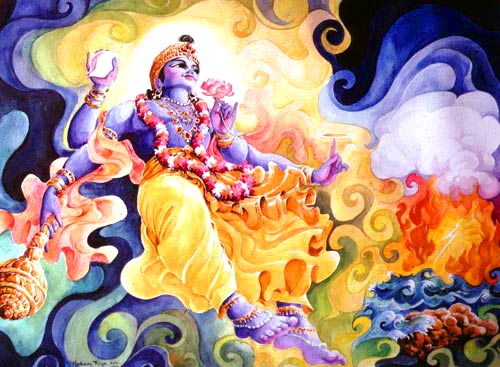
 The devas, headed by Lord Brahma revere Lord Narayana
Thanks: www.glimpseofkrishna.com.  Copyrighted image and caption reproduced with permission of the artist Smt. Madhavapriya Devi

'None is equal or greater to Lord Narayana': 

When Lord Krishna expounded to Arjuna the Vedic philosophy by revealing the Bhagavad Gita, He showed His Supreme Universal Form to Arjuna. Awed at that stunning magnified form, Arjuna praised Krishna thus, in the following Bhagavad Gita verse. Let us read the a part of one such verse (11.43) and then Sri Sankara's and Sri Anandagiri's explanations to the same.
na tvat samo(a)sti, abhi adhika kuto-anyo loka-trayo-api, apratima-prabhAva?
(Bhagavad Gita, 11.43)
[There is none who is equal to you, and when that is the case, how even can there be any who is superior to You in any of three worlds, Oh Lord, who is of unrivaled power?]

 Sri Sankara's explanation reflects the Acharya's opinion that the above mode of praise is not at all exaggerated. The Bhagavatpada-Acharya explains thus: "na hi IshvaradvayaM saMbhavati, anekeshvaratve vyavahAra-anupatteH" [Translation: For there cannot be two Supreme Gods, if so, the world as it exists now will not be able to function properly]. 

Sri Anandagiri confirms this further at the same place:  "IshvarAntaraM tulyaM bhavishyati-ityAsha^nkyAha -- 'na hi' iti | Ishvarabhede pratyekaM svAtantryAt-tadaikamatye hetvabhAvAt-nAnAmatitve ca ekasya sisRkSAyAM anyasya saMjihIRSAMsa-bhavAt vyavahAralopada-yuktaM-IshvaranAnAtvaM-ityarthaH" [Translation: The following presents itself as a doubt: can there ever be two Supreme Gods? The Acharya answers: Surely no. If there be several independent Supreme Gods, then their decisions will be independent, as there is no guarantee that they will be of one mind. The effort of one Supreme God in one direction will be neutralized by the effort of the other in the opposite direction. Then the world could not exist as it does now.]

'Lord Vishnu, the ruler of all other deva-s':

Commenting on Gita verse 10.2, Sri Sankara explains:
na me viduH na jAnanti suragaNAH brahmAdayaH | kiM te na viduH? mama prabhavaM prabhAvaM prabhushakti-atishayam, athavA prabhavaM prabhavanaM utpattiM | na-api mahaRSayaH bhRgvAdayaH viduH | kasmAt te na viduriti-ucyate -- aham AdiH kAraNaM hi yasmAt devAnAm mahaRSINAM ca sarvashaH sarvaprakAraiH
["(Lord Krishna says) 'neither the devas -- Brahma and others-- know; -what do they not know? My majesty, abundance of lordly power-or, derived in the sense of 'coming into being', it means origin. Nor even the great sages, Bhrgu, Marici, Atri, Pulastya, Pulaha, Kratu and Vasistha. This is because I am the Supreme Primordial Cause of all, including the devas and the sages.'"]
This is re-emphasized by the Acharya in his commentary to Gita verse 10.12 (Arjuna's words):
paraM brahma paramAtmA paraM dhAma paraM tejaH pavitraM pAvanaM paramaM prakRSTaM bhavAn ! puruSaM shAshvatam nityaM divyaM divi bhavaM AdidevaM sarvadevAnAm Adau bhavam ajam vibhum vibhavanashIlam | ishvaram
[ (Arjuna says) 'Oh Lord! You are the Supreme Brahman -- the Supreme Soul, the Supreme Light, and the Supreme Sanctifier. You are the eternal divine Person, the Primal deva since you preceded all the devas by time. You are birthless, omnipresent, and capable of assuming many forms.]
Sri Madhusudana Sarasvati, in Gudhartha Dipika, offers a very interesting explanation for a verse not very far (10.14) from the above verse.  Here, Sri Madhusudana Sarasvati says that Arjuna's addressing Krishna by one of His special Divine Names, "Kesava (keshava)" has a deep purpose: He says that the name "Kesava" is apt here since Arjuna is referring to Sri Krishna's supremacy --
tacca-sarvaj~natvAt tvaM jAnasIti -- keshau brahmarudrau sarveshAvapi-anukampyatayA vAti-avagacchatIti vyutpattim-Ashritya niratishaya-aishvarya-pratipAdakena keshava-padena sUcitam | ato yaduktam 'na me viduH suragaNAH prabhavaM na mahaRSayaH' ityAdi tattatheva -- hi yasmAt he bhagavan samagra-aishvaryAdi sampanna! te tava vyaktiM prabhAvaM j~nAnAtishayashAlino(a)pi devA na viduH na-api dAnavA, na mahaRSaya ityapi draSTavyam |
['And You know that since you are omniscient.' - this is indicated by the word keshava, by which is suggestive of 'unsurpassed sovereignty', according to the following derivative sense of the word: 'He who looks upon Ka and Isha, i.e., Brahma and Rudra,  as fit for compassion, even though they are great lords (compared to other devas and human beings).' Hence, what was said in 'Neither the deva-s nor the great sages know My Lordliness.' (10.2) is truly so. For, Oh Lord who art endowed with Sovereignty etc. in their entirety, neither the deva-s nor the demons, or even the great Rishis, comprehend your glory.]
- Madhusudana Sarasvati, Gudhartha Dipika, 10.14

One may wonder whether all the above statements by Arjuna, and by Acharyas like Sri Sankara, Anandagiri, Madhusudana Sarasvati are merely exaggerations for the sake of praising Lord Krishna. This doubt can be safely answered in the negative, as Sri Sankara himself says thus in his Brahma Sutra Bhashya (I.ii.17) where the Acharya is involved in serious polemical discussion, where he establishes the identity of 'the person in the eye' described in the Vedanta:
tathApi AtmatvaM tAvanna sambhavati, parAgrUpatvAt | amRtatvAdayo(a)pi na saMbhavanti utpatti-pralaya-shravaNAt | amaratvamapi devAnAM cirakAlAvasthAna-apekSam | aishvaryamapi parameshvara-Ayattam, na svabhAvikam; 'bhIshAsmAd-vAtaH pavate, bhISodeti sUryaH | bhISAsmAd-agniH-candraH-ca mRtyuH-dhAvati pa~ncamaH' iti mantravarNAt | tasmAt parameshvara eva-ayam-akSisthAnaH pratyetavyaH |
[Inner-self-hood cannot be ascribed to the sun (Aditya), on account of his externality. Immortality, also cannot be predicated of him, as Scripture speaks of his origin and his dissolution. For the so-called deathlessness of the deva-s only means their comparatively long existence. And their lordly power also is based on the highest Lord and does not naturally belong to them; as the mantra declares, 'From terror of it (Brahman) the wind blows, from terror the sun rises; from terror of it Agni and Indra, yea, Death runs as the fifth.'—Hence the person in the eye must be viewed as the highest Lord only.]

- Sri Sankara,  Brahma Sutra Bhashya, 1.2.7

Thus, the Acharyas have discussed at great length, the greatness and sovereignty of Lord Hari as per the Vedas.

REFERENCES

[1] For the naRRiNai and other Sangam and post-Sangam Tamil works, see here or here. (Flash player and font download required for first link; first link contains several commentaries by ancient and modern Tamil commentators).
[2] References for Bhagavad Gita commentaries etc. are as given in this post.
[3] Brahma Sutra Bhashya: See here and English translation here.
Read more >>

Friday, May 28, 2010

The Unassailable Glory of Lord Narayana -- Part 1: The Lord Extolled by the Vedas

The Veda, which forms the basis of sanAtana dharma (The Eternal Religion), is believed by all Astika-s (people who accept the authority of the Veda) to be unauthored (apauruSeya). It contains eternal truths which are not authored by anyone, human or even divine. All the great Acharyas of the different philosophical schools in sanAtana dharma concur on this one fact. Classified as Rg, yajuH, sAma, and atharva, and containing four sections (samhita-s, brAhmaNa-s, AraNyaka-s, and authentic upaniSad-s), all portions of the Veda are taken to be authentic in their entirety by all major philosophical schools, including advaita, vishiSTAdvaita, dvaita, and other schools of Vedanta. The Veda has been passed down from time immemorial, solely by the mode of rigorous study through listening, repeating, and chanting.

Students in a traditional Vedic school

Our great Lord Narayana is known as "vedAnta-vedya pratipAdyaH" which means "The Lord who is known from the eternal Vedic texts". Hari, one of the names of Lord Narayana, is uttered along with the divine praNava (the syllable "Om"), at the beginning and end of Vedic chants thus: "|| hariH om ||". This was mentioned by Kambar (kambanATTAlvAr in Tamil), the Tamil poet who sang Valmiki's Sanskrit Ramayana in beautiful Tamil, in the following invocatory verse at the beginning of his work:

"ஆதி அந்தம் அரி என யாவையும்
ஓதினார் அலகு இல்லன உள்ளன
வேதம் என்பன மெய்ந்நெறி நன்மையன்
பாதம் அல்லது பற்றிலர் பற்று இலார் "
Translation: Those great souls, who are devoid of selfish interests and therefore neutral, who chant the timeless and immeasurable Veda, beginning and ending it with "hariH om", do not put their faith in anything other than the tender feet of the One (i.e., Lord Vishnu or Narayana) who Himself is the truest way (to the highest human end, i.e., liberation) and is an ocean of auspicious qualities.


Let us enjoy the following passages from the commentaries of Sri Adi Sankara and other pUrvAcArya-s in his disciplic succession that confirm that it is none but Lord Narayana (known by various names such as Vishnu, vAsudeva, and Hari) alone who is to be known from the study of the Veda. We first take a look at the commentary to the Bhagavad Gita verse 15.15 and the commentaries to it:
sarvasya ca-ahaM hRdi sanniviSTo mattaH smRtirj~nAnamapohanaM ca |
vedaishca sarvairahameva vedyo vedantakRt-vedavit-eva ca-aham ||
(Bhagavad Gita 15.15)

In the above verse, Lord Narayana, in his Krishna form, teaches the following to Arjuna: "I am seated in the hearts of all beings. Memory, knowledge, as well as their loss come from Me. I alone am to be known from all the Vedas; I am indeed the author of Vedanta as well as its knower."

Sri Sankaracarya explains Lord Krishna's words here thus: "(Lord Krishna says): 'I am the Supreme Soul, the Paramatman to be known from all the Vedas. I alone am the originator of the Vedantic traditions, and it is I who know the Vedic teachings.' Thus, the majesty of the Lord, the Bhagavan who is known as 'Narayana' by name, are stated": vedaisca sarvair-ahameva paramAtmA vedyaH veditavyaH | vedantakRt vedAntArtha sampradAyakRt ityarthaH | vedavit vedArthavit eva ca aham | bhagavataH Ishvarasya nArAyaNAkhyasya vibhUtisaMkSepaH uktaH. Sri Anandagiri who wrote "glosses" (Tiika) to many of Sri Adi Sankara's works explains here that the statement of the Lord in the current verse removes any doubt that may linger in one's mind as to whether the Supreme Brahman extolled in the Vedas is different from Bhagavan Narayana: "vedavedyaM parambrahma bhagavato(a)nyAditi sha^nkAM vArayati -- vedairiti". Indeed, Sri Sankaracarya says in his commentary to the Bhagavad Gita thus:
"It (the Bhagavad Gita) expounds specially the nature of the Supreme Being and the Truth known as vAsudeva, the Para-brahman, who forms the subject of the discourse": paramArtha-tattvaM ca vAsudevAkhyaM parabrahma-abhideya-bhutaM visheSataH abhivyaj~nayad vishiSTa-prayojana-sambandha-abhideyavad gItA-shAstraM  (Introductory Chapter, Sri Sankara's bhagavadgItAbhASya).

"(Lord Krishna says) 'I, the Supreme Parabrahman known by name as vAsudeva, am the source of the whole world. From Me alone evolves the whole universe in all its changes, including existence and dissolution, action, effect, and enjoyment'": ahaM paraM brahma vAsudevAkhyaM sarvasya jagataH prabhava utpattiH | matta eva sthiti-nAsha-kriyA-phalopabhoga-lakSaNaM vikriyA-rUpaM sarvaM jagat pravartate |  (Sri Sankara's commentary to Bhagavad Gita, 10.8)

Moreover, in his commentary to the Kathopanisad verse 1.3.9, Sri Sankara says: "The statement here that 'He obtains The Supreme Abode of Vishnu' refers to entering the Supreme Abode and State of the all-pervading Brahman, the Supreme Soul, known by name as 'vAsudeva' ": tadviSNor vyApanashIlasya brahmaNaH paramAtmano vAsudevAkhyasya paramaM prakRSTaM padam sthAnam satattvaM-iti-etad asAvApnoti.

Echoing all the above points, Sri Anandagiri writes in his gloss to Sri Sankara's commentary (15.15) that Parabrahman cannot refer to anyone other than Bhagavan Sri vAsudeva -- "vedavedyaM parambrahma bhagavato(a)nyAditi sha^nkAM vArayati -- vedairiti".
 
The Lord as Sri Parthasarathy Perumal deity in the temple of Triplicane (Chennai, TN, India) - He is in His battlefield attire, ready to serve His devotee, Arjuna

Sri Madhusudana Sarasvati, in his magnum-opus "gUDhArthadIpika" (a glorious, independent commentary to the Bhagavad Gita) explains here (15.15) that even though the Vedas contain hymns to Indra and other devas, it is still only Bhagavan vAsudeva alone is to be known from the Vedas as He is the in-dwelling supersoul of all: "vedaishca sarvaih-indrAdi-devatA-prakAshaih-api ahameva vedyaH, sarvAtmatvAt". Sri Sarasvati then explains that Vedic passages such as --
"They call Agni as Indra, Mitra, and Varuna; they also say that He is the divine Garutman of beautiful wings. The sages speak of Him, who is one, in many ways; they call Him Agni, Yama, mAtarishvan."
(Atharva Veda, 9.10.28)

and "... for He is all the devas" (Brihadaranyaka Upanishad, 1.4.6) are to be understood in that way.

As if to reiterate all these, Sri Sankara explains as follows, in the Vishnusahasranama Bhashya:


"shabdasahaH" (# 912):

He (Vishnu) is known as "shabdasahaH" as He is the one who alone is proclaimed by all the Vedas unanimously: sarve vedastAtparyeNa tameva vadantIti shabdasahaH


"kathitaH" (# 848):

vedAdibhir-ayameka eva paratvena kathita kathita iti kathitaH | sarvairvedaiH kathita iti vA kathitaH | "sarve vedA yatpadamAmananti", "vedaishca sarvairahameva vedyaH", "vede rAmAyaNe puNye bhArate bharatarSabhaH! adau madye tathA cAnte viSNuH sarvatra gIyate" iti shruti-smRtyAdi-vacanebhyaH |

Translation:  He (Vishnu) is known as kathitaH since He alone is declared as supreme by the Veda and Vedic texts; or He who is described by all the Vedas. The following statements from the shruti (Vedas) and smRtis confirm this:

"All the Vedas describe His status.." (Kathopanishad 1.2.15),

"I alone am to be known from all the Vedas" (Bhagavad Gita 15.15),

"Vishnu is sung everywhere at the beginning, middle, and end of the Vedas, the holy rAmAyaNa and the mahAbhArata, O Best of the lineage of Bharata!" (Harivamsa, 3.132.95).

[Sri Taraka Brahmananda Sarasvati, in his gloss on Sri Sankara's Vishnusahasranama Bhashya, has explained some finer points in the above explanations.]


Govinda ("govindaH", #539):

The word "go" can be taken to mean "speech/words", and hence "govindaH" is one who is known through the "words", i.e., the words of the Vedanta. The Vishnutilaka text says, "You are known as Govinda as you are to be known through scriptural texts": gobhiH vANIbhiH vedyata iti vedAntavAkyairiti vA govindaH | 'gobhireva yato vedyo govindaH samudAhRta' iti viSNutilake |

The Lord is known only through the timeless Vedic statements. He cannot be known by experimentation and logical inference, as He is beyond what we can perceive. Moreover, the Vedic statements are unaothored. Any compromise on any of these points would lead to cyclic logic. This is also highlighted by Sri Sankara's explanation to the divine name "Govinda". Sri Amalananda Sarasvati was another Acharya who commented on Sri Sankara's works. In his work "vedAnta kalpataru" (a gloss on the "Bhamati", which is a sub-commentary to Sri Sankara's commentary on the Brahma Sutras), he explains this while refuting the views of Saivas, Pasupatas, and Vaiseshikas (in Sutra 2.2.37) by saluting Sri Hari thus:

"tat-sukha-advaitabodha-AtmsvabhAva haraye namaH |
vedAntaika pramANAya kutarkANAM abhUmaye ||"
Translation: "Salutations to Lord Hari, who is blissful, who is without a second, who is pure and transcendental by nature, who is inferred from the texts of the Vedanta alone, and who cannot be understood by those who rely solely on pointless argumentative means."

Yet another point relevant to this discussion: In the Bhagavad Gita, Lord Sri Krishna says: "I am the sacred syllable Om (known as Pranava)in all the Vedas". (Bhagavad-Gita 7.8). Here Sri Sankara adds "In Me (Lord Krishna), who am that Pranava, all the Vedas are woven" (tasmin praNavabhute mayi sarve vedAH protAH). Closely related to this Gita verse are the following divine names occurring in the Vishnu Sahasranama:


"mantraH" (#280)

Sri Sankara explains in his commentary that the Lord is called "mantraH", which means "the sacred chant", as He exists as the Rg, yajuH, and sAma Vedas (RgyajussAma-lakSaNaH mantraH). Moreover, He is the one revealed in those sacred chants (mantra-bodhyatvAt-vA mantraH) - this is the second explanation given by Sri Sankara.


"praNavaH" (#957)

Sri Sankara explains this name as: "praNavo nAma paramAtmano vAcaka oMkAra tat-abheda-upacAreNa-ayaM praNavaH" meaning, "The Supreme syllable 'Om', the Pranava, denotes the Paramatman, the Supreme Soul. He is hence said to be verily the Pranava itself."

Thus, it is indeed Lord Narayana who is the object of all Vedic knowledge and meditation.

(to be continued)

REFERENCES:
[1] Free online viewer/downloads of (a) the Sanskrit original and English translations of of Sri Sankara's Bhagavad-Gita commentary, and (b) Sanskrit texts of Sri Anandagiri's and Sri Madhusudana Saraswati's commentaries for the same: see under this article.
[2] Sanskrit commentary and English translation of Sri Sankara's commentary are adopted from the book titled "Visnusahasranama - with the Bhasya of Sri Samkaracarya, translated into English in light of Sri Samkara's Bhasya" by R. Ananthakrishna Sastry, published by Adyar Library and Research centre (1980 edition).
[3] English translation of Sri Madhusudana Sarasvati's "Gudhartha Dipika" commentary to the Bhagavad-Gita can be bought online at this Amazon.com link.
[4] Relevant page from Sri Amalananda Sarasvati's Kalpataru can be viewed here.


Read more >>

Tuesday, April 27, 2010

Generosity (Audaryam) in Sri Sankara's Gita Bhashya -- Part 2

In this post, we continue with our discussion of the Lord's generosity as discussed in Sri Sankara's Bhagavad Gita commentary. Let us continue to experience and enjoy more such instances. In Gita 5.29, Sri Sankara says:


"suhRdaM sarva-bhUtAnAM sarva-prANInAm pratyupakAra-nirapekSatayA upakAriNaM sarva bhUtAnAM hRdayeshAM sarva-karma-phalAdyakSaM sarva-pratyaya-sAkSiNaM mAM nArAyaNaM"
(Adi Sankara's Gita Commentary, 5.29)

Translation: "(The Lord says): 'I, Lord Narayana, am friendly to all, doing good to all creatures without expecting anything in return. I dwell in the hearts of all beings, being witness to their actions and disbursing their fruits accordingly.'"

In 9.18, Sri Sankara explains:

"gatiH karma-phalam, bhartA poSatA, prabhuH svAmI, sAkSI prANinAM kRtAkRtasya, nivAso yasmin prANino nivasanti, sharaNaM ArtAnAM, prapannAnAM ArtiharaH | suhRt pratyupakAra-anapekSaH sann upakArI"
(Gita Commentary, 9.18)

Translation: "Hari (Krishna/Vishnu) is the goal - the fruit of karma; He is the nourisher; He is the Lord, the witness of the actions of all beings, the abode wherein all beings dwell. He is the shelter for the distressed, and relieves those who surrender to Him of their suffering. He is the friend, since He helps all creatures without expecting a selfish reward."

Again, the Acharya explains:

"tapAmyhaM Adityo bhUtvA kaishcit rashmibhir ulbaNaiH | aham varSaM kaishcid rashmibhir utsRjAmi | utsRjya punar nigRhNAmi kaishcid rashmibhir aSTabhir mAsaiH punar utsRjAmi prAvRSi |"
(Gita Bhashya, 9.19)

Translation: "(Lord Hari says): 'By means of the sun's rays, I provide warmth to the earth, send forth rain, take it back during eight months, and again send it forth during the rainy season.'"


Lord Sriman Narayana, always intent on helping His creatures, pours forth grace in the form of rain. (Painting on the wall of Sri Oppiliappan Temple, near Kumbakonam, TN, India)
 (Courtesy of Sri Oppiliappan K Sadagopan. Reproduced with permission from http://thiruppavai.etemples.net/)

In the last discussion, we saw that Sri Sankara refers to the "Lord (bhagavAn) Narayana as the one who acts out of no interest of His own, but with the sole intention of helping His creatures."  In the commentaries to two verses discussed above (5.29, 9.18), we see that Acharya Sri Sankara has re-emphasized this, saying that the Lord does good to all without selfishly expecting anything in return from us (pratyupakAra anapekSa upakAri). The Lord cures His devotees' suffering by relieving them of their distress. Further, the point highlighted in the above commentary is that the entire cosmos is sustained simply by the divine grace and generosity of the Lord -- by His act of sustenance (5.29, 9.19).

To sum up, Sri Sankaracharya says that  the generosity of Lord Hari (Vishnu), who is the Supreme Lord of the Universe revealed in the Vedas, is spontaneous. This is because, being all-perfect, He lacks nothing and has no special selfish interest of His own.
(Concluded)
NOTES AND ACKNOWLEDGEMENTS:

[1] Thanks: Internet Archive, Google Books, Gita Supersite 2.0, Gaudiya Granthamandira

[2] Full download of Sri Sankaracharya's Gita Bhashya translated to English by Alladi Mahadeva Sastri: http://www.archive.org/details/bhagavadgitawith00maharich

[3] Gita Supersite 2.0: Unicode text of eleven commentaries to the Bhagavad Gita viewable online: http://202.3.77.102/acquia/?q=node/20

[4] Adi Sankaracharya's Gita Bhashya in original sanskrit from Gaudiya Granthamandira site, contains the original Sanskrit text of the introductory chapter not found in Gita Supersite 2.0: http://granthamandira.com/download.php?file=bhagavad-gita_-_sankara-bhasya.doc
Read more >>

Saturday, April 17, 2010

Generosity (Audaryam) in Sri Sankara's Gita Bhashya -- Part 1

Our Supreme Lord of the Universe, who is known as Sriman Narayana, Lord Vasudeva, Lord Vishnu, and by a thousand other names, possesses several divine auspicious qualities (Kalyana Gunas). We dealt a little bit about His Paratvam (Lordliness), Saulabhyam (Accessibility), and Saushilyam (Friendliness) till now. In the next few posts, we shall experience Lord's quality of being generous (audAryam or magnanimity)

The Supreme Lord Narayana, after creating us, does not simply watch us suffer in this imperfect world where evils such as greed, animosity, disease, and natural calamities are abound. In contrast, the Lord provides everything He is capable of, by directly taking up the act of protecting His creation. Let us briefly review His threefold activity to understand His act of protection better:

We saw in a previous post that the Lord creates all the material elements, and then Lord Brahma is born from the divine lotus that springs from His navel. In support of this, Sri Adi Sankara, while commenting upon the words of Arjuna, says the following: Lord Krishna is the one who is the cause of even Brahma, known as Hiranyagarbha, hence He is called the Primordial Creator ["yato brahmaNo hiraNyagarbhasyApi Adi kartA kAraNaM atas tasmAd Adi-kartre" Gita Bhashya, 11.37]. He is called Adi deva (Primal God) since He creates the universe; He is called the purANa puruSa (Primordial Person) since even as He dwells within all of us, He has always existed since time immemorial; He is the abode of all creatures at the time of mahApralaya or universal dissolution ["tvam Adi-devo jagataH sraSTRtvAt, puruSaH purI shayanAt, purANas cirantanaH, tvam evAsya vishvasya paraM prakRSTam nidhAnam nidhIyate(a)smin jagat sarvam mahApralayAdau iti" Gita Bhashya, 11.38], and that He is the 'Great-grand sire' of all since He is the father of even four-faced Brahma who is popularly known as 'Grand sire' ["pitAmahasyApi pitA prapitAmahaH; brahmaNo(a)pi pitAmahaH iti arthaH", Gita Bhashya, 11.39]

Lord Brahma takes over the task of further creation under the instructions of our Supreme Lord. It is the Supreme Lord Vasudeva Himself who indirectly creates beings and destroys them by being the inner-controller of Lord Brahma and Lord Siva. But He directly takes up the act of sustenance for Himself. Thus, the popular conception of Lord Brahma as the creator, Lord Vishnu as the protector, and Lord Siva as the destroyer is reconciled with the Vedic and scholarly statement that it is indeed only Lord Narayana who performs the threefold act of creation, sustenance, and dissolution of the entire universe, as we discussed before in another post. This is exactly the explanation given by Sri Sankara in the Vishnu Sahasranama Bhashya:

"rajoguNaM samAshritya viri~ncirUpeNa bhUtAni karotIti bhUtakRt | tamOguNamAsthAya sa rudrAtmanA bhUtAni kRtanti kRNoti hinastIti vA bhUtakRt | sattvaguNamadhiSThAya bhUtAni bibharti dhArayati poSayatIti vA bhUtabhRt"

(Sri Sankara's Vishnu Sahasranama Bhashya, Names #4 and #5)

Translation: "Through the mode of rajas (activity/passion) in the form of Brahma, He creates beings and hence He is known as bhUtakRt. Or, using the mode of tamas (ignorance/darkness) in the body of Rudra (Siva), He destroys beings and hence He is known as bhUtakRt. Taking up the mode of sattva (goodness/stability) He (directly) supports and protects all beings and hence He is known as bhUtabhRt".

Sri Sankara says later in the same text, while commenting on the divine name "subhujaH" (#265), which means "beautiful-armed", that the Lord's arms are indeed beautiful as they protect the universe ("shobhanA bhujAH jagadrakSAkarA asyeti subhujaH").

Thus, the act of resolving to protect His creatures itself is a sign of his magnanimity. It is appropriate to ask thus: What is that greatest, priceless gift that the Lord can give that serves as a best example of this ever-benevolent nature of Him? In my opinion, His greatest gift to us is twofold: First, the Lord gives Himself to His devotees by being accessible to us through His avatars. Secondly, He gives another priceless gift -- the scriptures, known as shAstra-s that teach us dharma and adharma (good and evil) that provide the way for well-being and prosperity, as well as the way to serve Him best. A very nice summary of these two aspects of His generosity has been given to us by the great teacher, Acharya Sri Adi Sankara. Let us then turn to Sri Adi Sankara's introduction to the Bhagavad Gita.

The story of Lord Krishna's birth, according to Sri Sankara:

Right after the invocatory verse ("nArAyaNaH paro-avyaktAt") that we saw in a previous post, the Acharya proceeds with his commentary to the Bhagavad Gita as follows:

"sa bhagavAn sRSTvedaM jagat... dvividho hi vedokto dharmaH pravRtti-lakSaNo nivRtti-lakSaNashca jagataH sthiti-kAraNam | prANinAM sAkSAd abhyudayaniH-shreyasa-hetur yaH sa dharmo brAhmaNAdyair varNibhir Ashramibhish ca shreyo(a)rthibhir anuSThIyamAnaH |"
Translation: "The Lord (Bhagavan) created the universe and wishing to secure order in His created universe, taught the paths of involving in works and renunciation. It is this two-fold Vedic path of works and renunciation that is responsible for the protection of the universe. This Vedic path, which secures prosperity and well-being for all creatures, was practiced by men of all classes and orders in life who sought welfare, starting with Brahmanas (knowers of Brahman or Supreme Lord)."

The Lord's magnanimity is evident from the above. Further still, Sri Sankara says that the Lord Himself patiently and generously teaches the Vedic dharma to human beings again when we lose track of it out of our own folly:

"dIrgheNa kAlena anuSThAtRRNAM kAmodbhavAd dhIyamAna-viveka-j~nAna-hetukena adharmeNa abhiyUyamAne dharme, pravardhamAne ca adharme, jagataH sthitiM paripAlayiSuH sa Adi kartA nArAyaNAkhyo viSNur bhaumasya brahmaNo brAhmaNatvasya cAbhirakSaNArthaM devakyAM vasudevAd aMshena kRSNaH sambabhUva |"
Translation: "As time progressed, the evil of lust overpowered the practitioners they gradually lost the faculty of discrimination (between good and bad), leading to irreligion overpowering religion. It was then that the Primordial Creator, Lord Vishnu known as Narayana, wishing to maintain order in the universe, incarnated Himself as Krishna, begotten by devakI and vasudeva, for the preservation of the Vedic path."


  Lord Krishna was born to Devaki and Vasudeva to protect the world and the Vedic Dharma

Sri Sankara then says that the Lord is ever possessed with the six qualities of wisdom, supremacy, power, strength, might, and vigor (sa ca bhagavAn j~nAna-aishvarya-shakti-bala-vIrya-tejobhiH sampannaH) and is ever the unborn (ajaH-avyayaH) Lord of Beings (bhUtAnAm IshvaraH) who is Eternal, Pure, Intelligent and Free (nitya-shuddha-buddha-mukta svabhAvaH). The Acharya then says that even though our Lord Narayana has nothing to achieve and has no selfish interest, with the sole intention of helping His creatures, He taught Arjuna, who was plunged in grief and delusion, the two-fold Vedic religion:
"svaprayojana abhAve(a)pi bhUtAnujighRkSayA vaidikaM hi dharma-dvayaM arjunAya shoka-moha-mahodadhau nimagnAya upadidesha"

It is only those like us, whose life is imperfect and lacking, will have something more that he/she is yet to achieve and hence we are driven by that desire to act for our own selfish ends. Being the eternally-perfect Supreme Lord of the cosmos, He has no wants and desires and thus has no compulsion to act. Even then, He performs His divine deeds to benefit us, generously giving us more than what we deserve.

(to be continued)

Tailpiece:
The appellation "Eternal, Pure, Intelligent, and Free" (nitya-shuddha-buddha-mukta) is often used by Sri Sankara in his commentaries and refer to the Supreme Lord, who is also known as Parabrahman and Paramatman. He employs them in the Brahma Sutra Bhashya at least at two places (I.i.1 and II.i.14), in his commentaries to the Upanishads (eg., Brihadaranyaka I.iv.7), and in the Vishnu Sahasranama Bhashya while explaining the name "Paramatma" (kArya kAraNa vilakSaNo nitya-shuddha-buddha-mukta svabhAvaH).


Read more >>

Tuesday, March 9, 2010

The Lord of Guruvayur, Narayaneeyam, and Cosmic Manifestation

Guruvayur is a sacred pilgrimage center in the state of Kerala in South India. There is a very famous temple dedicated to Lord Krishna here. According to the traditional history of this temple, this is the spot where Lord Siva is said to have instructed the Rudra Gita, a song that glorifies Sriman Narayana -- the Lord of even great Lords like Brahma, Siva, and Indra. The deity of this temple is said to have been in possession of Lord Krishna during His stay in Dwaraka, which he then gave to a disciple named Uddhava before voluntarily disappearing from this world after fulfilling the mission of His avatar. But since a deluge followed the ascent of Lord Krishna back to His spiritual realm, the idol had to be eventually salvaged by Brihaspati (bRhaspati, also known as guru),  the devata in charge of the planet Jupiter, with the help of his disciple Vayu (vAyu) who is in charge of the one of the elements of nature- the wind. Ultimately, they were guided by Lord Siva, and hence it was installed at the present location - Guruvayur. The name Guruvayur comes from the combination guru + vAyu (the devatas who installed the deity of Lord Krishna) and the word oor which means "place" in the South Indian languages Malayalam and Tamil. Here, the deity form of Lord Krishna is known affectionately as guruvAyUrappan - the Lord of Guruvayur.


Little Lord Krishna, the deity of Guruvayur

Bhagavata  Purana (srImad bhAgavata purANa, srImad bhAgavatam, or simply bhAgavatam) is a divine revelation compiled by Sri Veda Vyasa Maharishi, consisting of 18,000 verses. The book extols devotion to Supreme Lord Hari, and is praised by both scholars and the lay as "the essence of all Vedic literature". Sri Narayana Bhattathiri (nArAyaNa bhaTTatiri) was a great devotee of Lord Krishna who belonged to the 16th Century. He identified with the Advaita school of Vedanta. When he was once inflicted with a severe illness Sri Bhattathiri prayed to the Lord of Guruvayur. The devotional outpourings came in the form of a 1000-verse summary of the contents of the Bhagavata Purana, known as "Narayaneeyam" (nArAyaNIyam).


Lord Krishna's abode at Guruvayur, Kerala

In the last several posts, we have been dealing with the subject of the threefold acts of creation, sustenance, and destruction by Lord Narayana. We shall now wind up this discussion with relevant verses from Narayaneeyam which summarize the Lord's threefold activity. Let us now look at the following slokas-

vyakta-avyaktam-idaM na ki~ncit-abhavat prAk prAkRta-prakSaye
        mAyAyAM guNa-sAmya-ruddha-vikRtau tvayi-AgatAyAM layam     |
no mRtyuH-ca tat-AmRtaM ca sama-bhUnnohno na rAtreH sthitiH
        tatra-ekaH-tvam-ashiSyathAH kila para-Ananda-prakAsha-AtmanA    ||
(Narayaneeyam, 5:1)

Translation:

"When the earlier great deluge occurred, the world was nonexistent and mAyA (the primordial seed of material existence) was merged in Thy (Lord Krishna's) Supreme Form indiscernible in any way. There was no life or death and no day or night. Only Thy brilliant form of Supreme Bliss existed."

In a previous post, we saw that, according to Vedic Sanatana Dharma, the universe is created, sustained, and re-absorbed by Lord Hari. This entire process is repeated in a cyclical manner. At the end of each cycle, there is a period known as mahApraLaya ("great deluge") when the entire material universe exists without name and form in a subtle, indescribable manner. In another post, we saw that this indescribable matter is described as "avyakta" in the Vedic scriptures. The Narayaneeyam verse that we just saw above confirms these scriptural statements. It describes the dissolved state of the material universe during this great deluge, before the universe was created by Lord Hari as it exists today.

Lord Manu, the author of Manu-Smriti also confirms that the material universe existed in a very subtle, indiscernible form during the cosmic night:
This (universe) existed in the shape of Darkness, unperceived, destitute of distinctive marks, unattainable by reasoning, unknowable, wholly immersed, as it were, in deep sleep.
(Manu Smriti, I.5)

Manu Bhagavan then proceeds to describe the brilliance of the Lord as He shone during the great deluge, in the manner agreed by the above Narayaneeyam verse:
He who can be perceived by the internal organ (alone), who is subtle, indiscernible, and eternal, who contains all created beings and is inconceivable, shone forth of his own (will).
(Manu Smriti, I.7)

One may ask thus-- "When it is said in scripture that 'the universe did not exist', does it mean that the Lord created everything out of nothing"? Not at all, says Sri Narayana Bhattathiri in the next verse:

kAlaH karma guNAH-ca jIvanivahA vishvaM ca  kArye vibho!
         cilliilAratimeyuSi tvayi tadA nirliinatAmAyayuH                                    |
teSAM na-eva vadanti-asatvamayi bhOH-shakti-AtmanA 
         no cet kiM gagana-prasUna-sadRshAM bhUyo bhavet-sambhavaH        ||
(Narayaneeyam, 5:2)
Translation:

"Oh Lord ! At that point of time everything in the Universe viz. Kala (time), Karma (action), Guna (mood), the Jivathmas (individual souls ) all lay merged in Thy supreme form. But they were never nonexistent or imaginary like flowers of the sky. They were ensconced in Thee and re-emerged after the deluge."

For how long did this state last, and how did creation begin? Narayana Bhattathiri answers this for us thus:

evam-ca dvi-parArdha-kAla-vigatAvIkSAM sisRkSAtmikAM
        bibhrANe tvayi cukSubhe tribhuvanIbhAvAya mAyA svayam            |
mAyAtaH khalu kAla-shaktiH-akhila-adRSTaM svabhAvo-api ca
        prAdurbhUya guNAn vikAsya vidadhuH-tasyAH sahAya-kriyAm     ||
(Narayaneeyam, 5:3)
Translation:

This state lasted for one hundred Brahma-years. Then with the desire for creation Thou activated the mAyA (primordial matter) with a single glance and the evolution of the three worlds began. From the mAyA came "kAla-shakti", the hidden resultant karmA (the balance of good and bad deeds committed in the past) of individual souls and their svabhAvas (inborn dispositions). From these evolved the guNas (qualities/natures) and helped mAyA to manifest as the universe.

Hence, Sri Bhattathiri says that all the cosmic forces that maintain orderliness and justice in the universe were activated by Lord Vishnu by a single glance of his eyes. One hundred Brahma-years is the lifetime of one Brahma (four-faced deva), and is approximately equal to 310 Trillion human years. In the past, innumerable Brahmas have lived through their full tenures, and more will continue to do so. Fifty Brahma-years is known as a parArdha in Vedic cosmology. In other words, after the lifetime of every Brahma, the universe enters into another cosmic deluge lasting for 100 Brahma-years, but actually there is no Brahma during this time.

The next verse (5:4) of the Narayaneeyam describes Supreme Lord Narayana as the witness to the entire process of creation, and that he is not enveloped by mAyA, the cause of delusion and suffering in the material universe. Everything in this universe is ordained by the Lord, according to the principles of dharma (justice) and karma (past good/bad deeds).

Under the Lord's ordinance, primordial matter then evolved into the principle known as mahAn, then into aha"nkAra (ego-principle). The ego-principle further got divided into the three modes: sAttvika (goodness), rAjasa (passion), and tAmasa (ignorance). From the tAmasa ego-principle, the principles behind the five modes of perception (tanmAtra-s) -- sabda, sparsha, rUpa, rasa, and gandha (sound, touch, sight, taste, and smell), as well as the five material elements -- space, wind, fire, water, and earth, came into existance one after the other in an interleaved manner. This creation is described in the following Narayaneeyam verse:

shabdAd vyoma tataH sasarjitha vibho! sparshaM tato mArutam
        tasmAd rUpamato maho-athaH-ca rasaM toyaM ca gandhaM mahIm        |
evam mAdhava! pUrva-pUrva-kalanAd-AdyAdadharmAnvitaM
        bhUtagrAmamimaM tvayeva bhagavan! prAkAshayaH-tAmasAt               ||
(Narayaneeyam, 5:8)
Translation:

"From sound (sabda) Thou created the space (AkAsha). From that came touch (sparsha); from which air (vAyu) was born; from that came the visual form (rUpa); from visual form came fire (agni); from fire came taste (rasa); then came water (Apa) from taste; from water came smell (gandha) and from smell earth (prithvI) was formed. Thus Oh Lord Madhava ! Thou caused the group of elements to manifest from tamasa egoism with each one of them having the qualities of those created prior to them and hence all of them being interconnected."


In the Causal Ocean, the Supreme Lord first separates the qualities of the material elements (ether, air, fire, water, and earth) by His glance. 
 Thanks: www.glimpseofkrishna.com.  Copyrighted image and caption reproduced with permission of the artist Smt. Madhavapriya Devi

The above creation process by Lord Vishnu is known as samaSTi sRSTi or "aggregate creation" in English. The samaSTi sRSTi process continues further until four-faced Brahma deva is created by the Supreme Lord Narayana from the Divine Lotus springing from His navel. After that, the Lord ordains Brahma to be the agent for the next stage in creation known as vyaSTi sRSTi or "individual creation". It is then that Lord Brahma, under the instructions of the Lord, proceeds to create other beings -- from devas, gandharvas, angels, elves, demons, men, animals, down to plants, and further down to simplest single-cell organisms.

We close the discussion of Lord Hari's relation to the cosmos and His creation, which we have been running for weeks, with the following excellent summary given by Sri Adi Shankaracharya in his introductory chapter to his commentary on the Bhagavad Gita:

"sa Adi-kartA nArAyaNAkhyo viSNUH... sa ca bhagavAn jnAna-aishvarya-shakti-bala-vIrya-tejobhiH sadA sampannas triguNAtmikAm vaiSNavIm svAm mAyAm mUla-prakRtim vashIkrtya, ajo-avyayo bhUtAnAm Ishvaro nitya-shuddha-buddha-mukta svabhAvaH"
 (Adi Sankara's Introduction 
to Bhagavad Gita)
Translation:

"Lord Vishnu (all-pervading), known as Narayana, is the primordial creator... The Lord, possessed of infinite knowledge, supremacy, power, strength, might, and vigor, controls the mAyA -- belonging to Him as Vishnu -- the primordial matter that is the first cause composed of the three natures (goodness, passion, and ignorance). The Lord is unborn and indestructible, and is by nature Eternal, Pure, Intelligent, and Free."

So far, we have explored the greatness and supremacy (paratva) of the Lord. Starting with the next post, we will start exploring his other great aspect, namely His compassion and accessibility (saulabhya) to all of His creatures.


Read more >>

Saturday, February 27, 2010

Shri Ramanujacharya: The marvelous miracles of Lord Madhava

Bhagavad Ramanujacharya (rAmAnuja-AcArya, 1017 A.D.-1137 A.D.) was the great proponent of Vishishtadvaita philosophy in the eleventh century. His service to the cause of Vedic sanAtana dharma (eternal religion of the Vedic scriptures) is one of the most unparalleled. He was also a great proponent of the Bhakti movement, and a social reformer par excellence. The tradition propounded by this great Acharya continues to live on today as the Srivaishnava (shrIvaiSNava) tradition, many of whose followers have their roots in South India. Let us prostrate and salute this great savior of the eternal Vedic religion with the following sloka (verse) composed by his direct disciple shrIvatsA"nka (in Tamil: kUrattAlvAn):
yo nityaM acyuta-padAmbuja-yugma-rukma
vyAmohatas tad itarANi tRNAya mene |
asmad guror bhagavato 'sya dayaika-sindhoH
rAmAnujasya caraNau sharaNam prapadye ||
English translation (thanks- http://sriramanujar.tripod.com/):  "I take refuge at the feet of our guru Bhagavaan Ramanuja, that ocean of mercy who, infatuated with the gold-like, lotus feet of the Lord, considered all else as mere blades of grass."

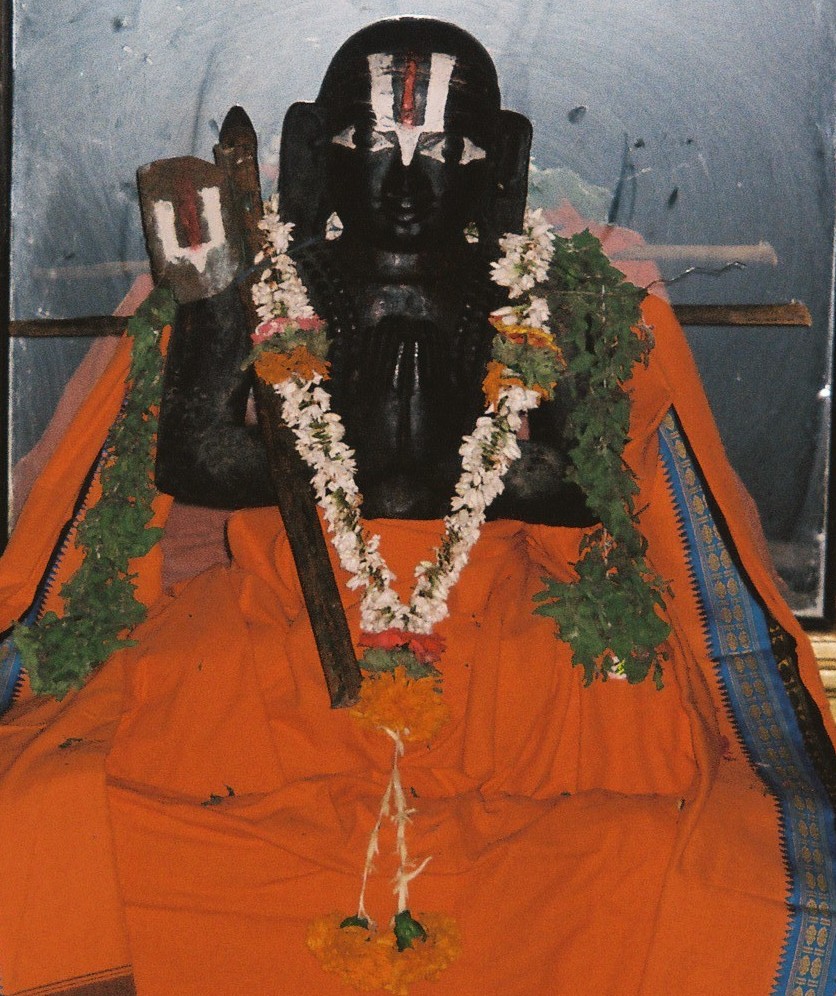
 Ramanujacharya's image in a Temple

Srimad Ramanujacharya has produced a remarkable commentary on the Bhagavad Gita for the benefit of this world. Before him, his grand-guru Yamunacharya (Sanskrit: yAmunAcArya, Tamil: ALavandAr) produced a terse metrical exposition on the essence of the Bhagavad Gita, dedicating one verse to each chapter of the Gita, known as gItArtha sa"ngraH. Sri Vedanta Desika Acharya (a.k.a ve"nkaTanAtha), who lived a little more than a century after Sri Ramanuja, has produced an elaborate sub-commentary known as tAtparya candrika, upholding the spiritual lineage.


We will now look at how the great acharya of the Srivaishnava tradition, Sri Ramanuja, has attested to the Lord's attributes of Transcendence (paratvam), Immanence (antaryAmitvam), and Creator-hood (jagatkAraNatvam) that we saw in the second and the third posts using Sri Ramanujacharya's commentary to the Bhagavad Gita. Thankfully, there is a good English translation of the same available on the web, and I am depending on the same [1]. Elaborating on verse 5 of Chapter 9 in the Gita, Sri Ramanujacharya writes:
"Lord Hari says: 'I do not support the beings as a jug or any kind of vessel supports the water contained in them. How then are the beings contained in Me? By My will. Behold My divine Yoga power, namely, My wonderful divine modes, unique to Me alone and having no comparison elsewhere'. What are these modes? 'I am the upholder of all beings and yet I am not in them --- My will sustains all beings.' The meaning is, 'I am the supporter of all beings, and yet I derive no help for Myself whatever from them. My will alone projects, sustains and controls all beings.' "
(Ramanuja's bhagavad-gItA-bhASya, 9.5)

The Acharya then says that the Lord is now going to give an illustration to show how all beings depend on His will for their being and acts. To the next verse in the Gita, Sri Ramanuja writes:
"The knowers of the Veda declare thus: 'The origin of clouds, the waters of the ocean remaining within bounds, the phases of the moon, the strong movements of the gale, the flash of lightning and the movements of the sun --- all these are marvelous manifestations of the power of Vishnu.' The meaning is that they are all the marvelous miracles which are unique to Vishnu."
(Ramanuja's bhagavad-gItA-bhASya, 9.6)

He proceeds thus in his commentary to the next verse:
"All the mobile and immobile entities enter into the primordial matter owned by Lord Krishna at the end of a cycle, namely at the end of Brahma's life in accordance with the Lord's will." 
(Ramanuja's bhagavad-gItA-bhASya, 9.7)

and then,

"Lord Hari, operating His Prakrti (primordial matter), with its wonderfully variegated potency, develops it eightfold and send forth this fourfold aggregate of beings: the devas, animals, men and inanimate things, time after time." 
(Ramanuja's bhagavad-gItA-bhASya, 9.8)

We turn to the natural question - How does our dear Lord Hari work these great miracles without physical effort? Before we investigate, let us learn a little bit more about Sri Ramanujacharya's glorious school.

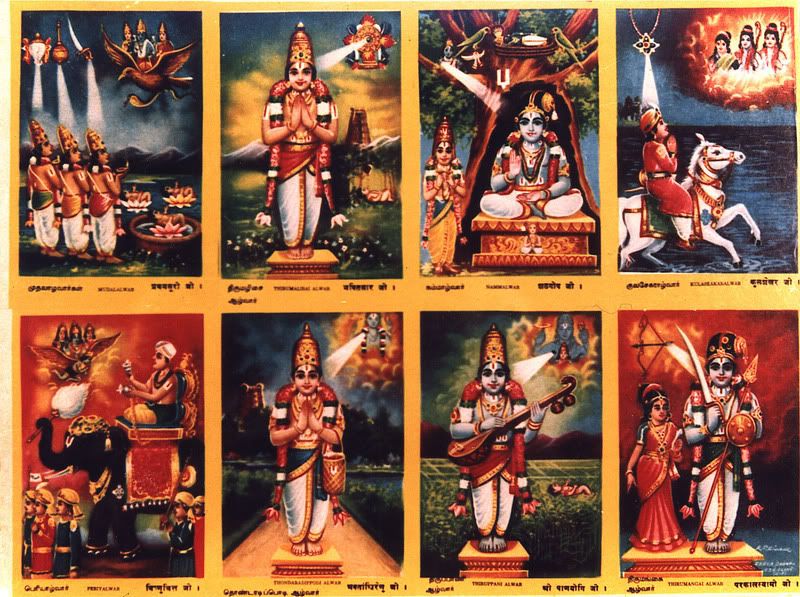
The Divya Prabandha (divya prabandha) is an anthology of 4000 devotional hymns on Lord Hari in Tamil, written by South Indian saints known as Azhwars (pronounced as AlvArs in our transliteration scheme). Traditionally, the lifetimes of these saints are said to have spanned several thousand years BC till somewhere around the 7th/8th Centuries AD. The works of these twelve poets, rich in devotion, philosophical depth, and universal brotherhood concepts, are celebrated as "Dravida Vedam (drAviDa vedam)" by great scholars of Sri Ramanujacharya's tradition. This is indeed no exaggeration and hence is not to be taken lightly, as the Divya Prabandha works do indeed get into the depths of the philosophy and theology of the Vedas, albeit in poetic Tamil. However, unlike the Sanskrit Vedas, the Divya Prabandhas do not require very strict regulations on chanting, and in fact, can be learned by anyone irrespective of caste, creed, gender, etc.

 An illustration of the lives of ten of the twelve Azhwars
The very first successors and disciples of Sri Ramanujacharya include the following Acharyas in the following order: (1) Sri Embar (a.k.a. Govinda Bhattar), the cousin of Sri Ramanujacharya; (2) Sri Parasara Bhattar, the disciple of Sri Embar and the son of Sri Kurattalvan; (3) Sri Nanjeeyar, disciple of Sri Bhattar, and (4) Sri Nampillai, disciple of Sri Nanjeeyar. Sri Nampillai wrote a commentary (known as nampiLLai iiDu in Tamil) on "Thiruvaimozhi (tiru-vAy-moli)", a work of Saint Nammalwar that belongs to the Divya Prabandha.

Acharya Nanjeeyar

Sri Nampillai's guru and Sri Parasara Bhattar's disciple, Sri Nanjeeyar, is initially said to have been an advaitin known as mAdhavAcArya, and eventually became the disciple of Sri Parasara Bhattar owing to the latter's brilliant exposition of "Thirunedum-Thandakam" (tiru-neDum-tANDakam) which also belongs to the 4000 Divya Prabandha and is composed by one of the AlvAr saints known as "Thirumangai Azhwar" (tiruma"ngai AlvAr). Thirunedum-Thandakam is a very beautiful composition that combines both "masculine" philosophical exposition and "feminine" devotional adoration in a balanced manner, in one single work. It combines both Vedantic descriptions of Lord Hari as well as the adoration of His form, as he resides in sacred shrines located all over India. In one verse, Saint Tirumangai Azhwar says:
indirarkkum piramaRkkum mudalvan-tannai
irunilamkAl tInIrviN pUtam aintAy,
cen-tiRatta tamizhOsai vaDa-soll-Agit
ticai nAnkumAyt ti"nkaL ~nAyiRAgi,
antarattil-tEvarkkum aRiyal AgA-
andaNanai, andaNar mATTu andi-vaitta-
mandirattai, mandirattAl maRavAdu enRum
vAzhutiyEl vAzhalAm maDa ne~njE!
(Thirunedum-Thandakam 4, Divya Prabandha 2055)

The above verse means: "Hey you foolish mind! If you want to live, live chanting the name of the Lord using the sacred eight-lettered mantra ending with 'namo nArAyaNAya' - the name of the Lord who is (1) The Lord to even great devatas such as the four-faced Brahma and Indra, (2) Who is the inner controller and inner-dweller (antaryAmin) for everything made of the five elements - earth, water, fire, wind, and space, (3) Who pervades all directions, the sun and the moon, (4) Who is very hard to comprehend even for the great devas from Brahma, Indra, etc. (5) Who is praised by the Sanskrit Upanishads and the Tamil Divya Prabandha, (5) Who is the Lord known through the wealth of the learned scholars - the Vedas." Thus, Thirumangai Azhwar is confirming the doctrine of the Lord Narayana being the antaryAmi or the inner-soul and inner-controller of everything in the universe, the Lord of all, and is known through the Vedas and Tamil Divya Prabandha texts.

Since the last post, we have discussed about the marvelous miracles of Lord Madhava (another name of the Supreme Lord Hari).With His unlimited unfathomable power, He creates, sustains, and dissolves the entire universe consisting of all beings. This shows that we are entirely dependent on Him and should thank Him for our existence, prosperity, and enjoyment in this life and the next.

(to be continued)

Bibliography

[1] English Translation of Ramanuja's Gita Bhashya, Dr. S. Sankaranarayanan. (Thanks: Gita Supersite 2.0)
[2] Sudarshanam Editor Sri Puttur Krishnaswami Iyengar's book, "Thirunedum-Thandaka Vivaranam" (திருநெடுந்தாண்டக விவரணம்), Thanks: http://www.maransdog.org

Read more >>
 
Web Analytics