Guruvayur is a sacred pilgrimage center in the state of Kerala in South India. There is a very famous temple dedicated to Lord Krishna here. According to the traditional history of this temple, this is the spot where Lord Siva is said to have instructed the Rudra Gita, a song that glorifies Sriman Narayana -- the Lord of even great Lords like Brahma, Siva, and Indra. The deity of this temple is said to have been in possession of Lord Krishna during His stay in Dwaraka, which he then gave to a disciple named Uddhava before voluntarily disappearing from this world after fulfilling the mission of His avatar. But since a deluge followed the ascent of Lord Krishna back to His spiritual realm, the idol had to be eventually salvaged by Brihaspati (bRhaspati, also known as guru), the devata in charge of the planet Jupiter, with the help of his disciple Vayu (vAyu) who is in charge of the one of the elements of nature- the wind. Ultimately, they were guided by Lord Siva, and hence it was installed at the present location - Guruvayur. The name Guruvayur comes from the combination guru + vAyu (the devatas who installed the deity of Lord Krishna) and the word oor which means "place" in the South Indian languages Malayalam and Tamil. Here, the deity form of Lord Krishna is known affectionately as guruvAyUrappan - the Lord of Guruvayur.

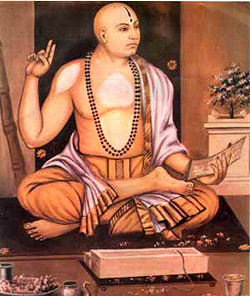
Bhagavata Purana (srImad bhAgavata purANa, srImad bhAgavatam, or simply bhAgavatam) is a divine revelation compiled by Sri Veda Vyasa Maharishi, consisting of 18,000 verses. The book extols devotion to Supreme Lord Hari, and is praised by both scholars and the lay as "the essence of all Vedic literature". Sri Narayana Bhattathiri (nArAyaNa bhaTTatiri) was a great devotee of Lord Krishna who belonged to the 16th Century. He identified with the Advaita school of Vedanta. When he was once inflicted with a severe illness Sri Bhattathiri prayed to the Lord of Guruvayur. The devotional outpourings came in the form of a 1000-verse summary of the contents of the Bhagavata Purana, known as "Narayaneeyam" (nArAyaNIyam).

In the last several posts, we have been dealing with the subject of the threefold acts of creation, sustenance, and destruction by Lord Narayana. We shall now wind up this discussion with relevant verses from Narayaneeyam which summarize the Lord's threefold activity. Let us now look at the following slokas-
Translation:
"When the earlier great deluge occurred, the world was nonexistent and mAyA (the primordial seed of material existence) was merged in Thy (Lord Krishna's) Supreme Form indiscernible in any way. There was no life or death and no day or night. Only Thy brilliant form of Supreme Bliss existed."
In a previous post, we saw that, according to Vedic Sanatana Dharma, the universe is created, sustained, and re-absorbed by Lord Hari. This entire process is repeated in a cyclical manner. At the end of each cycle, there is a period known as mahApraLaya ("great deluge") when the entire material universe exists without name and form in a subtle, indescribable manner. In another post, we saw that this indescribable matter is described as "avyakta" in the Vedic scriptures. The Narayaneeyam verse that we just saw above confirms these scriptural statements. It describes the dissolved state of the material universe during this great deluge, before the universe was created by Lord Hari as it exists today.
Lord Manu, the author of Manu-Smriti also confirms that the material universe existed in a very subtle, indiscernible form during the cosmic night:
One may ask thus-- "When it is said in scripture that 'the universe did not exist', does it mean that the Lord created everything out of nothing"? Not at all, says Sri Narayana Bhattathiri in the next verse:
Read more >>

Little Lord Krishna, the deity of Guruvayur
Bhagavata Purana (srImad bhAgavata purANa, srImad bhAgavatam, or simply bhAgavatam) is a divine revelation compiled by Sri Veda Vyasa Maharishi, consisting of 18,000 verses. The book extols devotion to Supreme Lord Hari, and is praised by both scholars and the lay as "the essence of all Vedic literature". Sri Narayana Bhattathiri (nArAyaNa bhaTTatiri) was a great devotee of Lord Krishna who belonged to the 16th Century. He identified with the Advaita school of Vedanta. When he was once inflicted with a severe illness Sri Bhattathiri prayed to the Lord of Guruvayur. The devotional outpourings came in the form of a 1000-verse summary of the contents of the Bhagavata Purana, known as "Narayaneeyam" (nArAyaNIyam).

Lord Krishna's abode at Guruvayur, Kerala
In the last several posts, we have been dealing with the subject of the threefold acts of creation, sustenance, and destruction by Lord Narayana. We shall now wind up this discussion with relevant verses from Narayaneeyam which summarize the Lord's threefold activity. Let us now look at the following slokas-
vyakta-avyaktam-idaM na ki~ncit-abhavat prAk prAkRta-prakSaye
mAyAyAM guNa-sAmya-ruddha-vikRtau tvayi-AgatAyAM layam |
no mRtyuH-ca tat-AmRtaM ca sama-bhUnnohno na rAtreH sthitiH
tatra-ekaH-tvam-ashiSyathAH kila para-Ananda-prakAsha-AtmanA ||(Narayaneeyam, 5:1)
Translation:
"When the earlier great deluge occurred, the world was nonexistent and mAyA (the primordial seed of material existence) was merged in Thy (Lord Krishna's) Supreme Form indiscernible in any way. There was no life or death and no day or night. Only Thy brilliant form of Supreme Bliss existed."
In a previous post, we saw that, according to Vedic Sanatana Dharma, the universe is created, sustained, and re-absorbed by Lord Hari. This entire process is repeated in a cyclical manner. At the end of each cycle, there is a period known as mahApraLaya ("great deluge") when the entire material universe exists without name and form in a subtle, indescribable manner. In another post, we saw that this indescribable matter is described as "avyakta" in the Vedic scriptures. The Narayaneeyam verse that we just saw above confirms these scriptural statements. It describes the dissolved state of the material universe during this great deluge, before the universe was created by Lord Hari as it exists today.
Lord Manu, the author of Manu-Smriti also confirms that the material universe existed in a very subtle, indiscernible form during the cosmic night:
This (universe) existed in the shape of Darkness, unperceived, destitute of distinctive marks, unattainable by reasoning, unknowable, wholly immersed, as it were, in deep sleep.
(Manu Smriti, I.5)
Manu Bhagavan then proceeds to describe the brilliance of the Lord as He shone during the great deluge, in the manner agreed by the above Narayaneeyam verse:
He who can be perceived by the internal organ (alone), who is subtle, indiscernible, and eternal, who contains all created beings and is inconceivable, shone forth of his own (will).
(Manu Smriti, I.7)
One may ask thus-- "When it is said in scripture that 'the universe did not exist', does it mean that the Lord created everything out of nothing"? Not at all, says Sri Narayana Bhattathiri in the next verse:
kAlaH karma guNAH-ca jIvanivahA vishvaM ca kArye vibho!
cilliilAratimeyuSi tvayi tadA nirliinatAmAyayuH |
teSAM na-eva vadanti-asatvamayi bhOH-shakti-AtmanA
no cet kiM gagana-prasUna-sadRshAM bhUyo bhavet-sambhavaH ||(Narayaneeyam, 5:2)
Translation:
"Oh Lord ! At that point of time everything in the Universe viz. Kala (time), Karma (action), Guna (mood), the Jivathmas (individual souls ) all lay merged in Thy supreme form. But they were never nonexistent or imaginary like flowers of the sky. They were ensconced in Thee and re-emerged after the deluge."
For how long did this state last, and how did creation begin? Narayana Bhattathiri answers this for us thus:
So far, we have explored the greatness and supremacy (paratva) of the Lord. Starting with the next post, we will start exploring his other great aspect, namely His compassion and accessibility (saulabhya) to all of His creatures.
For how long did this state last, and how did creation begin? Narayana Bhattathiri answers this for us thus:
evam-ca dvi-parArdha-kAla-vigatAvIkSAM sisRkSAtmikAM
bibhrANe tvayi cukSubhe tribhuvanIbhAvAya mAyA svayam |
mAyAtaH khalu kAla-shaktiH-akhila-adRSTaM svabhAvo-api ca
prAdurbhUya guNAn vikAsya vidadhuH-tasyAH sahAya-kriyAm ||(Narayaneeyam, 5:3)
Translation:
This state lasted for one hundred Brahma-years. Then with the desire for creation Thou activated the mAyA (primordial matter) with a single glance and the evolution of the three worlds began. From the mAyA came "kAla-shakti", the hidden resultant karmA (the balance of good and bad deeds committed in the past) of individual souls and their svabhAvas (inborn dispositions). From these evolved the guNas (qualities/natures) and helped mAyA to manifest as the universe.
Hence, Sri Bhattathiri says that all the cosmic forces that maintain orderliness and justice in the universe were activated by Lord Vishnu by a single glance of his eyes. One hundred Brahma-years is the lifetime of one Brahma (four-faced deva), and is approximately equal to 310 Trillion human years. In the past, innumerable Brahmas have lived through their full tenures, and more will continue to do so. Fifty Brahma-years is known as a parArdha in Vedic cosmology. In other words, after the lifetime of every Brahma, the universe enters into another cosmic deluge lasting for 100 Brahma-years, but actually there is no Brahma during this time.
The next verse (5:4) of the Narayaneeyam describes Supreme Lord Narayana as the witness to the entire process of creation, and that he is not enveloped by mAyA, the cause of delusion and suffering in the material universe. Everything in this universe is ordained by the Lord, according to the principles of dharma (justice) and karma (past good/bad deeds).
Under the Lord's ordinance, primordial matter then evolved into the principle known as mahAn, then into aha"nkAra (ego-principle). The ego-principle further got divided into the three modes: sAttvika (goodness), rAjasa (passion), and tAmasa (ignorance). From the tAmasa ego-principle, the principles behind the five modes of perception (tanmAtra-s) -- sabda, sparsha, rUpa, rasa, and gandha (sound, touch, sight, taste, and smell), as well as the five material elements -- space, wind, fire, water, and earth, came into existance one after the other in an interleaved manner. This creation is described in the following Narayaneeyam verse:
shabdAd vyoma tataH sasarjitha vibho! sparshaM tato mArutam
tasmAd rUpamato maho-athaH-ca rasaM toyaM ca gandhaM mahIm |
evam mAdhava! pUrva-pUrva-kalanAd-AdyAdadharmAnvitaM
bhUtagrAmamimaM tvayeva bhagavan! prAkAshayaH-tAmasAt ||
(Narayaneeyam, 5:8)
Translation:
"From sound (sabda) Thou created the space (AkAsha). From that came touch (sparsha); from which air (vAyu) was born; from that came the visual form (rUpa); from visual form came fire (agni); from fire came taste (rasa); then came water (Apa) from taste; from water came smell (gandha) and from smell earth (prithvI) was formed. Thus Oh Lord Madhava ! Thou caused the group of elements to manifest from tamasa egoism with each one of them having the qualities of those created prior to them and hence all of them being interconnected."

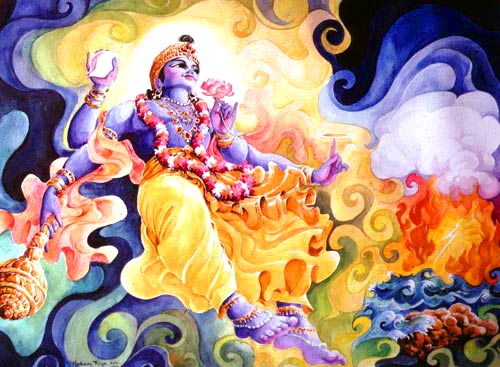
In the Causal Ocean, the Supreme Lord first separates the qualities of the material elements (ether, air, fire, water, and earth) by His glance.
Thanks: www.glimpseofkrishna.com. Copyrighted image and caption reproduced with permission of the artist Smt. Madhavapriya Devi
The above creation process by Lord Vishnu is known as samaSTi sRSTi or "aggregate creation" in English. The samaSTi sRSTi process continues further until four-faced Brahma deva is created by the Supreme Lord Narayana from the Divine Lotus springing from His navel. After that, the Lord ordains Brahma to be the agent for the next stage in creation known as vyaSTi sRSTi or "individual creation". It is then that Lord Brahma, under the instructions of the Lord, proceeds to create other beings -- from devas, gandharvas, angels, elves, demons, men, animals, down to plants, and further down to simplest single-cell organisms.
We close the discussion of Lord Hari's relation to the cosmos and His creation, which we have been running for weeks, with the following excellent summary given by Sri Adi Shankaracharya in his introductory chapter to his commentary on the Bhagavad Gita:
We close the discussion of Lord Hari's relation to the cosmos and His creation, which we have been running for weeks, with the following excellent summary given by Sri Adi Shankaracharya in his introductory chapter to his commentary on the Bhagavad Gita:
"sa Adi-kartA nArAyaNAkhyo viSNUH... sa ca bhagavAn jnAna-aishvarya-shakti-bala-vIrya-tejobhiH sadA sampannas triguNAtmikAm vaiSNavIm svAm mAyAm mUla-prakRtim vashIkrtya, ajo-avyayo bhUtAnAm Ishvaro nitya-shuddha-buddha-mukta svabhAvaH"
(Adi Sankara's Introduction
to Bhagavad Gita)
Translation:"Lord Vishnu (all-pervading), known as Narayana, is the primordial creator... The Lord, possessed of infinite knowledge, supremacy, power, strength, might, and vigor, controls the mAyA -- belonging to Him as Vishnu -- the primordial matter that is the first cause composed of the three natures (goodness, passion, and ignorance). The Lord is unborn and indestructible, and is by nature Eternal, Pure, Intelligent, and Free."
So far, we have explored the greatness and supremacy (paratva) of the Lord. Starting with the next post, we will start exploring his other great aspect, namely His compassion and accessibility (saulabhya) to all of His creatures.