Showing posts with label Adi Sankara. Show all posts

Monday, June 7, 2010

The Unassailable Glory of Lord Narayana: Part 3 -- From the Narayaneeyam


In a previous post, we have learned a little bit about the Narayaneeyam, a devotional work by Sri Narayana Bhattathiri, a 16th Century Keralite scholar. The following verses firmly establish Sri Bhattathiri's conviction that Lord Narayana is the Supreme One:

Narayaneeyam, 82-9:
muhustAvacchakraM varuNamajayo nandaharaNe
yamaM bAlAnItau davadahana pAne(a)nila sakham |
vidhiM vatsasteye girishamiha bANasya samare
vibho vishvotkarSI tadayamavatAro jayati te ||
[Thy repeated victories over Indra, over Varuna (when Nandagopa was kidnapped by him while bathing), over Yama (by reclaiming from him the son of Thy preceptor, Sandeepani), over Agni (by Thy devouring the wild forest fire), over Brahma (when he stole the calves) and over Siva here in the battle with Bana, O Lord, amply prove that this avatAra of Thine as Krishna surpasses all other avatAra-s and is most superior.]

Narayaneeyam, 90-1:
vRka bhRgu muni mohinyambarIShaadi vRtteSu
ayi tava hi mahattvaM sarvasharvAdi jaitram |
sthitamiha paramAtman niSkalArvAgabhinnaM
kimapi tadavabhAtaM taddhi rUpaM tavaiva ||
[O Supreme Being ! From the episodes of Vrikasura, Sage Bhrigu, the Mohini incarnation, King Ambarisha and others, it is here firmly established that Thy glory is superior to, and transcends, that of Siva and all other deva-s. Thou art none other than the Nishkala Supreme Brahman, as also all the Sakala forms, and art that Indefinable One who doth shine as the essence of all.]

Sri Madhusudana Saraswati expounds on this further in his Gudhartha Dipika, in his commentary to verse 7-24 of the Bhagavad Gita:
"nanu janma-kAle(a)pi sarva-yogi-dhyeyaM shrIvaikuṇṭhasthaM-aishvarameva rUpaM-AvirbhAvitavati saMprati ca shrIvatsa-kaustubha-vanamAlA-kirITa-kuNDalAdi-divya-upakaraNashAlini kambu-kamala-kaumodakI-cakra-varadhAri-caturbhuje shrImad-vainateyavAhane nikhila-sura-loka-saMpAdita-rAjarAjeshvara-abhiSekAdi-mahAvaibhave sarva-surAsura-jetari vividha-divyaliilA-vilAsashIle sarva-avatArashiromaNau sAkSAd-vaikuNTha-nAyake nikhilaloka-duHkha-nistArAya bhuvamavatIrNe viri~nci-prapa~nca-asaMbhavi-niratishaya-saundaryasAra-sarvasvamUrtau bAlaliilA-vimohita-vidhAtari taraNi-kiraNojjvalavyapItAmbare nirupamashyAmasundare karadIkRta-pArijAtArtha-parAjita-purandare bANayuddha-vijita-shashA^nkashekhare samasta-surAsura-vijayi-naraka-prabhRti-mahAdaiteya-prakara-prANa-paryanta-sarva-svahAriNi shrIdAmAdi-parama-ra^nka-mahAvaibhava-kAriNi SoDasha-sahasra-divya-rUpadhAriNya-parimeya-guNagarimaNi mahAmahimani nArada-mArkraNDeyAdi-mahAmunigaNastute tvayi katham-avivekino(a)pi manuSya-buddhir-jIvabuddhir-veti?"

[Well, with regard to you who even at the time of Your birth had manifested that Divine Form itself which exists in the holy Vaikuntha, and which is an object of meditation for the yogis, and who at present possesses charming adorations such as the Srivatsa, the Kaustubha, a garland of flowers etc. reaching up to the feet, a crown, earrings, etc., who have four hands holding a conch, a lotus, the (mace called) Kaumodaki and an excellent discus, who have the graceful Vainateya (Garuda) as your carrier, who are possessed of the great glory of having been coronated as the Supreme King of kings by the entire heavenly world, who have conquered all the devas (celestial beings) and asuras (demons), who like to remain engaged in various divine sports, who are the crest-jewel of all avatAra-s, who are none other than the Lord of Vaikuntha, who have descended on the earth to help all people get rid of their sorrows, who are the embodiment of all that constitutes the essence of the unsurpassable beauty that is not to be found in the creation of Brahma, who outwitted Brahma by the divine sport of your childhood, who wear a dazzling yellow garment as bright as the rays of the sun, who are incomparably dark and charming, who defeated Indra to make him offer the Parijata tree as a tribute, who defeated Siva while fighting Bana, who took away everything including the lives of mighty demons such as Naraka and others who had defeated all the devas and asuras, who made an extremely poor person like Sudama greatly opulent, who had assumed sixteen thousand divine forms, who are endowed with virtues the excellence of which is immeasurable, who are possessed of great fame, and who are prayed to by the great sages such as Narada, Markandeya and others, how can even the non-discriminating persons have the idea that You are a human being or a jiva?]


In another place, Sri Narayana Bhattathiri cites the incident where the devas and asuras were churning the ocean seeking the amRta (elixir), with the aid of none other than Lord Vishnu. Lakshmi, the eternal companion of the Lord in His Vaikuntha abode, manifested herself as one of the by-products during the course of churning. She examined all the onlookers one by one, and finally chose our Lord Sri Hari as her husband. Sri Bhattathiri says thus:

Narayaneeyam, 28-7:
girishadruhiNAdi sarvadevAn guNabhAjo(a)pyavimukta doSaleshAn |
avamRshya sadaiva sarvaramye nihitaa tvayyanayA(a)pi divyamAlA ||
[Knowing that all the others such as Brahma and Siva, though virtuous were still not blemishless, she offered the divine garland to Thee, who art the eternal embodiment of perfection and charm.]

It is worth noting here that in Sri Vishnu Sahasranama Bhashya, Sri Sankara explains the name "shrIpatiH" as follows: "amRtamathane sarvAn sura-asurAdIn vihAya shrIrenaM patitvena varayAmAseti shrIpatiH" [He who was chosen by Laksmi after she rejected all the other devas and asuras during the churning of the cosmic ocean for nectar].

Sri Bhattathiri further confirms this doctrine in the following verse belonging to the section describing the deliverence of the elephant Gajendra:

Narayaneeyam, 26-8:
shrRtvaa stotraM nirguNasthaM samastaM brahmeshAdyairnAhamityaprayAte |
sarvAtmA tvaM bhUri kAruNya vegAt tArkshyArUDhaH prekSitobhUH purastAt ||
[On hearing the entire hymn, describing the impersonal nature of the Universal Being, Brahma, Siva and others, knowing that it did not refer to them, did not come there. But Thou, who art all knowing, manifested before him, seated on Garuda, impelled by Thy flow of mercy.]

Hence, our Acharyas have repeatedly emphasized the point that the glory of Lord Narayana surpasses that of the other devas such as Brahma, Siva, Indra, and others.


Read more >>

Sunday, June 6, 2010

The Unassailable Glory of Lord Narayana -- Part 2: Unequalled and Unsurpassed Supremacy

Long before the advent of great Acharyas, ancient India had a glorious time during which Vedic knowledge had spread far and wide, owing to the unparalleled efforts of great sages such as Valmiki, Vasishta, Shakti, Parashara, Vyasa, and Shuka who propounded that knowledge among the masses through the Smritis, Itihasas, and Puranas. Their reach extended from East to West, and from North to South, all over the great nation of India. No wonder then that the Vedic conception of Lord Sri Hari as the "Supreme revealed in the Vedas" (வேத முதல்வன்) found its way into secular Tamil literature of the ancient times. The following invocatory verse of the literary work "naRRiNai" (நற்றிணை) bears testimony to this:


மாநிலஞ் சேவடி யாகத் தூநீர்
வளைநரல் பெளவம் உடுக்கை யாக 
விசும்புமெய் யாகத் திசைகை யாகப்  
பசுங்கதிர் மதியமொடு சுடர்கண் ணாக 
இயன்ற எல்லாம் பயின்றகத் தடக்கிய 
வேத முதல்வன் என்ப  
தீதற விளங்கிய திகிரி யோனே

Translation: "Having the earth for His tender reddish feet, wearing as cloth the oceans that contain pure water and resonating conch-shells, having the space for His body, having the directions as His hands, having the sun and the moon for His eyes, enveloping everything as His very body, He -- the One who bears the discus (Lord Vishnu) is praised as the foremost of all divinities in the Vedas."


Clearly, the author of the invocatory verse in naRRiNai is familiar with Vedic concepts, as he praises Lord Vishnu, following the manner of Mundaka-Upanishad, Purusha-Suktam, Narayana-Suktam, etc. (See this post). More such references to the Lord Vishnu as the "essence of the Vedas" are available in the work called "paripADal".


In the last post, we saw that Acharyas such as Sri Sankara clearly expounded this ancient Vedic wisdom alone, and did not deliberately invent anything on their own.


We now continue our discussion of the supreme glory of Lord Narayana as explained by our Acharyas. We explain the verses where our Acharyas have shown that the glory of Lord Narayana cannot be compared with those of the other devas, and that He is the one who rules all of them.

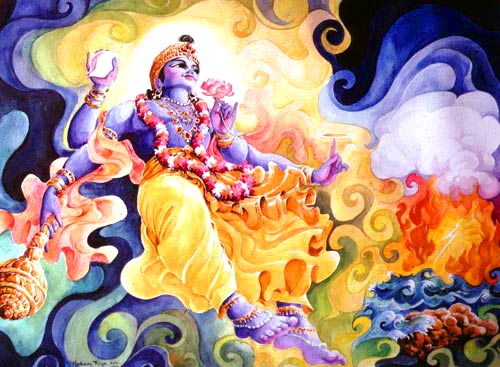
 The devas, headed by Lord Brahma revere Lord Narayana
Thanks: www.glimpseofkrishna.com.  Copyrighted image and caption reproduced with permission of the artist Smt. Madhavapriya Devi

'None is equal or greater to Lord Narayana': 

When Lord Krishna expounded to Arjuna the Vedic philosophy by revealing the Bhagavad Gita, He showed His Supreme Universal Form to Arjuna. Awed at that stunning magnified form, Arjuna praised Krishna thus, in the following Bhagavad Gita verse. Let us read the a part of one such verse (11.43) and then Sri Sankara's and Sri Anandagiri's explanations to the same.
na tvat samo(a)sti, abhi adhika kuto-anyo loka-trayo-api, apratima-prabhAva?
(Bhagavad Gita, 11.43)
[There is none who is equal to you, and when that is the case, how even can there be any who is superior to You in any of three worlds, Oh Lord, who is of unrivaled power?]

 Sri Sankara's explanation reflects the Acharya's opinion that the above mode of praise is not at all exaggerated. The Bhagavatpada-Acharya explains thus: "na hi IshvaradvayaM saMbhavati, anekeshvaratve vyavahAra-anupatteH" [Translation: For there cannot be two Supreme Gods, if so, the world as it exists now will not be able to function properly]. 

Sri Anandagiri confirms this further at the same place:  "IshvarAntaraM tulyaM bhavishyati-ityAsha^nkyAha -- 'na hi' iti | Ishvarabhede pratyekaM svAtantryAt-tadaikamatye hetvabhAvAt-nAnAmatitve ca ekasya sisRkSAyAM anyasya saMjihIRSAMsa-bhavAt vyavahAralopada-yuktaM-IshvaranAnAtvaM-ityarthaH" [Translation: The following presents itself as a doubt: can there ever be two Supreme Gods? The Acharya answers: Surely no. If there be several independent Supreme Gods, then their decisions will be independent, as there is no guarantee that they will be of one mind. The effort of one Supreme God in one direction will be neutralized by the effort of the other in the opposite direction. Then the world could not exist as it does now.]

'Lord Vishnu, the ruler of all other deva-s':

Commenting on Gita verse 10.2, Sri Sankara explains:
na me viduH na jAnanti suragaNAH brahmAdayaH | kiM te na viduH? mama prabhavaM prabhAvaM prabhushakti-atishayam, athavA prabhavaM prabhavanaM utpattiM | na-api mahaRSayaH bhRgvAdayaH viduH | kasmAt te na viduriti-ucyate -- aham AdiH kAraNaM hi yasmAt devAnAm mahaRSINAM ca sarvashaH sarvaprakAraiH
["(Lord Krishna says) 'neither the devas -- Brahma and others-- know; -what do they not know? My majesty, abundance of lordly power-or, derived in the sense of 'coming into being', it means origin. Nor even the great sages, Bhrgu, Marici, Atri, Pulastya, Pulaha, Kratu and Vasistha. This is because I am the Supreme Primordial Cause of all, including the devas and the sages.'"]
This is re-emphasized by the Acharya in his commentary to Gita verse 10.12 (Arjuna's words):
paraM brahma paramAtmA paraM dhAma paraM tejaH pavitraM pAvanaM paramaM prakRSTaM bhavAn ! puruSaM shAshvatam nityaM divyaM divi bhavaM AdidevaM sarvadevAnAm Adau bhavam ajam vibhum vibhavanashIlam | ishvaram
[ (Arjuna says) 'Oh Lord! You are the Supreme Brahman -- the Supreme Soul, the Supreme Light, and the Supreme Sanctifier. You are the eternal divine Person, the Primal deva since you preceded all the devas by time. You are birthless, omnipresent, and capable of assuming many forms.]
Sri Madhusudana Sarasvati, in Gudhartha Dipika, offers a very interesting explanation for a verse not very far (10.14) from the above verse.  Here, Sri Madhusudana Sarasvati says that Arjuna's addressing Krishna by one of His special Divine Names, "Kesava (keshava)" has a deep purpose: He says that the name "Kesava" is apt here since Arjuna is referring to Sri Krishna's supremacy --
tacca-sarvaj~natvAt tvaM jAnasIti -- keshau brahmarudrau sarveshAvapi-anukampyatayA vAti-avagacchatIti vyutpattim-Ashritya niratishaya-aishvarya-pratipAdakena keshava-padena sUcitam | ato yaduktam 'na me viduH suragaNAH prabhavaM na mahaRSayaH' ityAdi tattatheva -- hi yasmAt he bhagavan samagra-aishvaryAdi sampanna! te tava vyaktiM prabhAvaM j~nAnAtishayashAlino(a)pi devA na viduH na-api dAnavA, na mahaRSaya ityapi draSTavyam |
['And You know that since you are omniscient.' - this is indicated by the word keshava, by which is suggestive of 'unsurpassed sovereignty', according to the following derivative sense of the word: 'He who looks upon Ka and Isha, i.e., Brahma and Rudra,  as fit for compassion, even though they are great lords (compared to other devas and human beings).' Hence, what was said in 'Neither the deva-s nor the great sages know My Lordliness.' (10.2) is truly so. For, Oh Lord who art endowed with Sovereignty etc. in their entirety, neither the deva-s nor the demons, or even the great Rishis, comprehend your glory.]
- Madhusudana Sarasvati, Gudhartha Dipika, 10.14

One may wonder whether all the above statements by Arjuna, and by Acharyas like Sri Sankara, Anandagiri, Madhusudana Sarasvati are merely exaggerations for the sake of praising Lord Krishna. This doubt can be safely answered in the negative, as Sri Sankara himself says thus in his Brahma Sutra Bhashya (I.ii.17) where the Acharya is involved in serious polemical discussion, where he establishes the identity of 'the person in the eye' described in the Vedanta:
tathApi AtmatvaM tAvanna sambhavati, parAgrUpatvAt | amRtatvAdayo(a)pi na saMbhavanti utpatti-pralaya-shravaNAt | amaratvamapi devAnAM cirakAlAvasthAna-apekSam | aishvaryamapi parameshvara-Ayattam, na svabhAvikam; 'bhIshAsmAd-vAtaH pavate, bhISodeti sUryaH | bhISAsmAd-agniH-candraH-ca mRtyuH-dhAvati pa~ncamaH' iti mantravarNAt | tasmAt parameshvara eva-ayam-akSisthAnaH pratyetavyaH |
[Inner-self-hood cannot be ascribed to the sun (Aditya), on account of his externality. Immortality, also cannot be predicated of him, as Scripture speaks of his origin and his dissolution. For the so-called deathlessness of the deva-s only means their comparatively long existence. And their lordly power also is based on the highest Lord and does not naturally belong to them; as the mantra declares, 'From terror of it (Brahman) the wind blows, from terror the sun rises; from terror of it Agni and Indra, yea, Death runs as the fifth.'—Hence the person in the eye must be viewed as the highest Lord only.]

- Sri Sankara,  Brahma Sutra Bhashya, 1.2.7

Thus, the Acharyas have discussed at great length, the greatness and sovereignty of Lord Hari as per the Vedas.

REFERENCES

[1] For the naRRiNai and other Sangam and post-Sangam Tamil works, see here or here. (Flash player and font download required for first link; first link contains several commentaries by ancient and modern Tamil commentators).
[2] References for Bhagavad Gita commentaries etc. are as given in this post.
[3] Brahma Sutra Bhashya: See here and English translation here.
Read more >>

Friday, May 28, 2010

The Unassailable Glory of Lord Narayana -- Part 1: The Lord Extolled by the Vedas

The Veda, which forms the basis of sanAtana dharma (The Eternal Religion), is believed by all Astika-s (people who accept the authority of the Veda) to be unauthored (apauruSeya). It contains eternal truths which are not authored by anyone, human or even divine. All the great Acharyas of the different philosophical schools in sanAtana dharma concur on this one fact. Classified as Rg, yajuH, sAma, and atharva, and containing four sections (samhita-s, brAhmaNa-s, AraNyaka-s, and authentic upaniSad-s), all portions of the Veda are taken to be authentic in their entirety by all major philosophical schools, including advaita, vishiSTAdvaita, dvaita, and other schools of Vedanta. The Veda has been passed down from time immemorial, solely by the mode of rigorous study through listening, repeating, and chanting.

Students in a traditional Vedic school

Our great Lord Narayana is known as "vedAnta-vedya pratipAdyaH" which means "The Lord who is known from the eternal Vedic texts". Hari, one of the names of Lord Narayana, is uttered along with the divine praNava (the syllable "Om"), at the beginning and end of Vedic chants thus: "|| hariH om ||". This was mentioned by Kambar (kambanATTAlvAr in Tamil), the Tamil poet who sang Valmiki's Sanskrit Ramayana in beautiful Tamil, in the following invocatory verse at the beginning of his work:

"ஆதி அந்தம் அரி என யாவையும்
ஓதினார் அலகு இல்லன உள்ளன
வேதம் என்பன மெய்ந்நெறி நன்மையன்
பாதம் அல்லது பற்றிலர் பற்று இலார் "
Translation: Those great souls, who are devoid of selfish interests and therefore neutral, who chant the timeless and immeasurable Veda, beginning and ending it with "hariH om", do not put their faith in anything other than the tender feet of the One (i.e., Lord Vishnu or Narayana) who Himself is the truest way (to the highest human end, i.e., liberation) and is an ocean of auspicious qualities.


Let us enjoy the following passages from the commentaries of Sri Adi Sankara and other pUrvAcArya-s in his disciplic succession that confirm that it is none but Lord Narayana (known by various names such as Vishnu, vAsudeva, and Hari) alone who is to be known from the study of the Veda. We first take a look at the commentary to the Bhagavad Gita verse 15.15 and the commentaries to it:
sarvasya ca-ahaM hRdi sanniviSTo mattaH smRtirj~nAnamapohanaM ca |
vedaishca sarvairahameva vedyo vedantakRt-vedavit-eva ca-aham ||
(Bhagavad Gita 15.15)

In the above verse, Lord Narayana, in his Krishna form, teaches the following to Arjuna: "I am seated in the hearts of all beings. Memory, knowledge, as well as their loss come from Me. I alone am to be known from all the Vedas; I am indeed the author of Vedanta as well as its knower."

Sri Sankaracarya explains Lord Krishna's words here thus: "(Lord Krishna says): 'I am the Supreme Soul, the Paramatman to be known from all the Vedas. I alone am the originator of the Vedantic traditions, and it is I who know the Vedic teachings.' Thus, the majesty of the Lord, the Bhagavan who is known as 'Narayana' by name, are stated": vedaisca sarvair-ahameva paramAtmA vedyaH veditavyaH | vedantakRt vedAntArtha sampradAyakRt ityarthaH | vedavit vedArthavit eva ca aham | bhagavataH Ishvarasya nArAyaNAkhyasya vibhUtisaMkSepaH uktaH. Sri Anandagiri who wrote "glosses" (Tiika) to many of Sri Adi Sankara's works explains here that the statement of the Lord in the current verse removes any doubt that may linger in one's mind as to whether the Supreme Brahman extolled in the Vedas is different from Bhagavan Narayana: "vedavedyaM parambrahma bhagavato(a)nyAditi sha^nkAM vArayati -- vedairiti". Indeed, Sri Sankaracarya says in his commentary to the Bhagavad Gita thus:
"It (the Bhagavad Gita) expounds specially the nature of the Supreme Being and the Truth known as vAsudeva, the Para-brahman, who forms the subject of the discourse": paramArtha-tattvaM ca vAsudevAkhyaM parabrahma-abhideya-bhutaM visheSataH abhivyaj~nayad vishiSTa-prayojana-sambandha-abhideyavad gItA-shAstraM  (Introductory Chapter, Sri Sankara's bhagavadgItAbhASya).

"(Lord Krishna says) 'I, the Supreme Parabrahman known by name as vAsudeva, am the source of the whole world. From Me alone evolves the whole universe in all its changes, including existence and dissolution, action, effect, and enjoyment'": ahaM paraM brahma vAsudevAkhyaM sarvasya jagataH prabhava utpattiH | matta eva sthiti-nAsha-kriyA-phalopabhoga-lakSaNaM vikriyA-rUpaM sarvaM jagat pravartate |  (Sri Sankara's commentary to Bhagavad Gita, 10.8)

Moreover, in his commentary to the Kathopanisad verse 1.3.9, Sri Sankara says: "The statement here that 'He obtains The Supreme Abode of Vishnu' refers to entering the Supreme Abode and State of the all-pervading Brahman, the Supreme Soul, known by name as 'vAsudeva' ": tadviSNor vyApanashIlasya brahmaNaH paramAtmano vAsudevAkhyasya paramaM prakRSTaM padam sthAnam satattvaM-iti-etad asAvApnoti.

Echoing all the above points, Sri Anandagiri writes in his gloss to Sri Sankara's commentary (15.15) that Parabrahman cannot refer to anyone other than Bhagavan Sri vAsudeva -- "vedavedyaM parambrahma bhagavato(a)nyAditi sha^nkAM vArayati -- vedairiti".
 
The Lord as Sri Parthasarathy Perumal deity in the temple of Triplicane (Chennai, TN, India) - He is in His battlefield attire, ready to serve His devotee, Arjuna

Sri Madhusudana Sarasvati, in his magnum-opus "gUDhArthadIpika" (a glorious, independent commentary to the Bhagavad Gita) explains here (15.15) that even though the Vedas contain hymns to Indra and other devas, it is still only Bhagavan vAsudeva alone is to be known from the Vedas as He is the in-dwelling supersoul of all: "vedaishca sarvaih-indrAdi-devatA-prakAshaih-api ahameva vedyaH, sarvAtmatvAt". Sri Sarasvati then explains that Vedic passages such as --
"They call Agni as Indra, Mitra, and Varuna; they also say that He is the divine Garutman of beautiful wings. The sages speak of Him, who is one, in many ways; they call Him Agni, Yama, mAtarishvan."
(Atharva Veda, 9.10.28)

and "... for He is all the devas" (Brihadaranyaka Upanishad, 1.4.6) are to be understood in that way.

As if to reiterate all these, Sri Sankara explains as follows, in the Vishnusahasranama Bhashya:


"shabdasahaH" (# 912):

He (Vishnu) is known as "shabdasahaH" as He is the one who alone is proclaimed by all the Vedas unanimously: sarve vedastAtparyeNa tameva vadantIti shabdasahaH


"kathitaH" (# 848):

vedAdibhir-ayameka eva paratvena kathita kathita iti kathitaH | sarvairvedaiH kathita iti vA kathitaH | "sarve vedA yatpadamAmananti", "vedaishca sarvairahameva vedyaH", "vede rAmAyaNe puNye bhArate bharatarSabhaH! adau madye tathA cAnte viSNuH sarvatra gIyate" iti shruti-smRtyAdi-vacanebhyaH |

Translation:  He (Vishnu) is known as kathitaH since He alone is declared as supreme by the Veda and Vedic texts; or He who is described by all the Vedas. The following statements from the shruti (Vedas) and smRtis confirm this:

"All the Vedas describe His status.." (Kathopanishad 1.2.15),

"I alone am to be known from all the Vedas" (Bhagavad Gita 15.15),

"Vishnu is sung everywhere at the beginning, middle, and end of the Vedas, the holy rAmAyaNa and the mahAbhArata, O Best of the lineage of Bharata!" (Harivamsa, 3.132.95).

[Sri Taraka Brahmananda Sarasvati, in his gloss on Sri Sankara's Vishnusahasranama Bhashya, has explained some finer points in the above explanations.]


Govinda ("govindaH", #539):

The word "go" can be taken to mean "speech/words", and hence "govindaH" is one who is known through the "words", i.e., the words of the Vedanta. The Vishnutilaka text says, "You are known as Govinda as you are to be known through scriptural texts": gobhiH vANIbhiH vedyata iti vedAntavAkyairiti vA govindaH | 'gobhireva yato vedyo govindaH samudAhRta' iti viSNutilake |

The Lord is known only through the timeless Vedic statements. He cannot be known by experimentation and logical inference, as He is beyond what we can perceive. Moreover, the Vedic statements are unaothored. Any compromise on any of these points would lead to cyclic logic. This is also highlighted by Sri Sankara's explanation to the divine name "Govinda". Sri Amalananda Sarasvati was another Acharya who commented on Sri Sankara's works. In his work "vedAnta kalpataru" (a gloss on the "Bhamati", which is a sub-commentary to Sri Sankara's commentary on the Brahma Sutras), he explains this while refuting the views of Saivas, Pasupatas, and Vaiseshikas (in Sutra 2.2.37) by saluting Sri Hari thus:

"tat-sukha-advaitabodha-AtmsvabhAva haraye namaH |
vedAntaika pramANAya kutarkANAM abhUmaye ||"
Translation: "Salutations to Lord Hari, who is blissful, who is without a second, who is pure and transcendental by nature, who is inferred from the texts of the Vedanta alone, and who cannot be understood by those who rely solely on pointless argumentative means."

Yet another point relevant to this discussion: In the Bhagavad Gita, Lord Sri Krishna says: "I am the sacred syllable Om (known as Pranava)in all the Vedas". (Bhagavad-Gita 7.8). Here Sri Sankara adds "In Me (Lord Krishna), who am that Pranava, all the Vedas are woven" (tasmin praNavabhute mayi sarve vedAH protAH). Closely related to this Gita verse are the following divine names occurring in the Vishnu Sahasranama:


"mantraH" (#280)

Sri Sankara explains in his commentary that the Lord is called "mantraH", which means "the sacred chant", as He exists as the Rg, yajuH, and sAma Vedas (RgyajussAma-lakSaNaH mantraH). Moreover, He is the one revealed in those sacred chants (mantra-bodhyatvAt-vA mantraH) - this is the second explanation given by Sri Sankara.


"praNavaH" (#957)

Sri Sankara explains this name as: "praNavo nAma paramAtmano vAcaka oMkAra tat-abheda-upacAreNa-ayaM praNavaH" meaning, "The Supreme syllable 'Om', the Pranava, denotes the Paramatman, the Supreme Soul. He is hence said to be verily the Pranava itself."

Thus, it is indeed Lord Narayana who is the object of all Vedic knowledge and meditation.

(to be continued)

REFERENCES:
[1] Free online viewer/downloads of (a) the Sanskrit original and English translations of of Sri Sankara's Bhagavad-Gita commentary, and (b) Sanskrit texts of Sri Anandagiri's and Sri Madhusudana Saraswati's commentaries for the same: see under this article.
[2] Sanskrit commentary and English translation of Sri Sankara's commentary are adopted from the book titled "Visnusahasranama - with the Bhasya of Sri Samkaracarya, translated into English in light of Sri Samkara's Bhasya" by R. Ananthakrishna Sastry, published by Adyar Library and Research centre (1980 edition).
[3] English translation of Sri Madhusudana Sarasvati's "Gudhartha Dipika" commentary to the Bhagavad-Gita can be bought online at this Amazon.com link.
[4] Relevant page from Sri Amalananda Sarasvati's Kalpataru can be viewed here.


Read more >>

Tuesday, May 11, 2010

Generosity in Vishnu Sahasranama Bhashyas - Part 2

This post is a continuation of the previous post. It analyzes further instances of the Lord's generosity or audAryam explained in the commentaries to Vishnu Sahasranama by Sri Adi Sankaracharya and Sri Parasara Bhatta.

[AS# 557, PB# 562] mahAmanaH:  Sri Parasara Bhattar explains this name as follows: "teSu agAdhodAravismRta manAH" which means "one who has a deep, generous, and broad mind (towards His devotees)."

[AS# 570, PB# 575] draviNapradaH:  Sri Sankara explains this as "draviNaM vA~nchitaM bhaktebhyaH pradAtIti" (One who bestows the objects desired by His devotees to them). Sri Bhattar's explanation goes as "samagraM shAstra-tad-artha-rUpa draviNaM pradAtIti", meaning "One who bestows the wealth in the form of shAstras (scriptures, lit. instructive books)." Here, we should recall similar statements by Sri Sankara in the introduction to his commentary on the Gita where the Acharya explains similarly that Lord Vishnu (Hari), the Supreme Lord of the Universe, came down to the earth in the form of Krishna, the son of Devaki and Vasudeva, to expound on the Vedic religion for the benefit of all Humans, out of His concern for our well-being. Continuing with his explanation of the Divine Name in the current discussion, Sri Bhattar asks us to recall the dhyAna shloka (invocatory verse) on sage Vyasa (who is none other than our Lord Sriman Narayana's avatar): 

vahnvai vAmahastena sarvashAstrArthasaMcayam           |
dakSiNena ca shAstrArthAnAdishaMshca yathAsthitAn     ||
Translation: Vyasa holds in his left hand the collection of all the shAstra-s and their
purport, and propounds by his right hand (the upadesha mudrA, i.e., hand-gesture indicating scriptural advice) the true import of all the shAstra-s.

[AS# 605, PB# 612] shrIdaH:  Sri Sankara says, "shrIyaM dadAti bhaktAnAmiti shrIdaH" - One who grants (dadAti) wealth (shrIH) to His devotees is known as shrIdaH.

[AS# 609, PB# 616] shrIvibhAvanaH:  Sri Sankara says that this name indicates the Lord's fairness in His act of distributing different kinds of wealth to all beings in accordance with their past karma-s (karmAnurUpeNa vividhAH shrIyaH sarvabhUtAnAM vibhAvayatIti shrIvibhAvanaH).


[AS# 611, PB# 618] shrIkaraH: Sri Sankara's commentary here is "smaratAM stuvatAM arcayatAM ca bhaktAnAM shriyaM karotIti shrIkaraH" (One who makes those who meditate on, praise, and worship Him with flowers - His devotees - prosperous).

[AS# 693/694, PB# 698/699] vasupradaH:  This name occurs twice consecutively in the Vishnu Sahasranama hymn. Hence, two explanations are given by both the Acharyas.

Sri Sankara:

"vasu dhanaM prakarSeNa dadAti sAkSAt-dhanAdhyakSo(a)yaM, itarastu tatprasAdAt dhanAdhyakSa iti". To put this in English - It is noted that as per the Vedas, it is possible for one to please the celestial being (devata) Kubera and obtain wealth from him as a result. Sri Sankara says that even Kubera is able to bestow wealth only on account of Lord Vasudeva's grace.

"vasu prakRSTaM mokSAkhyaM phalaM bhaktebhyaH pradAtIti dvitIyo vasupradaH". Sri Sankara explains the second instance of the same name as "One who bestows the greatest wealth - that of salvation or liberation from rebirth - to His devotees". He then quotes a verse from the Veda (Brihadaranyaka Upanishad, 3.9.28) which says - 'It is Brahman, who is wisdom and bliss, the final goal of the giver of wealth.'

Sri Bhattar gives the following vivid explanations for the same name:

"paramanidhiM AtmAnaM devakI-vasudevAbhyAM putratvena pradAtIti", meaning "He who bestowed the greatest wealth - in the form of Himself - on Vasudeva and Devaki, by being born as their son. (The name of the person who fathered Lord Krishna during His pastime on the earth was 'Vasudeva', pronounced vasudeva, as opposed to vAdueva, the name of the Lord Himself. See transliteration scheme here for a pronunciation guide.) For the second instance, Sri Bhattar explains as: "He who brought glory and fame (vasu - kIrti) to Devaki and Vasudeva. He brought them fame by choosing them as His parents during His pastime as Krishna".

[AS# 744, PB# 750] ghRtAshIH:  Sri Bhattar comments on this name thus: "ghRtaM sacenaM svaguNaiH jagadApyAyanaM". This is one of the two explanations given by this Acharya at this place. He says that the Lord sprinkles prosperity on the world and makes it prosperous by means of His benevolent qualities.

[AS# 808, PB# 814] kundaraH:  Sri Sankara explains - "kunda-puSpa-tulyAni shuddhAni phalAni rAti dadAti" which means "He who gives (ra) rewards as agreeable and pure as white jasmine (kunda) flowers."

[AS# 936, PB# 936] caturashraH: Sri Sankara says that the Lord is known as "caturashraH" since He is fair to everyone (nyAyasamavetaH). Sri Sankara then says that this is justified since the Lord distributes rewards in accordance with the merits men have accumulated through their own past actions (pumsAM karmAnurUpaM phalaM prayacchatIti).

In the last several posts, we got to experience the joy of contemplating on the Lord's Divine nature of being benevolent, graceful, and generous to His creatures. This post winds up the discussion that we started here. In the next post, we will start a new chapter in our journey filled with glimpses of various facets of the Divine Lord of the Vedas, Sriman Narayana.

REFERENCES - Kindly consult previous post.

Read more >>

Monday, May 10, 2010

Generosity in Vishnu Sahasranama Bhashyas - Part 1

In the following two posts, we will wind up our discussion of Generosity as one of the Divine Attributes of the Lord Narayana. This time, let us sit back and enjoy the following divine names as explained in the viSNu-sahasranAma-bhASya-s (commentaries to the Chapter on the 1000 divine names of the Lord in the mahAbhArata epic) of Sri Adi Sankaracharya and Sri Parasara Bhatta. The arrangement of names differ slightly in the commentaries of the two Acharyas, and hence I will indicate two numbers for each name. The label "AS#" indicates 'according to Sri Sankaracharya', and "PB#" means 'according to Sri Parasara Bhatta'. I will provide the English translations for each name, plus the original Sanskrit commentaries wherever possible. I believe that the explanations given by the Acharyas are quite clear and explain various aspects of the Lord's generosity. Hence, I will not venture to elaborate them further. I have pointed out the source material at the end of this post.


[AS# 48, PB# 47] hRSIkeshaH:  One of the explanations given by Sri Adi Sankara for this name is: "yasya vA sUrya rUpasya candrarUpasya jagat-prItikarA hRSTAH keshA rashmyaH saH hRSIkeshaH |" meaning, "He who, in the form of the sun and the moon, delights the earth with His rays." The Acharya then provides a verse from the Veda that supports this interpretation (Krishna Yajurveda, Taittiriya Samhita, 4.6.3.h) and the following verse from the Mokshadharma (mokSadharma) section of the Mahabharata [1-2]:
sUryA-candramasoH shashvadaMshubhiH kesha-saMj~nitaiH      |
bodhayan svApayaMshcaiva jagat-uttiSThate pRthak                    |
bodhanAt svApanAccaiva jagato harSaNaM bhavet                      ||
agnISoma-kRtairebhiH karmabhiH pANDunandana!                      |
hRSIkesho(a)hamIshAno varado lokabhAvanaH                             ||
Translation: "The sun and moon through their rays (known as kesha in Sanskrit) always uphold the world as it were by awaking it and causing it to sleep. By such awaking and causing to sleep, the world  is delighted (Sanskrit: harSa). It is in consequence of these acts of the fire (sun) and Soma (moon) who uphold the universe that I have come to be called by the name of hRSIkesha, O son of Pandu! Indeed, I am the boon-giver, the Lord, the sustainer of the universe."

In relation with this explanation, we have also seen similar statements by Sri Sankara in his commentary to the Bhagavad Gita verse 9.19 in a previous post on this page.


[AS# 64, PB# 64] ma^ngalaM paraM:  Sri Sankara Bhagavatpada Acharya connects the term "param" (supreme), which he explains as "paraM sarvabhUtebhya utkRSTaM brahma" (Lord Vishnu is the Supreme Brahman on account of His supremacy over all beings), with the term "ma^ngalaM" which he explains in two ways:

(1) Supreme beneficence, as explained by the following verse, says Sri Sankara:
"ashubhAni nirAcaSTe tanoti shubhasantitaM                         |
smRtimAtreNa yat puMsAM brahma tadma^ngalaM vidhuH ||"
Translation: "That Brahman is known as beneficence which wards off all evils and brings on a series of benefits to men on being merely remembered by them."

(2) kalyANarUpAdvA ma^ngalam (or, due to His attractive appearance, He is known as ma^ngalam).

Hence,the explanation given by Sri Sankara is "Supremely beneficient/attractive".

[AS# 257, PB# 258] vRSabhaH:  Sri Sankaracarya explains, "varSatyeSa bhaktebhyaH kAmAn iti vRSabhaH", meaning "The showerer of desired objects on His devotees".

[AS# 298, PB# 299] kAmapradaH:  According to Adi Sankara, this name is to be explained as "bhaktAnAM kAmAn prakarSeNa dadAtIti kAmapradaH", meaning "He who fulfills all the desires of His devotees". Sri Bhattar explains the name as "svakAmebhyaH kSudrakAmeshca yatArhaM kAmyaM pradAti", meaning "One who fulfills everything: He grants Himself to those who long for Him. He also grants wishes of those who long for trivial, lowly fruits (i.e., materialists)." Sri Bhattar then quotes the Veda (Katha Upanishad verse 2.2.13), which says "eko-bahUnAM yo vidadhAti kAmAn", meaning "The Supreme being, though One, dispenses desired objects to many".

[AS# 330, PB# 332] varadaH:  One explanation that Sri Sankara adopts for this name is "abhimatAn varAn dadAti varadaH", meaning "The granter of boons of the objects desired".

[AS# 350, PB# 352] mahArddhiH:  Sri Bhattar explains this name as follows: tad-yoga-kSema-kSama nissIma-vibhUtiH ("Lord Vishnu is known as mahArddhiH as He has boundless riches which can bring about prosperity and security to His devotees").

[AS# 460, PB# 461] suhRt:  Sri Sankara Bhagavatpada explains "suhRt" as "Friend", exactly in the same manner as he did in Gita Bhashya 5.29 - "pratyupakAra-nirapekSatayA-upakAritvAt suhRt", meaning "He is a true Friend as He confers benefits without desiring anything in return". Sri Bhattar explains more vividly: "nupakAriNi api 'kiM asya bhavishyati? kiM karavANi' iti SubhASamsi SobhanahRdayatvam su-hRtvam. su-hRtvam" which means, "friendliness is that quality of a benevolent person who wishes good even for those who have not helped him in any way, and who, being apprehensive of any evil that may befall them, always thinks 'How shall I help them?'". Note the similarity with Sri Periya Vachan Pillai's comment on "audArya" in the Saranagati Gadyam of Sri Ramanujacharya.
(to be continued)

REFERENCES

[1] English version of the quote can be found at page 164 here.

[2] Sanskrit version of the quote: http://www.sacred-texts.com/hin/mbs/mbs12330.htm

[3] A comparison of Sri Bhattar's and Sri Sankara's commentaries to the Vishnu Sahasranama can be read here in five parts.

[4] Sanskrit commentary and English translation of Sri Sankara's commentary are adopted from the book titled "Visnusahasranama - with the Bhasya of Sri Samkaracarya, translated into English in light of Sri Samkara's Bhasya" by R. Ananthakrishna Sastry, published by Adyar Library and Research centre (1980 edition).
Read more >>

Tuesday, April 27, 2010

Generosity (Audaryam) in Sri Sankara's Gita Bhashya -- Part 2

In this post, we continue with our discussion of the Lord's generosity as discussed in Sri Sankara's Bhagavad Gita commentary. Let us continue to experience and enjoy more such instances. In Gita 5.29, Sri Sankara says:


"suhRdaM sarva-bhUtAnAM sarva-prANInAm pratyupakAra-nirapekSatayA upakAriNaM sarva bhUtAnAM hRdayeshAM sarva-karma-phalAdyakSaM sarva-pratyaya-sAkSiNaM mAM nArAyaNaM"
(Adi Sankara's Gita Commentary, 5.29)

Translation: "(The Lord says): 'I, Lord Narayana, am friendly to all, doing good to all creatures without expecting anything in return. I dwell in the hearts of all beings, being witness to their actions and disbursing their fruits accordingly.'"

In 9.18, Sri Sankara explains:

"gatiH karma-phalam, bhartA poSatA, prabhuH svAmI, sAkSI prANinAM kRtAkRtasya, nivAso yasmin prANino nivasanti, sharaNaM ArtAnAM, prapannAnAM ArtiharaH | suhRt pratyupakAra-anapekSaH sann upakArI"
(Gita Commentary, 9.18)

Translation: "Hari (Krishna/Vishnu) is the goal - the fruit of karma; He is the nourisher; He is the Lord, the witness of the actions of all beings, the abode wherein all beings dwell. He is the shelter for the distressed, and relieves those who surrender to Him of their suffering. He is the friend, since He helps all creatures without expecting a selfish reward."

Again, the Acharya explains:

"tapAmyhaM Adityo bhUtvA kaishcit rashmibhir ulbaNaiH | aham varSaM kaishcid rashmibhir utsRjAmi | utsRjya punar nigRhNAmi kaishcid rashmibhir aSTabhir mAsaiH punar utsRjAmi prAvRSi |"
(Gita Bhashya, 9.19)

Translation: "(Lord Hari says): 'By means of the sun's rays, I provide warmth to the earth, send forth rain, take it back during eight months, and again send it forth during the rainy season.'"


Lord Sriman Narayana, always intent on helping His creatures, pours forth grace in the form of rain. (Painting on the wall of Sri Oppiliappan Temple, near Kumbakonam, TN, India)
 (Courtesy of Sri Oppiliappan K Sadagopan. Reproduced with permission from http://thiruppavai.etemples.net/)

In the last discussion, we saw that Sri Sankara refers to the "Lord (bhagavAn) Narayana as the one who acts out of no interest of His own, but with the sole intention of helping His creatures."  In the commentaries to two verses discussed above (5.29, 9.18), we see that Acharya Sri Sankara has re-emphasized this, saying that the Lord does good to all without selfishly expecting anything in return from us (pratyupakAra anapekSa upakAri). The Lord cures His devotees' suffering by relieving them of their distress. Further, the point highlighted in the above commentary is that the entire cosmos is sustained simply by the divine grace and generosity of the Lord -- by His act of sustenance (5.29, 9.19).

To sum up, Sri Sankaracharya says that  the generosity of Lord Hari (Vishnu), who is the Supreme Lord of the Universe revealed in the Vedas, is spontaneous. This is because, being all-perfect, He lacks nothing and has no special selfish interest of His own.
(Concluded)
NOTES AND ACKNOWLEDGEMENTS:

[1] Thanks: Internet Archive, Google Books, Gita Supersite 2.0, Gaudiya Granthamandira

[2] Full download of Sri Sankaracharya's Gita Bhashya translated to English by Alladi Mahadeva Sastri: http://www.archive.org/details/bhagavadgitawith00maharich

[3] Gita Supersite 2.0: Unicode text of eleven commentaries to the Bhagavad Gita viewable online: http://202.3.77.102/acquia/?q=node/20

[4] Adi Sankaracharya's Gita Bhashya in original sanskrit from Gaudiya Granthamandira site, contains the original Sanskrit text of the introductory chapter not found in Gita Supersite 2.0: http://granthamandira.com/download.php?file=bhagavad-gita_-_sankara-bhasya.doc
Read more >>

Saturday, April 17, 2010

Generosity (Audaryam) in Sri Sankara's Gita Bhashya -- Part 1

Our Supreme Lord of the Universe, who is known as Sriman Narayana, Lord Vasudeva, Lord Vishnu, and by a thousand other names, possesses several divine auspicious qualities (Kalyana Gunas). We dealt a little bit about His Paratvam (Lordliness), Saulabhyam (Accessibility), and Saushilyam (Friendliness) till now. In the next few posts, we shall experience Lord's quality of being generous (audAryam or magnanimity)

The Supreme Lord Narayana, after creating us, does not simply watch us suffer in this imperfect world where evils such as greed, animosity, disease, and natural calamities are abound. In contrast, the Lord provides everything He is capable of, by directly taking up the act of protecting His creation. Let us briefly review His threefold activity to understand His act of protection better:

We saw in a previous post that the Lord creates all the material elements, and then Lord Brahma is born from the divine lotus that springs from His navel. In support of this, Sri Adi Sankara, while commenting upon the words of Arjuna, says the following: Lord Krishna is the one who is the cause of even Brahma, known as Hiranyagarbha, hence He is called the Primordial Creator ["yato brahmaNo hiraNyagarbhasyApi Adi kartA kAraNaM atas tasmAd Adi-kartre" Gita Bhashya, 11.37]. He is called Adi deva (Primal God) since He creates the universe; He is called the purANa puruSa (Primordial Person) since even as He dwells within all of us, He has always existed since time immemorial; He is the abode of all creatures at the time of mahApralaya or universal dissolution ["tvam Adi-devo jagataH sraSTRtvAt, puruSaH purI shayanAt, purANas cirantanaH, tvam evAsya vishvasya paraM prakRSTam nidhAnam nidhIyate(a)smin jagat sarvam mahApralayAdau iti" Gita Bhashya, 11.38], and that He is the 'Great-grand sire' of all since He is the father of even four-faced Brahma who is popularly known as 'Grand sire' ["pitAmahasyApi pitA prapitAmahaH; brahmaNo(a)pi pitAmahaH iti arthaH", Gita Bhashya, 11.39]

Lord Brahma takes over the task of further creation under the instructions of our Supreme Lord. It is the Supreme Lord Vasudeva Himself who indirectly creates beings and destroys them by being the inner-controller of Lord Brahma and Lord Siva. But He directly takes up the act of sustenance for Himself. Thus, the popular conception of Lord Brahma as the creator, Lord Vishnu as the protector, and Lord Siva as the destroyer is reconciled with the Vedic and scholarly statement that it is indeed only Lord Narayana who performs the threefold act of creation, sustenance, and dissolution of the entire universe, as we discussed before in another post. This is exactly the explanation given by Sri Sankara in the Vishnu Sahasranama Bhashya:

"rajoguNaM samAshritya viri~ncirUpeNa bhUtAni karotIti bhUtakRt | tamOguNamAsthAya sa rudrAtmanA bhUtAni kRtanti kRNoti hinastIti vA bhUtakRt | sattvaguNamadhiSThAya bhUtAni bibharti dhArayati poSayatIti vA bhUtabhRt"

(Sri Sankara's Vishnu Sahasranama Bhashya, Names #4 and #5)

Translation: "Through the mode of rajas (activity/passion) in the form of Brahma, He creates beings and hence He is known as bhUtakRt. Or, using the mode of tamas (ignorance/darkness) in the body of Rudra (Siva), He destroys beings and hence He is known as bhUtakRt. Taking up the mode of sattva (goodness/stability) He (directly) supports and protects all beings and hence He is known as bhUtabhRt".

Sri Sankara says later in the same text, while commenting on the divine name "subhujaH" (#265), which means "beautiful-armed", that the Lord's arms are indeed beautiful as they protect the universe ("shobhanA bhujAH jagadrakSAkarA asyeti subhujaH").

Thus, the act of resolving to protect His creatures itself is a sign of his magnanimity. It is appropriate to ask thus: What is that greatest, priceless gift that the Lord can give that serves as a best example of this ever-benevolent nature of Him? In my opinion, His greatest gift to us is twofold: First, the Lord gives Himself to His devotees by being accessible to us through His avatars. Secondly, He gives another priceless gift -- the scriptures, known as shAstra-s that teach us dharma and adharma (good and evil) that provide the way for well-being and prosperity, as well as the way to serve Him best. A very nice summary of these two aspects of His generosity has been given to us by the great teacher, Acharya Sri Adi Sankara. Let us then turn to Sri Adi Sankara's introduction to the Bhagavad Gita.

The story of Lord Krishna's birth, according to Sri Sankara:

Right after the invocatory verse ("nArAyaNaH paro-avyaktAt") that we saw in a previous post, the Acharya proceeds with his commentary to the Bhagavad Gita as follows:

"sa bhagavAn sRSTvedaM jagat... dvividho hi vedokto dharmaH pravRtti-lakSaNo nivRtti-lakSaNashca jagataH sthiti-kAraNam | prANinAM sAkSAd abhyudayaniH-shreyasa-hetur yaH sa dharmo brAhmaNAdyair varNibhir Ashramibhish ca shreyo(a)rthibhir anuSThIyamAnaH |"
Translation: "The Lord (Bhagavan) created the universe and wishing to secure order in His created universe, taught the paths of involving in works and renunciation. It is this two-fold Vedic path of works and renunciation that is responsible for the protection of the universe. This Vedic path, which secures prosperity and well-being for all creatures, was practiced by men of all classes and orders in life who sought welfare, starting with Brahmanas (knowers of Brahman or Supreme Lord)."

The Lord's magnanimity is evident from the above. Further still, Sri Sankara says that the Lord Himself patiently and generously teaches the Vedic dharma to human beings again when we lose track of it out of our own folly:

"dIrgheNa kAlena anuSThAtRRNAM kAmodbhavAd dhIyamAna-viveka-j~nAna-hetukena adharmeNa abhiyUyamAne dharme, pravardhamAne ca adharme, jagataH sthitiM paripAlayiSuH sa Adi kartA nArAyaNAkhyo viSNur bhaumasya brahmaNo brAhmaNatvasya cAbhirakSaNArthaM devakyAM vasudevAd aMshena kRSNaH sambabhUva |"
Translation: "As time progressed, the evil of lust overpowered the practitioners they gradually lost the faculty of discrimination (between good and bad), leading to irreligion overpowering religion. It was then that the Primordial Creator, Lord Vishnu known as Narayana, wishing to maintain order in the universe, incarnated Himself as Krishna, begotten by devakI and vasudeva, for the preservation of the Vedic path."


  Lord Krishna was born to Devaki and Vasudeva to protect the world and the Vedic Dharma

Sri Sankara then says that the Lord is ever possessed with the six qualities of wisdom, supremacy, power, strength, might, and vigor (sa ca bhagavAn j~nAna-aishvarya-shakti-bala-vIrya-tejobhiH sampannaH) and is ever the unborn (ajaH-avyayaH) Lord of Beings (bhUtAnAm IshvaraH) who is Eternal, Pure, Intelligent and Free (nitya-shuddha-buddha-mukta svabhAvaH). The Acharya then says that even though our Lord Narayana has nothing to achieve and has no selfish interest, with the sole intention of helping His creatures, He taught Arjuna, who was plunged in grief and delusion, the two-fold Vedic religion:
"svaprayojana abhAve(a)pi bhUtAnujighRkSayA vaidikaM hi dharma-dvayaM arjunAya shoka-moha-mahodadhau nimagnAya upadidesha"

It is only those like us, whose life is imperfect and lacking, will have something more that he/she is yet to achieve and hence we are driven by that desire to act for our own selfish ends. Being the eternally-perfect Supreme Lord of the cosmos, He has no wants and desires and thus has no compulsion to act. Even then, He performs His divine deeds to benefit us, generously giving us more than what we deserve.

(to be continued)

Tailpiece:
The appellation "Eternal, Pure, Intelligent, and Free" (nitya-shuddha-buddha-mukta) is often used by Sri Sankara in his commentaries and refer to the Supreme Lord, who is also known as Parabrahman and Paramatman. He employs them in the Brahma Sutra Bhashya at least at two places (I.i.1 and II.i.14), in his commentaries to the Upanishads (eg., Brihadaranyaka I.iv.7), and in the Vishnu Sahasranama Bhashya while explaining the name "Paramatma" (kArya kAraNa vilakSaNo nitya-shuddha-buddha-mukta svabhAvaH).


Read more >>

Saturday, April 3, 2010

Thousand Names of the Divine Lord: Supremacy or Simplicity?

Acharya Sri Adi Sankara's service to the cause of preserving Vedic Sanatana Dharma from the onslaught of Buddhism, Jainism, and atheism (cArvAka philosophy) is unparalleled. He wrote commentaries on the Vedantic philosophical canon (prastAna traya) consisting of Upanishads, the Brahma-Sutras, and the Bhagavad Gita.

Acharya Shri Adi Shankara with his disciples

During his time, Sri Adi Sankara is also said to have written a commentary on Sri Vishnu Sahasranama (shrI viSNu sahasranAma), the thousand Divine Names of Supreme Lord Vishnu. The Thousand Divine Names occur as part of the great epic (known as itihAsa) Mahabharata. The epic describes the great war between five princes, known as Pandavas, and their evil cousins known as the Kauravas. It happened during the time that Lord Vishnu came down to the earth as Krishna avatAr, and hence contains a lot of stories about Him. The elderly Prince Bhishma, who was the beloved of the Pandavas and their great preceptor, fell in battle and was ensnared into a bed of arrows. In that state, he instructed Yudhishtra and the other Pandavas on various aspects of morality and ethics. Finally, he instructed the Pandavas that the greatest dharma (ethical way of action) is to chant the divine names of the Supreme Lord Vishnu. Thus, the Divine Names of Lord Vishnu were instructed to the Pandavas, in the presence of Lord Vishnu Himself in the form of Krishna. The names detail about various avatArs that the Lord undertook as well as describe His distinguishing Divine Qualities.

 Preceptor Bhishma on a bed of arrows instructing the Pandavas as Lord Krishna looks over

Sri Adi Sankaras' lucid commentary is perhaps the earliest available exposition on the Divine Names. This work has been referred to by Sri Narayana Bhattathiri, the composer of Narayaneeyam, a 16th century scholar of the Advaita Vedanta school. We also have a gloss on Sri Sankara's explanations of the names by a late (15th/16th century) commentator known as Taraka Brahmananda Sarasvati (tAraka brahmAnanda sarasvati). Another important commentary on Vishnu Sahasranama commentary came from Srimad Ramanuja's Vishishtadvaita school of Vedanta philosophy. This work, coming down as a great gift to us, was the contribution of none other than Sri Parasara Bhattar [1] and is titled "bhagavad-guNa-darpaNa", which means "The Mirror of the Divine Qualities of the Supreme Lord". In this work, Sri Bhattar has also made at least a couple of references to Sri Adi Sankarar's commentary on the Divine Names.

Sri Parashara Bhattar was the son of Sri kUrattAlvAn -- a senior disciple of Sri Ramanujacharya himself. Sri Bhattar's Acharya (Guru/Teacher) was Sri Embar (embAr) a.k.a. Govinda Bhatta (govinda bhaTTa) -- the maternal cousin of Sri Ramanujacharya. Let us then salute Sri Parasara Bhattar with the following invocation and then proceed with the topic of our discussion:
shrI parAshara bhaTTAryaH shri ra"ngesha purohitaH      |
shrIvatsA"nka sutaH shrImAn shreyase me-astu bhUyase   ||
Translation: "May Sri Parasara Bhattar, the son of shrI shrIvatsA"nka (a.k.a. kUresha or kUrattAlvAn), who has superior wealth of knowledge, and serving as the PurOhithar for Lord RanganAtha bless me with all auspiciousness!"

Acharya Shri Parasara Bhattar

I came across an interesting article that compares the two great commentaries to the Divine Names by Adi Shankara and Sri Bhattar here. The source for the article seems to be a commentary in Tamil of the Divine Names by the great Srivaishnava scholar of the 20th Century, Sri Prativadi Bhayankaram Annangaracharya (PBA) Swami. Sri PBA Swamy observes that Sri Shankara's explanations are mostly in light of the might, valor, glory, immaculateness, omnipotence, etc. which constitute the Divine Quality known as "paratvam". Sri Bhattar's explanations, however, mostly elaborate on the Lord's saulabhyam and saushIlyam. In the last article, we dealt with the Lord's Divine Quality of being accessible (saulabhyam) and readiness to act and mingle with us as though he is one among us (saushIlyam). The article I came across then proceeds to list a few instances where the commentators Shri Shankara and Shri Bhattar focus on one of these two contrasting aspects each. In this post, I endeavor to point out and elaborate on a few more such instances not covered in that article. (Credit goes to ahobilavalli.org [2-5] for hosting the clear and easy-to-understand meanings of the Divine Names along with the explanations given by Shri Shankara and Shri Bhattar which made my task easy.)


(1) Parigraha (In Adi Shankara's enumeration, this is name #420, in Parasara Bhattar's ordering, this is #421)

This name occurs in the following verse of the Vishnu Sahasranama:
RtuH sudarshanaH kAlaH parameSThI parigrahaH        |
ugraH saMvatsaro dakSo vishrAmo vishvadakSiNaH       ||58||
 Shri Adi Shankara's explanation of this name goes as:
  
"sharaNArthibhiH parito gRhyate sarvagatatvAt, parito j~nyAyate iti vA, patra puSpAdikaM bhaktairarpitaM parigRhNatIti vA parigrahaH"

There are three meanings that Sri Shankara gives. The first meaning that Adi Shankara Acharya gives is: "One who is approached on all sides by His devotees (those who surrender to Him)." Obviously, this is an explanation given in light of the Lord's Might, Power, and Glory. One is almost reminded of Sri Andal's (one of the Twelve Azhwars) work in Tamil (which is again part of the Divya Prabandha) known as Tiruppavai (tiruppAvai) where she says:
a"nkaN mA ~nyAlattu arasar abhimAna
        bha"ngamAy vandu nin paLLik kaTTiR kIzhE
sa"ngam iruppAr pOl vandu talai peydom
Translation: "Just as those kings from all over the world who you defeated in war came to the leg of Thy Divine Couch and surrendered to Thee with their egos destroyed, we have now come here to take refuge in Thee, with our heads bowing down in modesty."

The other two explanations given by Sri Shankara to the name Parigraha are: "One who can be reached in many different ways" and "One who gets many offerings from His devotees, such as flower, fruits, leaves, etc."

The explanation given by Shri Parasara Bhattar are again very different. This Acharya says:
"atra tatra ca parito grahaH asya iti parigrahaH. svasambandhi-paurajAna-padatat-sambandhinAm taddevatA tadArAma tarudUrvadeH api parama pada prApaNAt"
Sri Bhattar interprets the preceding few names to this one as to do with the Lord's avatar as Rama, and the name "Parigraha" to Bhattar is the last one that has to do with Rama in this set. Hence, he interprets the name as: "Here, there, and everywhere, He accepts all. When Lord Rama went back to Vaikuntam, the paramapadam (paradise) of Him as Lord Vishnu, after the purpose of His avatAr was completed, He took with Him every resident of the city of Ayodhya including, plants, trees, etc." The Lord in His avatar as Sri Ramachandra,  though born and raised as a Prince till the age of 24 in the palace of King Dasaratha, mingled with everyone affably during His exile to the woods. That includes the tribal chief Guha, the huntress Sabari, the vulture-king Jatayu, the monkey-king Sugriva, etc. This and the very fact that He granted liberation to everyone, including the lowest forms of life, who belonged to Ayodhya means that the Lord is indeed full of saulabhyam and saushIlyam.


(2) Kumuda (AS# 807, PB# 813) :

This name occurs in the following verse of the Sahasranama:
kumudaH kundaraH kundaH parjanyaH pavano(a)nilaH            |
amRtAMsho(a)mRtavapuH sarvaj~nyaH sarvatomukhaH            ||99||
The explanation given by Shri Shankara is: "kuM dharaNIM bhArAvataraNaM kurvan modayatIti kumudaH" meaning, "One who gladdens the earth by relieving it of its burdens (i.e., evil forces)".

The explanation given by Shri Bhattar is: "kau prakRtimaNDala evataissaha modata iti kumudaH" meaning, "One who likes to come down to this mundane material world to enjoy the company of His devotees". In other words, the Lord's accessibility is evident from the fact that He even likes to leave aside His supreme abode which is free from all ills, to come down to this world where evil and amorality rules, just to enjoy the company of His devotees!


Mother Earth approached in the form of a cow the celestials, and finally Lord Narayana, supplicating to have the burden of evil relieved.


The Lord likes to come down to the material world to enjoy the company of His devotees.
 Thanks: www.glimpseofkrishna.com.  Copyrighted images reproduced with permission of the artist Smt. Madhavapriya Devi

The rest of the Divine Names we are going to see in this post occur in the following verse of the Sahasranama:
sulabhaH suvrataH siddhaH shatrujicchatrutApanaH       |
nyagrodhodumbaro(a)shvat cANUrAndhra-niSUdanaH    ||101||

(3) Nyagrodha-udumbara (AS# 822 & 823, PB# 827):

Shri Adi Shankara interprets the above as two names:

a. The first explanation he gives for "Nyagrodha" as: "nyak arvAk rohati sarveSAM upari vyartata iti nyagrodhaH", meaning "One who, being primordial, is above all". The Acharya also provides an alternate explanation to the same name as "sarvANi bhUtAni nyakkRtya nijamAyAM vRNoti niruNaddhIti vA" meaning, "He who controls all beings by veiling Himself with His Maya power".

b. For "Udumbara", Sri Shankara gives two explanations. The first one is: "ambarAdudgataH kAraNatveneti udumbaraH" meaning, "He transcends the Ether, Himself being its cause." The second interpretation is: "URk annam, tena tadAtmanA vishvam poSayan udumbaraH" which translates to: "He that nourishes the universe in the shape of (or being the pervader/inner soul of) food etc." Shri Shankara then quotes the Veda (taittirIya brAhmaNa, 1.3.8 and 1.2.7), which says "Udumbara means food" in support of this interpretation.

Sri Bhattar gives the following explanations for the parts "Nyagrodha" and "Udumbara", then combines them to interpret "Nyagrodha-Udumbara" as a single name:

a. "Nyagrodha" - "kRtAnjalIbhI rudhyate svaprasAdaur-mukhyena vyavasthApyate iti" meaning, "One who is controlled by His devotees by means of their folded hands". In other words, the Lord is so benevolent to His devotees that His heart melts when He sees His devotees approach Him with folded hands. Sri Bhattar then quotes the following verse from Vishnu Dharmottara (33.105): a~njaliH paramA mudrA kSipram devaprasAdinI (The sight of hands joined in supplication immediately pleases the Lord).

b. "Udumbara" - "sarvaguNaiH udgataM ambaraM paraM dhAma tadupalakSitA lakSmI parijanAdayosyeti udumbaraH" meaning, "He Who has as the Supreme Abode, the paradise Shri Vaikuntam, is Udumbarah. This abode is Supreme because it has Lakshmi, and it rises above all other things by its magnificent qualities".

Shri Bhattar then combines the above parts into one name with the following comment: "atyucchRta sevyaH api atyanta-nIcAnAM api anuvartana sAdhyaH" meaning, "Though He is sought after by the great residents of His Supreme Abode, He is within easy reach of the lowest of people (as He does not demand much to be pleased)."


(4) Sulabha (AS# 817, PB# 823): This is at least one instance where both the revered commentators converge on the saulabhyam aspect of the Lord. I guess this is because the name does not lend itself to any other explanation. Again, they give great enjoyment for the devotee:

Shri Shankara explains the name as "patra-puSpa-AdibhiH bhaktimAtra-samarpitaiH sukhena labhyata iti sulabhaH" meaning, "One who is easily attained by simple offerings such as a leaf and a flower". He then quotes a verse from the Mahabharata in support of this:
patreSu puSpeSu phaleSu toyeSvkrItalabhyeSu sadaiva satsu                    |
bhaktyekalabhye puruSe purANe muktyai kathaM na kriyate prayatnaH     ||
Translation:  
"How can one fail to work for emancipation, when the ancient Purusha is capable of being attained by devotion alone, worshipping Him with offerings of leaf, flower, fruit, and water, which are always obtainable without much cost?"

The explanation given by Shri Bhattar is: "anarghaH-api mUlya bhAsena svIkartuM sakhyaH" meaning, "Even though He is priceless, He is attained for a small  price". Sri Bhattar then quotes an instance in the Lord's pastimes as Krishna -- During Lord Krishna's time on this earth, a lady with severely deformed face who makes sandal paste offered Him some of the same and made Him visit her humble dwelling by seizing His garbs and saying: "Come to my house!"

Conclusion: While elaborating on the Divine Names (Sahasranama), Shri Adi Shankaracharya emphasizes the omnipotence, omniscience, might and other qualities of the Lord related to His greatness, whereas Shri Bhattar dwells on the Lord's affability. In the last two posts, we got to clearly understand the qualities of saulabhyam (approachability) and saushIlyam (accessibility) of the Lord. Both are indispensable to our Lord. The CEO of a big corporation may have a lot of influence, power, and might, but is not really accessible to employees in the lowest strata of his organization. Your pet kitten at home may be easily accessed and approached, but it cannot save you from evil forces and calamities. As He combines these two aspects as part of His personality, our Lord is indeed unique! This makes devotion to Him possible even for people with very little means. Thus, He is quite benevolent and kind to us, even though He is the Lord of the entire cosmos.

From the next post onwards, we shall start on the next major Divine Quality, namely His magnanimity, known as audAryam.

REFERENCES:
[1] http://www.ibiblio.org/sadagopan/acharyans/ac10.htm
[2] http://www.ahobilavalli.org/vishnu_sahasra_namam_vol1.pdf
[3] http://www.ahobilavalli.org/vishnu_sahasra_namam_vol2.pdf
[4] http://www.ahobilavalli.org/vishnu_sahasra_namam_vol3.pdf
[5] http://www.ahobilavalli.org/vishnu_sahasra_namam_vol4.pdf
[6] http://www.ahobilavalli.org/vishnu_sahasra_namam_vol5.pdf


Read more >>

Tuesday, March 9, 2010

The Lord of Guruvayur, Narayaneeyam, and Cosmic Manifestation

Guruvayur is a sacred pilgrimage center in the state of Kerala in South India. There is a very famous temple dedicated to Lord Krishna here. According to the traditional history of this temple, this is the spot where Lord Siva is said to have instructed the Rudra Gita, a song that glorifies Sriman Narayana -- the Lord of even great Lords like Brahma, Siva, and Indra. The deity of this temple is said to have been in possession of Lord Krishna during His stay in Dwaraka, which he then gave to a disciple named Uddhava before voluntarily disappearing from this world after fulfilling the mission of His avatar. But since a deluge followed the ascent of Lord Krishna back to His spiritual realm, the idol had to be eventually salvaged by Brihaspati (bRhaspati, also known as guru),  the devata in charge of the planet Jupiter, with the help of his disciple Vayu (vAyu) who is in charge of the one of the elements of nature- the wind. Ultimately, they were guided by Lord Siva, and hence it was installed at the present location - Guruvayur. The name Guruvayur comes from the combination guru + vAyu (the devatas who installed the deity of Lord Krishna) and the word oor which means "place" in the South Indian languages Malayalam and Tamil. Here, the deity form of Lord Krishna is known affectionately as guruvAyUrappan - the Lord of Guruvayur.


Little Lord Krishna, the deity of Guruvayur

Bhagavata  Purana (srImad bhAgavata purANa, srImad bhAgavatam, or simply bhAgavatam) is a divine revelation compiled by Sri Veda Vyasa Maharishi, consisting of 18,000 verses. The book extols devotion to Supreme Lord Hari, and is praised by both scholars and the lay as "the essence of all Vedic literature". Sri Narayana Bhattathiri (nArAyaNa bhaTTatiri) was a great devotee of Lord Krishna who belonged to the 16th Century. He identified with the Advaita school of Vedanta. When he was once inflicted with a severe illness Sri Bhattathiri prayed to the Lord of Guruvayur. The devotional outpourings came in the form of a 1000-verse summary of the contents of the Bhagavata Purana, known as "Narayaneeyam" (nArAyaNIyam).


Lord Krishna's abode at Guruvayur, Kerala

In the last several posts, we have been dealing with the subject of the threefold acts of creation, sustenance, and destruction by Lord Narayana. We shall now wind up this discussion with relevant verses from Narayaneeyam which summarize the Lord's threefold activity. Let us now look at the following slokas-

vyakta-avyaktam-idaM na ki~ncit-abhavat prAk prAkRta-prakSaye
        mAyAyAM guNa-sAmya-ruddha-vikRtau tvayi-AgatAyAM layam     |
no mRtyuH-ca tat-AmRtaM ca sama-bhUnnohno na rAtreH sthitiH
        tatra-ekaH-tvam-ashiSyathAH kila para-Ananda-prakAsha-AtmanA    ||
(Narayaneeyam, 5:1)

Translation:

"When the earlier great deluge occurred, the world was nonexistent and mAyA (the primordial seed of material existence) was merged in Thy (Lord Krishna's) Supreme Form indiscernible in any way. There was no life or death and no day or night. Only Thy brilliant form of Supreme Bliss existed."

In a previous post, we saw that, according to Vedic Sanatana Dharma, the universe is created, sustained, and re-absorbed by Lord Hari. This entire process is repeated in a cyclical manner. At the end of each cycle, there is a period known as mahApraLaya ("great deluge") when the entire material universe exists without name and form in a subtle, indescribable manner. In another post, we saw that this indescribable matter is described as "avyakta" in the Vedic scriptures. The Narayaneeyam verse that we just saw above confirms these scriptural statements. It describes the dissolved state of the material universe during this great deluge, before the universe was created by Lord Hari as it exists today.

Lord Manu, the author of Manu-Smriti also confirms that the material universe existed in a very subtle, indiscernible form during the cosmic night:
This (universe) existed in the shape of Darkness, unperceived, destitute of distinctive marks, unattainable by reasoning, unknowable, wholly immersed, as it were, in deep sleep.
(Manu Smriti, I.5)

Manu Bhagavan then proceeds to describe the brilliance of the Lord as He shone during the great deluge, in the manner agreed by the above Narayaneeyam verse:
He who can be perceived by the internal organ (alone), who is subtle, indiscernible, and eternal, who contains all created beings and is inconceivable, shone forth of his own (will).
(Manu Smriti, I.7)

One may ask thus-- "When it is said in scripture that 'the universe did not exist', does it mean that the Lord created everything out of nothing"? Not at all, says Sri Narayana Bhattathiri in the next verse:

kAlaH karma guNAH-ca jIvanivahA vishvaM ca  kArye vibho!
         cilliilAratimeyuSi tvayi tadA nirliinatAmAyayuH                                    |
teSAM na-eva vadanti-asatvamayi bhOH-shakti-AtmanA 
         no cet kiM gagana-prasUna-sadRshAM bhUyo bhavet-sambhavaH        ||
(Narayaneeyam, 5:2)
Translation:

"Oh Lord ! At that point of time everything in the Universe viz. Kala (time), Karma (action), Guna (mood), the Jivathmas (individual souls ) all lay merged in Thy supreme form. But they were never nonexistent or imaginary like flowers of the sky. They were ensconced in Thee and re-emerged after the deluge."

For how long did this state last, and how did creation begin? Narayana Bhattathiri answers this for us thus:

evam-ca dvi-parArdha-kAla-vigatAvIkSAM sisRkSAtmikAM
        bibhrANe tvayi cukSubhe tribhuvanIbhAvAya mAyA svayam            |
mAyAtaH khalu kAla-shaktiH-akhila-adRSTaM svabhAvo-api ca
        prAdurbhUya guNAn vikAsya vidadhuH-tasyAH sahAya-kriyAm     ||
(Narayaneeyam, 5:3)
Translation:

This state lasted for one hundred Brahma-years. Then with the desire for creation Thou activated the mAyA (primordial matter) with a single glance and the evolution of the three worlds began. From the mAyA came "kAla-shakti", the hidden resultant karmA (the balance of good and bad deeds committed in the past) of individual souls and their svabhAvas (inborn dispositions). From these evolved the guNas (qualities/natures) and helped mAyA to manifest as the universe.

Hence, Sri Bhattathiri says that all the cosmic forces that maintain orderliness and justice in the universe were activated by Lord Vishnu by a single glance of his eyes. One hundred Brahma-years is the lifetime of one Brahma (four-faced deva), and is approximately equal to 310 Trillion human years. In the past, innumerable Brahmas have lived through their full tenures, and more will continue to do so. Fifty Brahma-years is known as a parArdha in Vedic cosmology. In other words, after the lifetime of every Brahma, the universe enters into another cosmic deluge lasting for 100 Brahma-years, but actually there is no Brahma during this time.

The next verse (5:4) of the Narayaneeyam describes Supreme Lord Narayana as the witness to the entire process of creation, and that he is not enveloped by mAyA, the cause of delusion and suffering in the material universe. Everything in this universe is ordained by the Lord, according to the principles of dharma (justice) and karma (past good/bad deeds).

Under the Lord's ordinance, primordial matter then evolved into the principle known as mahAn, then into aha"nkAra (ego-principle). The ego-principle further got divided into the three modes: sAttvika (goodness), rAjasa (passion), and tAmasa (ignorance). From the tAmasa ego-principle, the principles behind the five modes of perception (tanmAtra-s) -- sabda, sparsha, rUpa, rasa, and gandha (sound, touch, sight, taste, and smell), as well as the five material elements -- space, wind, fire, water, and earth, came into existance one after the other in an interleaved manner. This creation is described in the following Narayaneeyam verse:

shabdAd vyoma tataH sasarjitha vibho! sparshaM tato mArutam
        tasmAd rUpamato maho-athaH-ca rasaM toyaM ca gandhaM mahIm        |
evam mAdhava! pUrva-pUrva-kalanAd-AdyAdadharmAnvitaM
        bhUtagrAmamimaM tvayeva bhagavan! prAkAshayaH-tAmasAt               ||
(Narayaneeyam, 5:8)
Translation:

"From sound (sabda) Thou created the space (AkAsha). From that came touch (sparsha); from which air (vAyu) was born; from that came the visual form (rUpa); from visual form came fire (agni); from fire came taste (rasa); then came water (Apa) from taste; from water came smell (gandha) and from smell earth (prithvI) was formed. Thus Oh Lord Madhava ! Thou caused the group of elements to manifest from tamasa egoism with each one of them having the qualities of those created prior to them and hence all of them being interconnected."


In the Causal Ocean, the Supreme Lord first separates the qualities of the material elements (ether, air, fire, water, and earth) by His glance. 
 Thanks: www.glimpseofkrishna.com.  Copyrighted image and caption reproduced with permission of the artist Smt. Madhavapriya Devi

The above creation process by Lord Vishnu is known as samaSTi sRSTi or "aggregate creation" in English. The samaSTi sRSTi process continues further until four-faced Brahma deva is created by the Supreme Lord Narayana from the Divine Lotus springing from His navel. After that, the Lord ordains Brahma to be the agent for the next stage in creation known as vyaSTi sRSTi or "individual creation". It is then that Lord Brahma, under the instructions of the Lord, proceeds to create other beings -- from devas, gandharvas, angels, elves, demons, men, animals, down to plants, and further down to simplest single-cell organisms.

We close the discussion of Lord Hari's relation to the cosmos and His creation, which we have been running for weeks, with the following excellent summary given by Sri Adi Shankaracharya in his introductory chapter to his commentary on the Bhagavad Gita:

"sa Adi-kartA nArAyaNAkhyo viSNUH... sa ca bhagavAn jnAna-aishvarya-shakti-bala-vIrya-tejobhiH sadA sampannas triguNAtmikAm vaiSNavIm svAm mAyAm mUla-prakRtim vashIkrtya, ajo-avyayo bhUtAnAm Ishvaro nitya-shuddha-buddha-mukta svabhAvaH"
 (Adi Sankara's Introduction 
to Bhagavad Gita)
Translation:

"Lord Vishnu (all-pervading), known as Narayana, is the primordial creator... The Lord, possessed of infinite knowledge, supremacy, power, strength, might, and vigor, controls the mAyA -- belonging to Him as Vishnu -- the primordial matter that is the first cause composed of the three natures (goodness, passion, and ignorance). The Lord is unborn and indestructible, and is by nature Eternal, Pure, Intelligent, and Free."

So far, we have explored the greatness and supremacy (paratva) of the Lord. Starting with the next post, we will start exploring his other great aspect, namely His compassion and accessibility (saulabhya) to all of His creatures.


Read more >>
 
Web Analytics